

Investment Property Tax Write Offs: The Hidden Deductions That Could Save You Thousands
Most investment property owners can claim ten or more categories of tax write offs every year, from loan interest and council rates to depreciation on the building itself. The deductions that make the biggest difference are usually the ones investors do not know exist, not the ones already sitting in a spreadsheet.
Loan interest, insurance, and property management fees are familiar ground for most landlords. Depreciation, borrowing expenses, and the line between a repair and an improvement are where real money is won or lost, and where timing rules catch out even experienced investors.
This guide breaks down what falls into each category, sitting inside the broader picture of property investment strategy in Australia, and where the ATO's rules differ from what feels intuitive. Understanding which bucket each expense falls into is the difference between a return that reflects your actual position and one that quietly leaves cash on the table.
What Investment Property Tax Write Offs Can You Claim?
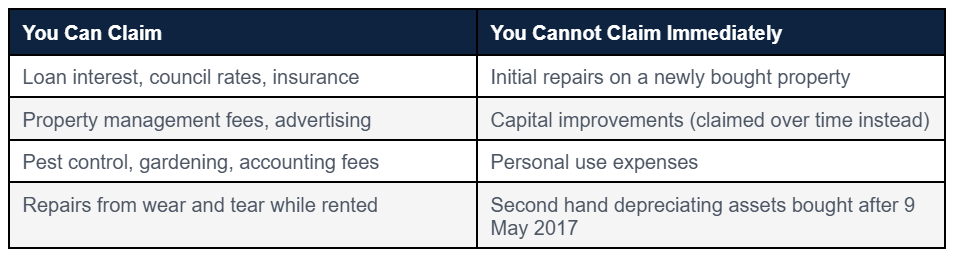
The ATO splits rental property expenses into three groups: those you claim immediately, those you claim over several years, and those you cannot claim at all. Getting an expense into the wrong group is one of the fastest ways to under claim, or to trigger a closer look at your return. See the ATO's guidance on how to claim rental expenses.
Loan interest, property management fees, council and water rates, insurance premiums, and advertising for tenants are all deductible in the year you pay them. Pest control, gardening, body corporate fees, accounting fees, and repairs that relate to genuine wear and tear from renting the property sit in the same immediate category.
Borrowing expenses behave differently to almost everything else on this list. If they total more than one hundred dollars, the ATO requires you to spread them over five years or the loan term, whichever is shorter, a detail that shapes how you think about how to increase your borrowing capacity for your next purchase.
How Does Investment Property Depreciation Work?
Depreciation splits into two categories that are easy to confuse. Capital works cover the building's structure, and plant and equipment cover removable items such as blinds, hot water systems, and carpets.
For most residential properties built after 15 September 1987, capital works are claimed at 2.5 percent of the original construction cost every year for 40 years. On a property with a $350,000 construction cost, that works out to roughly $8,750 a year, without spending another dollar once the building exists.
Plant and equipment purchased new can also be depreciated over its effective life, though secondhand items bought after 9 May 2017 generally cannot be claimed at all. A depreciation schedule from a quantity surveyor is usually the single document that captures both categories properly.
FOR EXAMPLE
An investor buys a townhouse with a $320,000 construction cost. A quantity surveyor's depreciation schedule adds around $8,000 a year in capital works deductions alone, on top of a plant and equipment schedule, turning a marginally negative cash flow property into one close to break even after tax.
Where a Typical Investor's Annual Deductions Come From
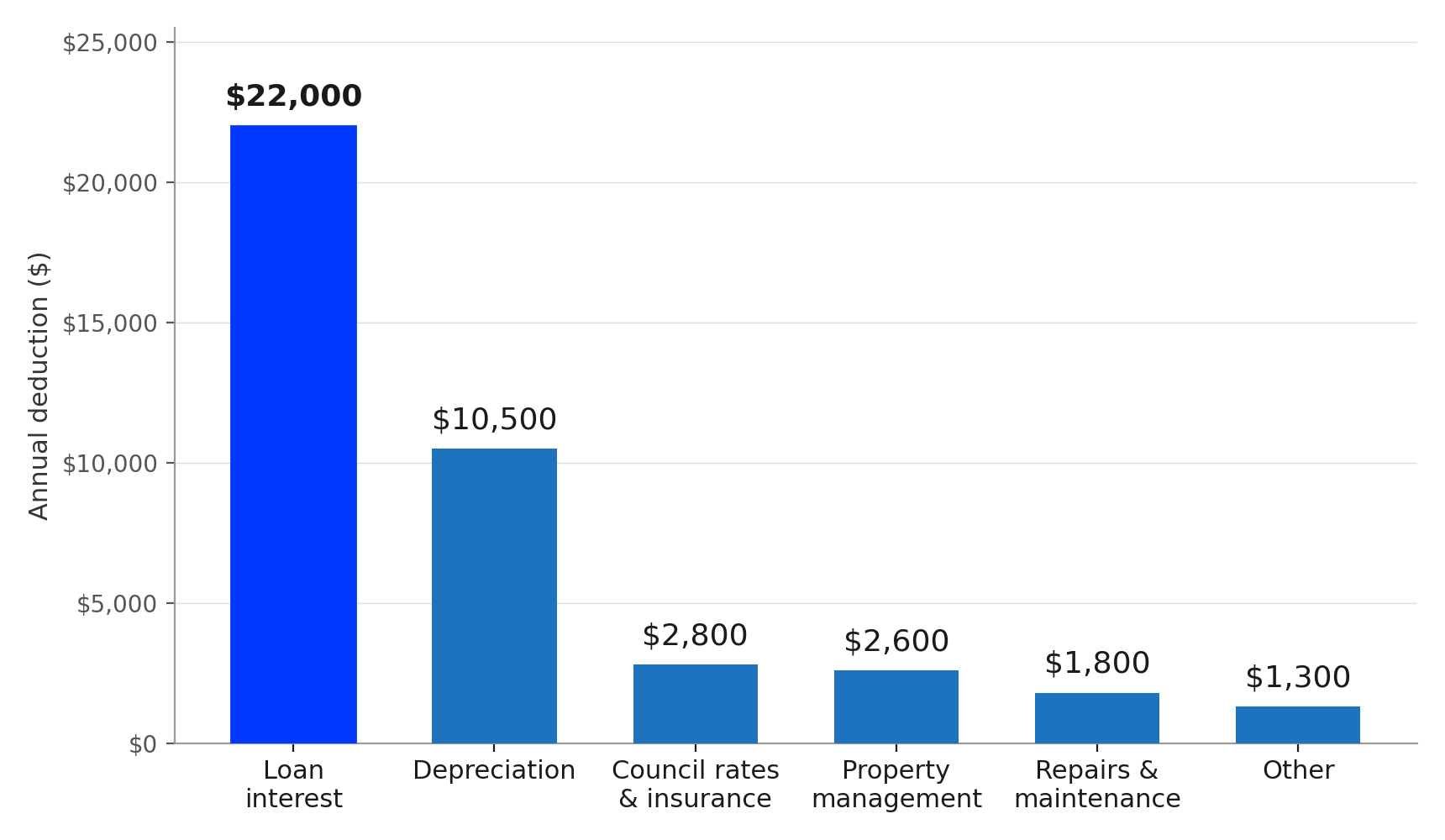
Source: ATO, Rental properties guide 2025. Figures shown are an indicative example only.
Repairs vs Improvements: Where the ATO Draws the Line
A repair restores something to its original condition and is deductible immediately. An improvement makes something better than it was, or adds something new, and must be depreciated over time instead.
Replacing a broken tap washer is a repair. Replacing an entire kitchen with higher spec finishes is an improvement, even if the old kitchen was also broken, and the distinction decides whether the cost is claimed in full this year or in fractions over decades.
Capital Works Deduction: How a $15,000 Improvement Is Claimed Over Time
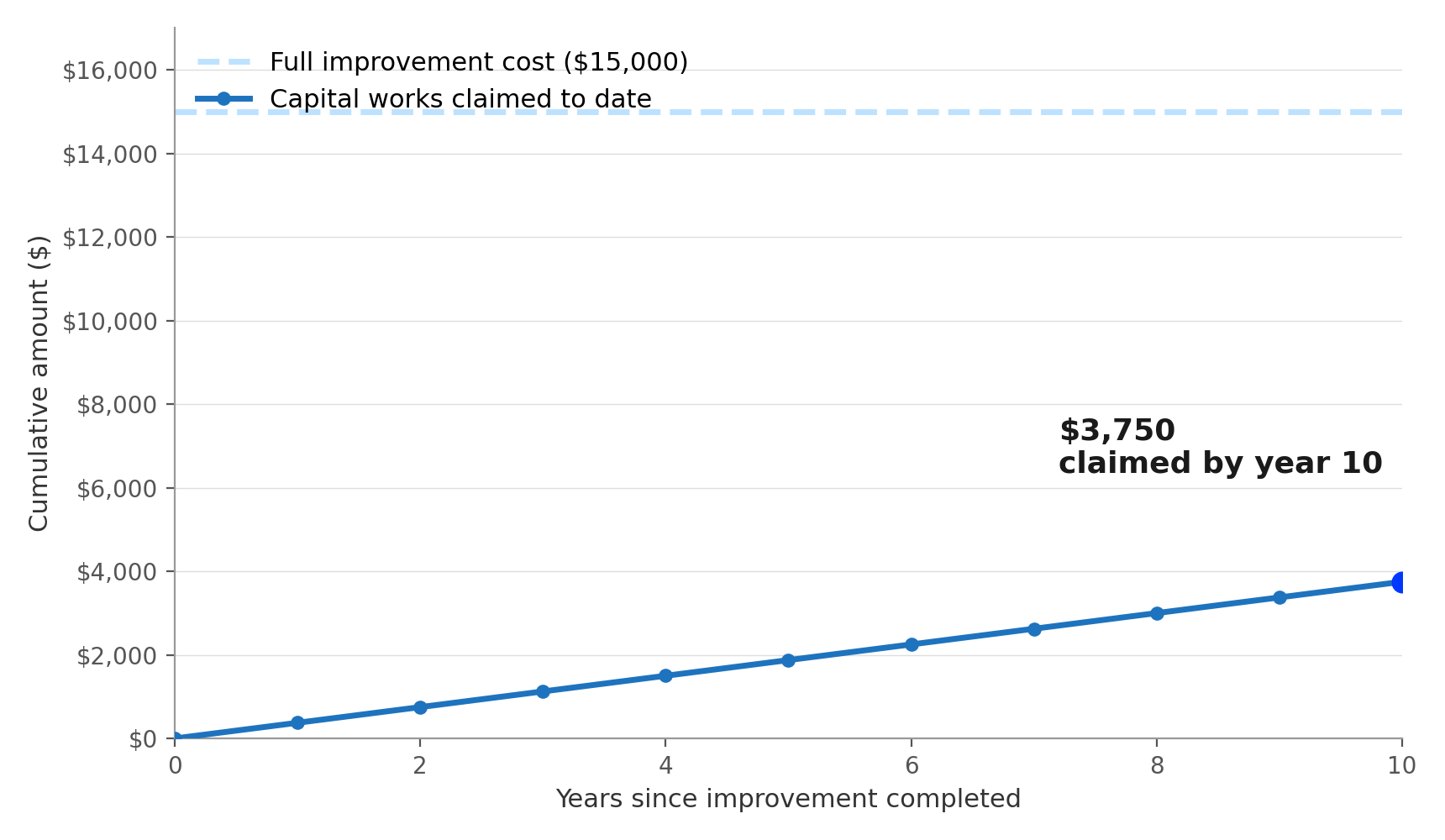
Source: ATO, Work out your capital works deductions, 2026.
The Investment Property Tax Write Offs Investors Consistently Miss
Borrowing expenses are the most missed deduction, mostly because investors assume loan costs are fully covered by claiming interest alone. Establishment fees, valuation fees, and lenders mortgage insurance are all separately deductible over five years or the loan term.
Poor record keeping is the second biggest cost, and it shows up most often among Australians who become accidental landlords rather than planning for one. Without receipts and a depreciation schedule on hand, many investors simply stop claiming items they cannot immediately locate proof for.
Mixing personal and investment expenses on a property with any period of private use is the third common gap, alongside a handful of mistakes first time investors tend to repeat every tax season. It usually understates deductions rather than overstates them, since most investors under claim out of caution rather than risk getting it wrong.
Common Investment Property Tax Mistakes That Cost Investors
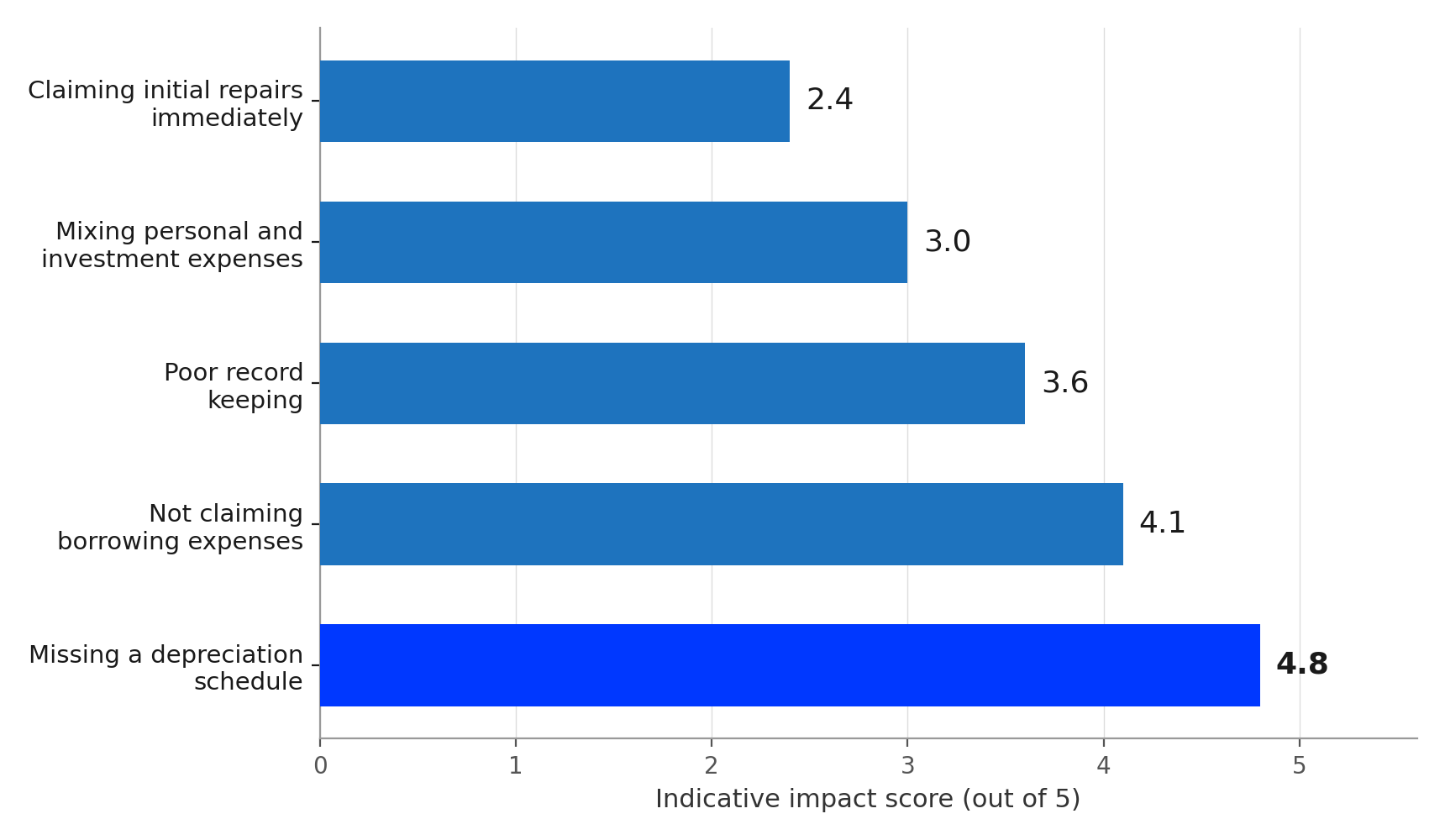
Source: ATO, Rental expenses guidance, 2025. Ranking reflects indicative frequency and impact based on common investor errors.
How Tax Write Offs Improve Cash Flow and Borrowing Power
Every dollar correctly claimed lowers taxable income, which improves after tax cash flow on the property. Lenders assess serviceability using your net rental position, so a well optimised return can genuinely strengthen the numbers behind a debt to income ratio calculator result for your next application.
This is where tax planning stops being a compliance exercise and starts becoming a portfolio strategy. An investor who claims every legitimate deduction each year effectively self-funds part of their next deposit through improved cash flow, rather than through additional savings alone, which matters most when weighing up yield versus growth for the next purchase.
None of this replaces a conversation with a mortgage broker who can see how your improved position translates into borrowing capacity. The two conversations, tax and lending, work best when they happen together rather than months apart.
Final Thoughts
Investment property tax write-offs cover far more ground than loan interest and management fees alone. Depreciation, borrowing expenses, and the line between a repair and an improvement are where investors either capture or lose real money every year.
The investors who benefit most treat their return as an annual audit of the property itself, not a once-a-year form filling exercise. A depreciation schedule, clean records, and a clear sense of which bucket each expense belongs in are usually worth more than any single deduction on its own.
None of this replaces advice from a registered tax agent, but understanding the categories means fewer surprises and fewer missed claims when tax time arrives.
Frequently Asked Questions
Recommended Reading
Two pages selected based on what readers of this article are most likely to need next.
Recommended Video
As of April 2026, Treasury is actively modelling potential changes ahead of the May Budget. This isn’t speculation—it’s confirmed. In this video, we unpack exactly what’s being proposed, who stands to benefit, who could be impacted, and what it could mean for investors, renters, and first home buyers across Australia.