

Mortgage Serviceability: How Lenders Assess Your Ability to Repay a Home Loan
You sit down with a lender expecting one number. The figure that comes back is tens of thousands lower. Same income and savings, but completely different borrowing ceiling. The reason almost always traces back to a single concept: mortgage serviceability.
It is the framework every Australian lender uses to decide whether you can afford to repay a home loan, and it explains far more about your borrowing power than your salary alone ever will. Understanding how it works is not optional for serious investors. It is the difference between a strategy that scales and one that stalls.
And if you want to know how your debt to income ratio feeds into this calculation, that matters more than most borrowers expect going in.
What Is Mortgage Serviceability?
Mortgage serviceability is a lender's assessment of whether you can comfortably meet your loan repayments alongside your other financial commitments. In plain terms, it answers one question: after living costs, existing debts and tax, do you have enough left over to cover the repayments on the loan you are asking for?
Home loan serviceability and serviceability assessment are the same idea in slightly different language. Both refer to the same calculation.
Mortgage Serviceability vs Borrowing Capacity
These two terms are linked but not identical. Serviceability is the test. Borrowing capacity is the result. Serviceability measures your surplus income against assessed repayments. Borrowing capacity is the largest loan that surplus can support.
Strengthen one and you move the other. Before you make an offer, a home loan pre approval turns that theoretical capacity into a figure you can rely on.
Why Lenders Run Serviceability Assessments
Australian lenders are required by law to lend responsibly. A serviceability assessment is how they demonstrate a borrower can repay without falling into financial hardship, even if circumstances change. It protects the borrower from over-committing. It also protects the lender from default.
How Mortgage Serviceability Is Calculated
Lenders build serviceability from three inputs: your assessable income, your living expenses, and your existing debt obligations. Income is rarely taken at face value. Overtime, bonuses, rental income, and self-employed earnings are often shaded, meaning the lender counts only a portion of what you declare.
Living expenses are measured against your declared spending or a benchmark figure, whichever is higher. Existing commitments, from car loans to credit card limits, are subtracted from whatever remains.
The Serviceability Buffer: Why Your Assessed Rate Is Not Your Actual Rate
One thing that catches borrowers off-guard is this: Lenders do not assess you at the actual interest rate on your loan.
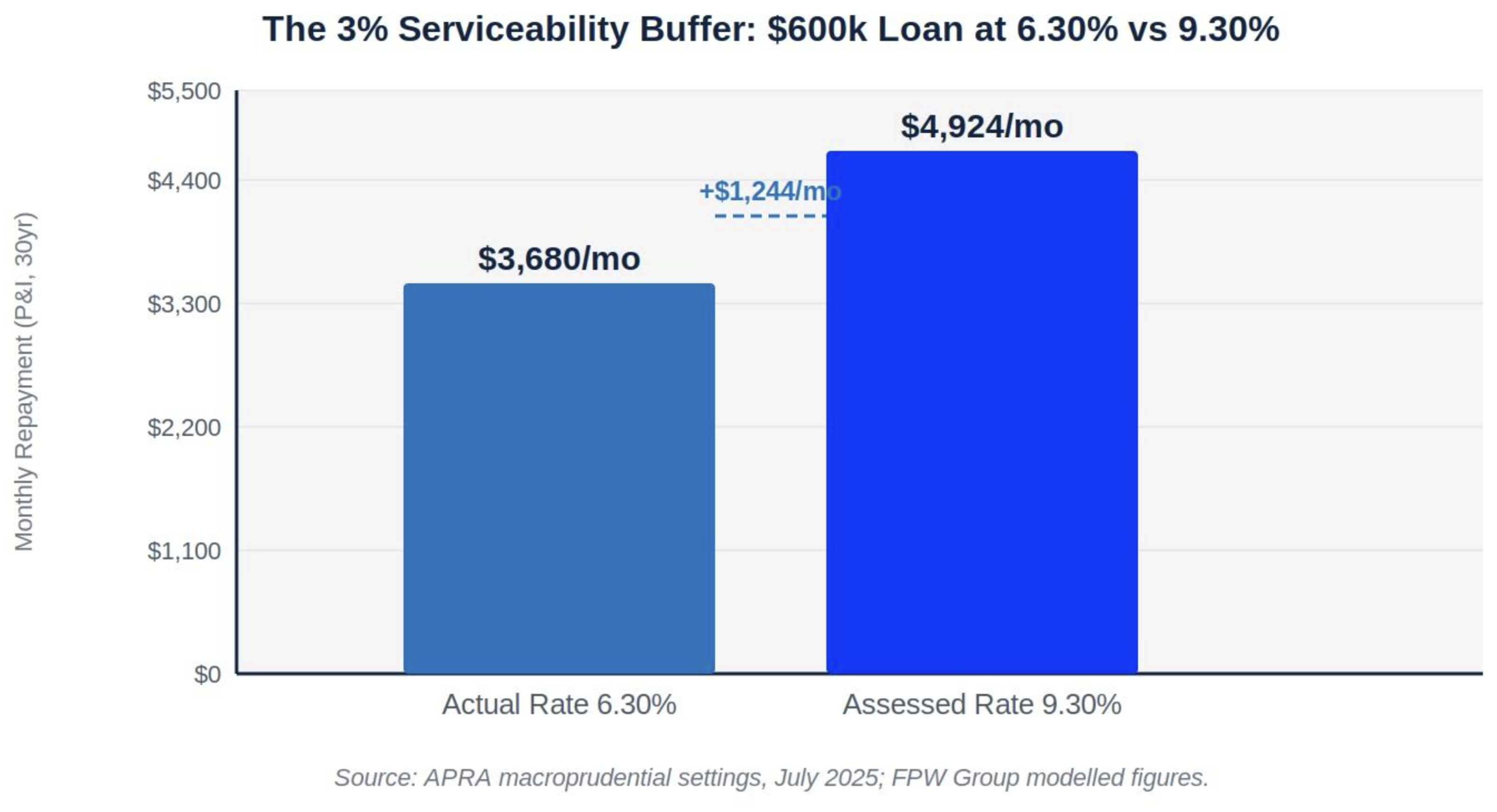
Under APRA rules, lenders must apply a serviceability buffer of at least 3 percentage points above the product rate. APRA confirmed in July 2025 that this buffer would remain at 3 percentage points. So a loan advertised at 6.30% is stress tested as if it were 9.30%.
That single rule is why your assessed repayment sits well above what you would actually pay each month. The buffer was not designed to be theoretical. For many borrowers, this is the point where the numbers stop feeling abstract.
The 3% Serviceability Buffer Applied to a $600,000 Loan
Source: APRA macroprudential settings, July 2025; FPW Group modelled figures.
What Factors Affect Mortgage Serviceability?
Beyond the buffer, several personal factors move your assessment up or down. Employment type matters a lot. Permanent salaried income is treated more favourably than casual, contract or newly self-employed income.
Household expenses reduce your surplus income directly. Each dependent raises the assumed cost of running your household. But debts are where it gets more nuanced.
How Debts Are Counted, and Why They Differ
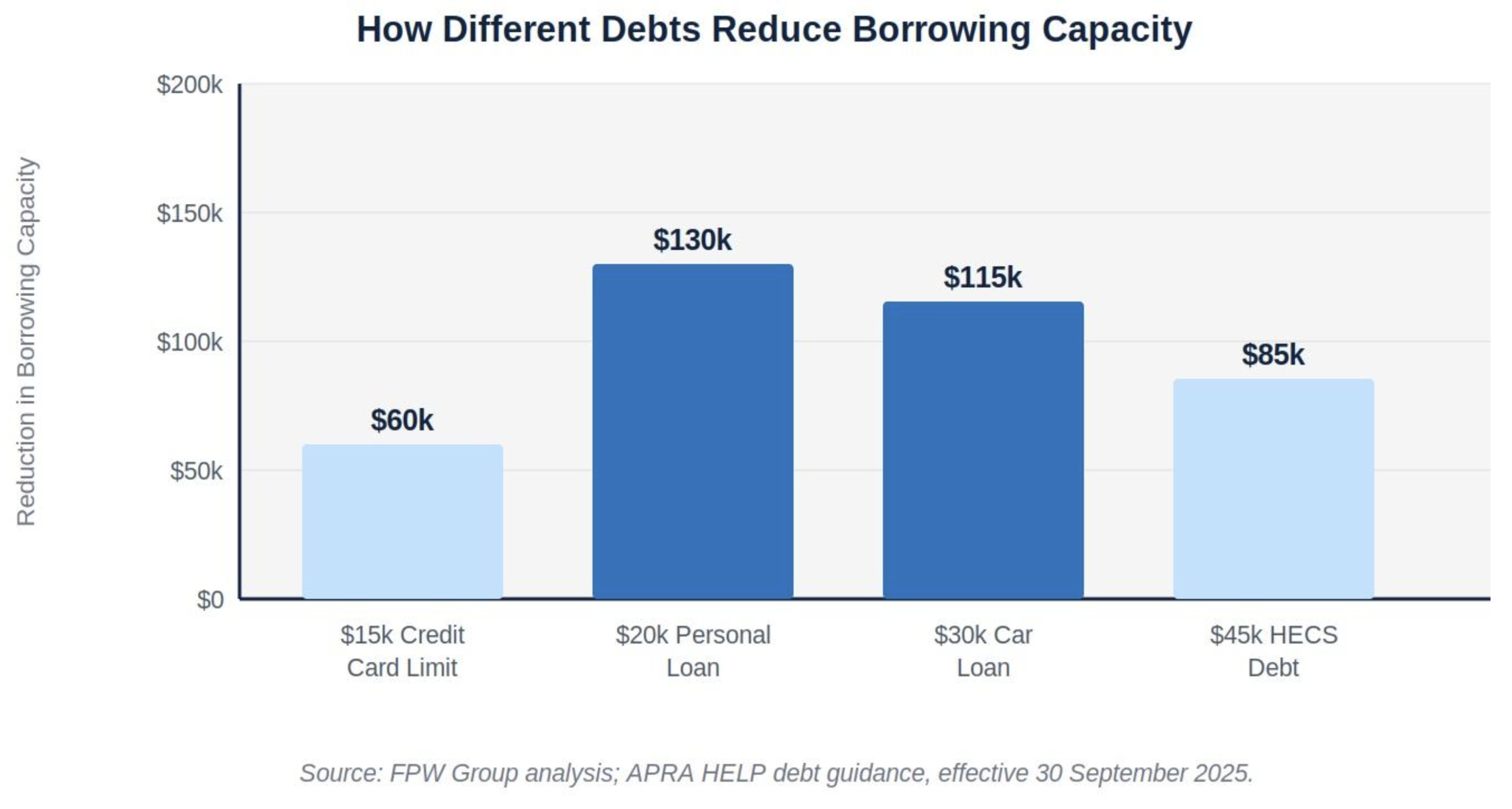
Credit cards are assessed on the limit, not the balance. A barely used $15,000 card still counts as if you are repaying $450 a month. Personal and car loans are assessed on their required repayments. HECS or HELP debt works differently again.
From 30 September 2025, following APRA's finalised HELP debt guidance, banks must exclude HELP balances from reported debt to income ratio calculator figures. Some lenders may now disregard HECS repayments entirely where the debt is close to being cleared.
How Different Debts Reduce Borrowing Capacity
FOR EXAMPLE
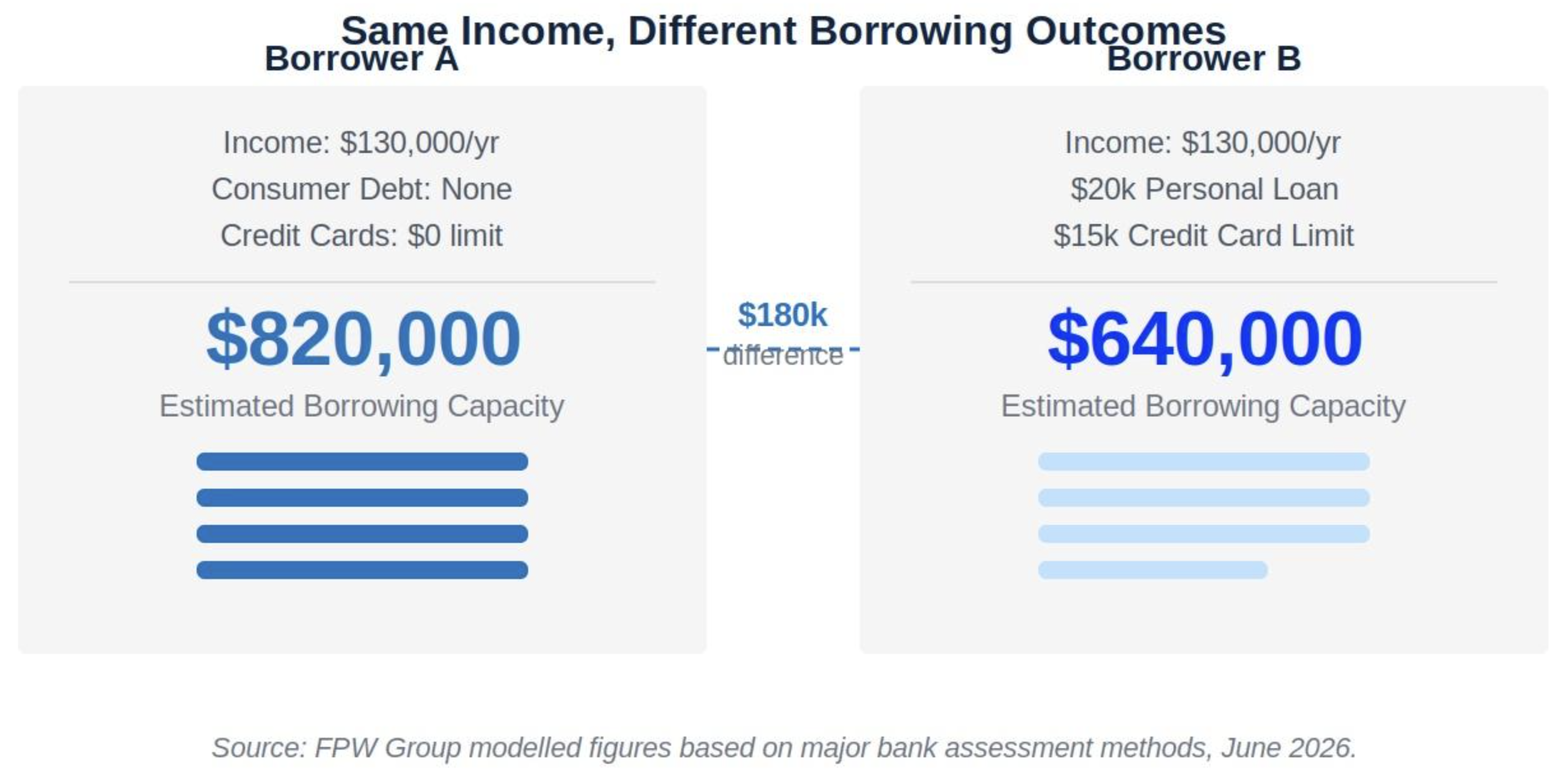
Two borrowers, both earning $130,000 a year. Borrower A has no consumer debt. Borrower B has a $20,000 personal loan and a $15,000 credit card limit.
Borrower A may borrow up to $820,000. Borrower B, with the same income, is assessed at around $640,000. The same salary. A $180,000 difference. That is entirely a debt structure problem, not an income problem.
Why Mortgage Serviceability Affects Borrowing Capacity
Income gets the attention. But income alone never decides your borrowing limit. Two people on the same salary can receive very different loan offers once debts, expenses, and commitments are layered in.
Serviceability is the bridge between what you earn and what you can borrow. And the debt to income ratio is the lever that often matters most in that calculation.
Same Income, Different Borrowing Outcomes
This is also why one bank can say yes while another says no on the same application. The logic behind how to increase borrowing capacity often comes down to knowing which variables each lender weighs most heavily.
Why Different Lenders Produce Different Results
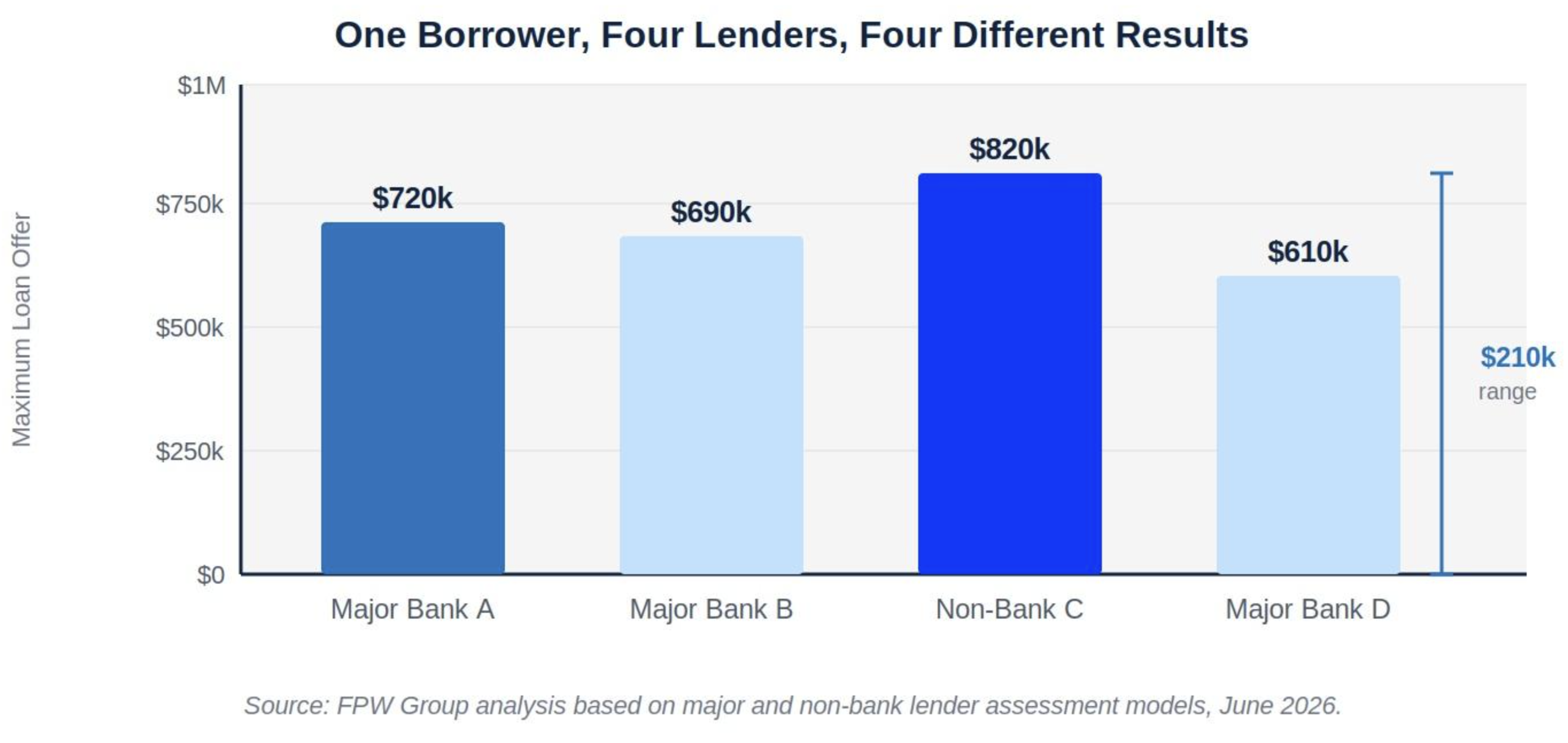
No two lenders assess a borrower the same way. They use different living expense models, different assessment rates, different income shading rules, and different risk tolerances. Major banks tend to apply more conservative expense benchmarks. Some non-bank and specialist lenders take a more flexible view of certain income types.
From February 2026, APRA introduced a cap limiting banks to no more than 20% of new loans going to borrowers with a debt-to-income ratio above six times. That tightens high-DTI lending across the board. But it does not affect every lender equally, which means lender selection has never mattered more.
One Borrower, Four Lenders, Four Different Results
How to Improve Mortgage Serviceability
You have more control over your serviceability than most borrowers realise. The highest-impact moves are usually straightforward, but timing matters.
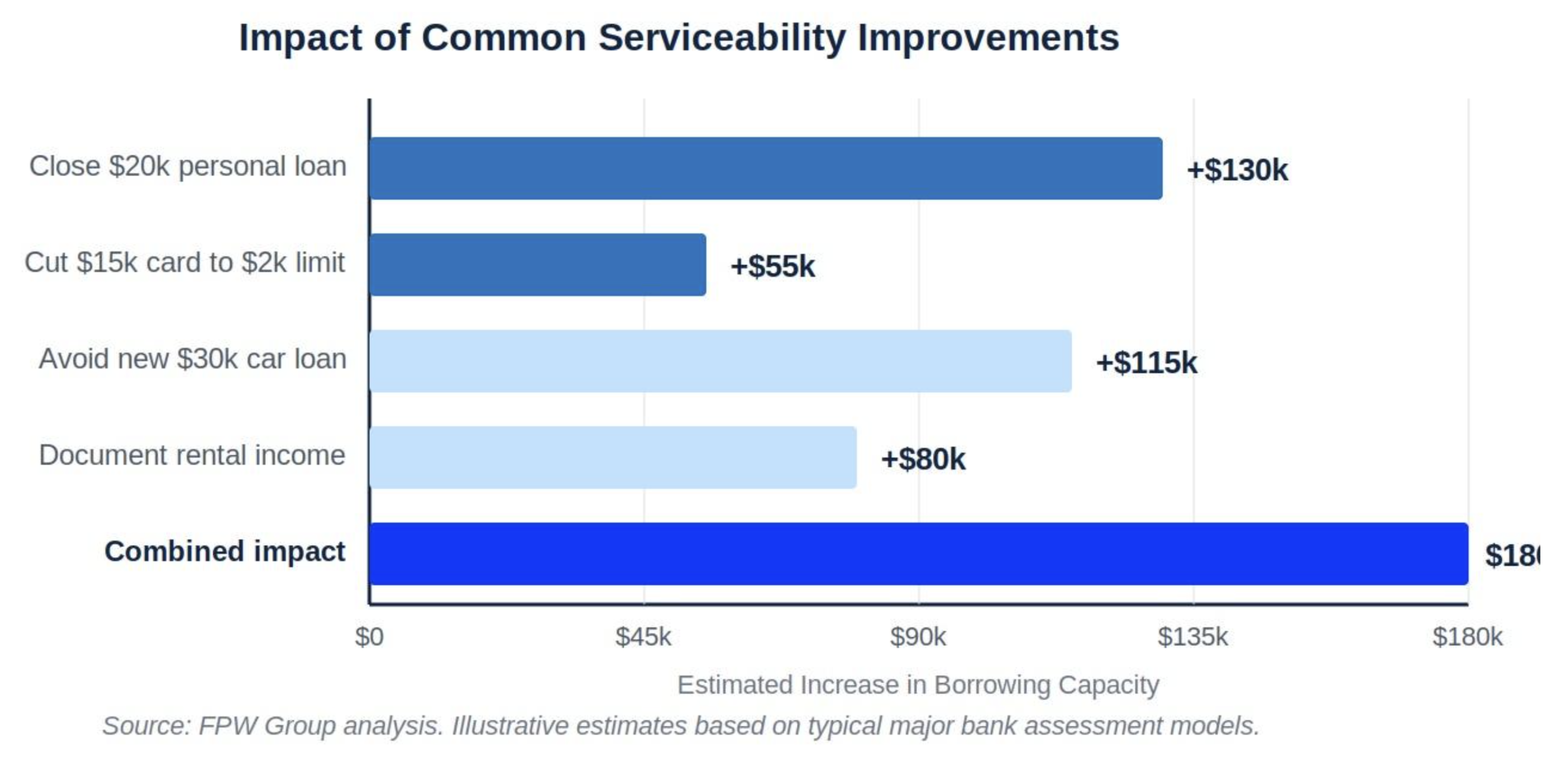
Reduce unsecured debt. Paying down or closing personal loans removes a fixed repayment from the assessment entirely.
Lower your credit card limits. Because cards are assessed on the limit, cutting an unused $20,000 card to $5,000 can add tens of thousands back to your maximum loan.
Increase assessable income. Stable, documented income strengthens the result. A longer track record on variable or rental earnings helps significantly.
Delay unnecessary borrowing. A new car loan or buy-now-pay-later facility signed weeks before settlement can sink an otherwise solid application.
Review your lender options. A stronger deposit and the right lender match can shift the outcome independently of anything else.
For investors using existing properties to expand, the same principles apply when you refinance an investment property to release equity.
If you are building a portfolio and want to understand how finance sequencing affects your ability to buy the next property, the framework behind equity property investment is worth understanding before you commit to a structure.
Impact of Common Serviceability Improvements
Common Mistakes That Hurt Mortgage Serviceability
A few avoidable errors show up repeatedly in applications that get knocked back or come in lower than expected.
Understating living expenses. Lenders verify spending against bank statements and benchmark figures. Unrealistic declarations get corrected upward, and it creates a credibility problem.
Taking on new debt before applying. A car loan or buy-now-pay-later account opened in the weeks before settlement can materially reduce your approved amount. The timing matters more than people expect.
Assuming every lender assesses the same way. A decline from one institution is not a universal verdict. The same application, structured differently and presented to the right lender, can pass.
For investors who have already made a purchase and are trying to understand why the second one is proving harder, the mechanics of buying a second property involve a completely different borrowing dynamic than the first.
Final Thoughts
Mortgage serviceability is not just a compliance exercise lenders run. It is the primary constraint on what most Australians can borrow, and it moves based on factors well within a borrower's control.
Income matters. But debt structure, credit card limits, and the choice of lender can collectively shift your borrowing capacity by hundreds of thousands of dollars independently of what you earn. That is worth understanding before you make any offer.
If your borrowing capacity has come in lower than expected, the first question is not 'how do I earn more?' It is 'how is my debt currently being counted, and which lender is likely to count it most favourably?'
Frequently Asked Questions
Recommended Reading
Two pages selected based on what readers of this article are most likely to need next.
Recommended Video
As rates rise, many people immediately assume it is no longer a good time to invest. But in reality, the opportunity has not disappeared, it has simply shifted. This episode explains why higher interest rates do not automatically remove your ability to invest, but they do change your borrowing power, your cash flow, and the price point that makes sense for you.