

The Two-Hour Rule: How Far from a Capital City Should Property Investors Buy?

The best property investment in Australia is not determined by how far the property sits from a capital city. It is determined by whether the market has the fundamentals to sustain demand: population growth, employment diversity, rental demand, and infrastructure investment that creates durable value over time.
The two-hour rule is one of the most repeated pieces of shorthand in Australian property circles, but it misses the more important question: not how far, but why the location works. Understanding property investment in Australia means understanding that distance is a filter, not a thesis.
What Is the Two-Hour Rule in Property Investment?
The two-hour rule emerged as a practical heuristic for investors navigating regional markets outside the major capitals. The underlying logic is that property within a two-hour drive of a capital city remains connected to the employment and economic engine of that city, supporting buyer demand, liquidity, and price stability across the market cycle.
It became popular when capital city prices ran ahead of investor affordability, pushing buyers into regional markets. The rule offered a rough boundary: far enough to find affordable entry points, close enough to stay connected to a major economy. In practice, it homogenises markets that are actually very different from each other.
Why Two Hours Should Be Treated as a Guideline, Not a Rule
Two hours of travel time can encompass radically different markets. A satellite city one hour from Brisbane may have stronger population growth, more diversified employment, and tighter vacancy rates than a smaller town two hours away with none of those characteristics. Physical distance and economic connectivity are not the same thing.
Economic connectivity, the degree to which a location participates in a major economy's employment and service ecosystem, is a better predictor of property performance than travel time. Reviewing how to choose investment grade suburbs gives investors a more reliable framework than any distance rule alone.
How Far Should Investors Really Buy from a Capital City?
The more useful framework is to think about location in tiers rather than a binary of inside or outside a two-hour boundary. Each tier carries a different profile of risk, return, and liquidity.
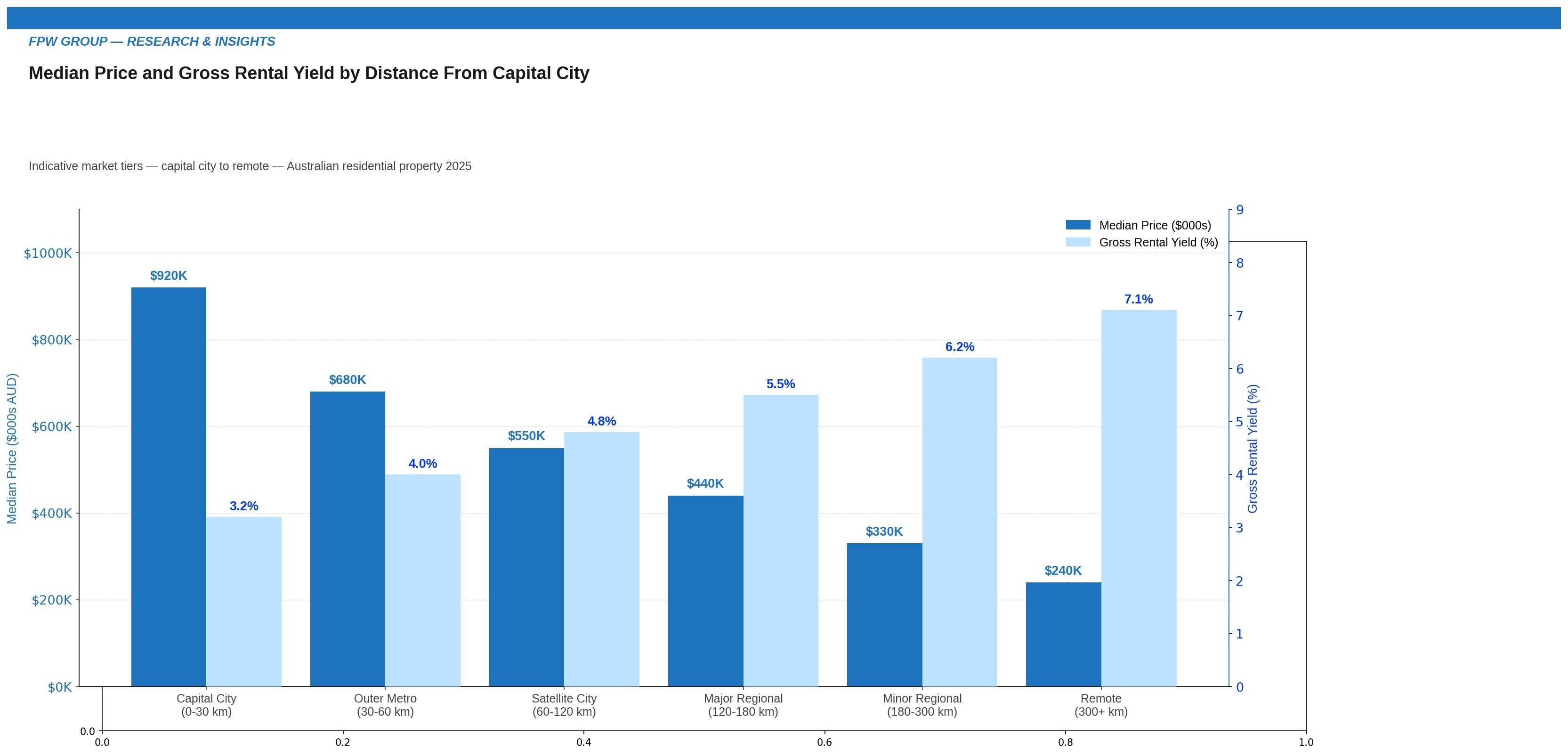
Median Price and Gross Rental Yield by Distance from Capital City
Source: CoreLogic, 2025; PropTrack Regional Market Report, 2025.
Capital city markets offer the deepest buyer pools and strongest long-term capital growth, but entry prices are high and rental yields are typically the lowest of any tier. Outer metro markets, 30 to 60 km from the CBD, combine reasonable access to employment centres with lower entry points and slightly stronger yields.
Satellite cities within 60 to 120 km represent the area where the two-hour rule most consistently adds value. These markets tend to benefit from capital city economic connectivity while offering genuinely different price points. Major regional centres, 120 to 180 km out, can outperform on yield and sometimes on population growth, but liquidity begins to thin beyond that tier.
Physical Distance vs Economic Distance
A town 150 km from Sydney that has a major employer, a hospital, a university, and growing residential demand is economically closer to a functioning property market than a town 90 km away with none of those drivers. The distinction investors miss is the difference between being physically close to a capital city and being economically connected to one.
What Makes a Location One of the Best Property Investments in Australia?
The best property investment areas in Australia share a common set of fundamentals that have nothing to do with distance and everything to do with the conditions that create durable property demand across the cycle.
Population Growth and Future Housing Demand
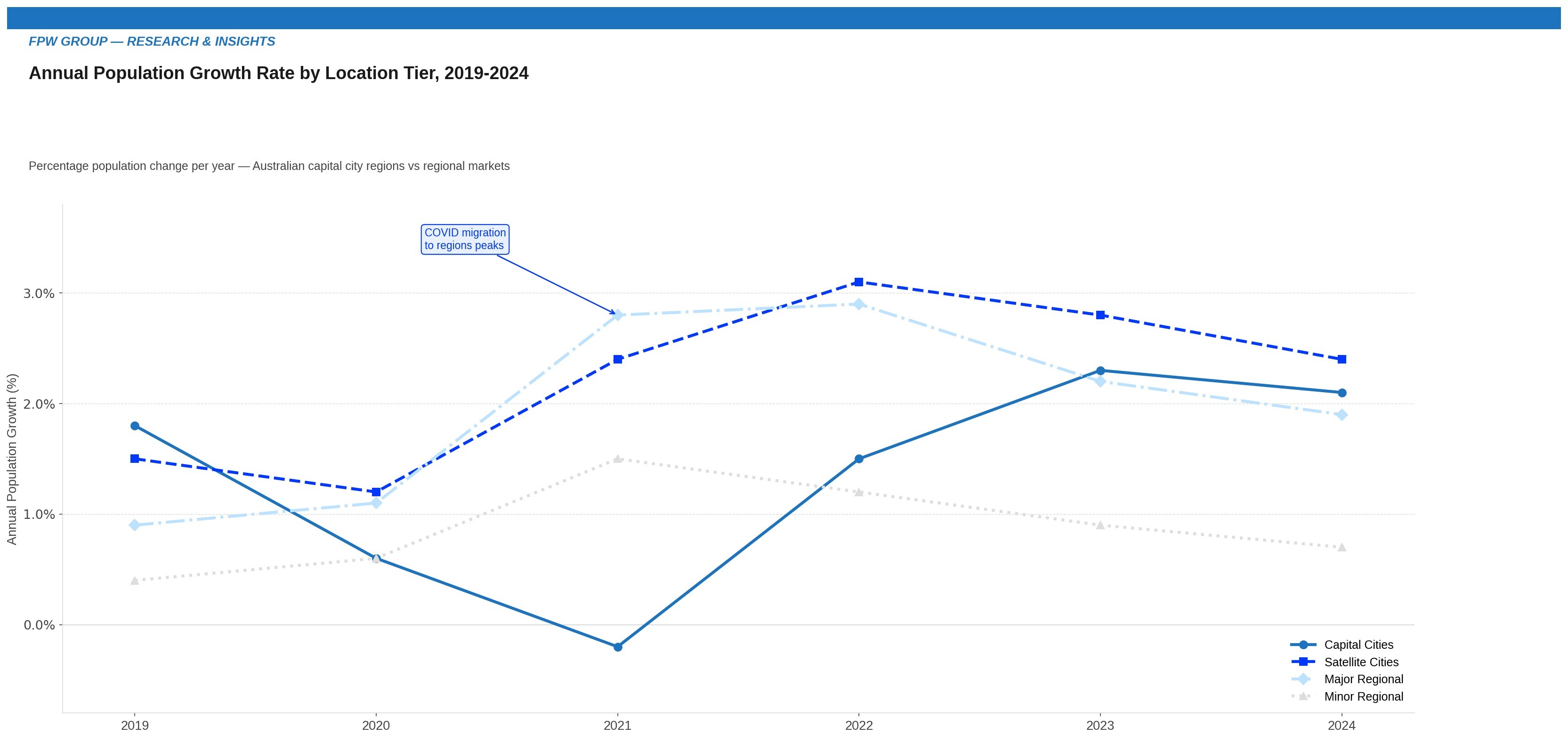
ABS Regional Population Statistics 2024 show that satellite cities and major regional centres recorded the fastest population growth rates of any market tier between 2020 and 2024. Remote work adoption and lifestyle migration drove this shift. The structural demand it created is ongoing and has not reversed with the partial return to offices.
Annual Population Growth Rate by Location Tier, 2019-2024
Source: ABS Regional Population Statistics, 2024.
Employment and Economic Diversity
Markets reliant on a single employer or industry carry structural risk that no price or yield level adequately compensates. When the dominant employer contracts, property demand collapses with it. The best property investment locations have diversified local economies: healthcare, education, government services, logistics, and growing professional services.
Infrastructure and Connectivity
Infrastructure investment is one of the strongest leading indicators of property market performance. Road upgrades, rail extensions, hospital builds, and university campuses create sustained employment and attract population. A property in a market currently receiving major infrastructure funding sits in a structurally better position than one where that capital has already been deployed and priced in.
Rental Demand and Vacancy Rates
PropTrack's 2025 Regional Market Report recorded national residential vacancy rates at 1.1 percent as of mid-2025, with regional markets tracking tighter in many areas. The rental crisis in Australia is not uniform. Some regional markets have vacancy rates below 0.5 percent, which translates directly to landlord pricing power and capital protection for investors.
Does Being Within Two Hours Actually Improve Investment Potential?
The honest answer is: sometimes. The two-hour boundary correlates with better liquidity and buyer depth because more buyers can physically access the market for inspections and purchases. That correlation is real but incomplete.
When Distance Works in Investors' Favour
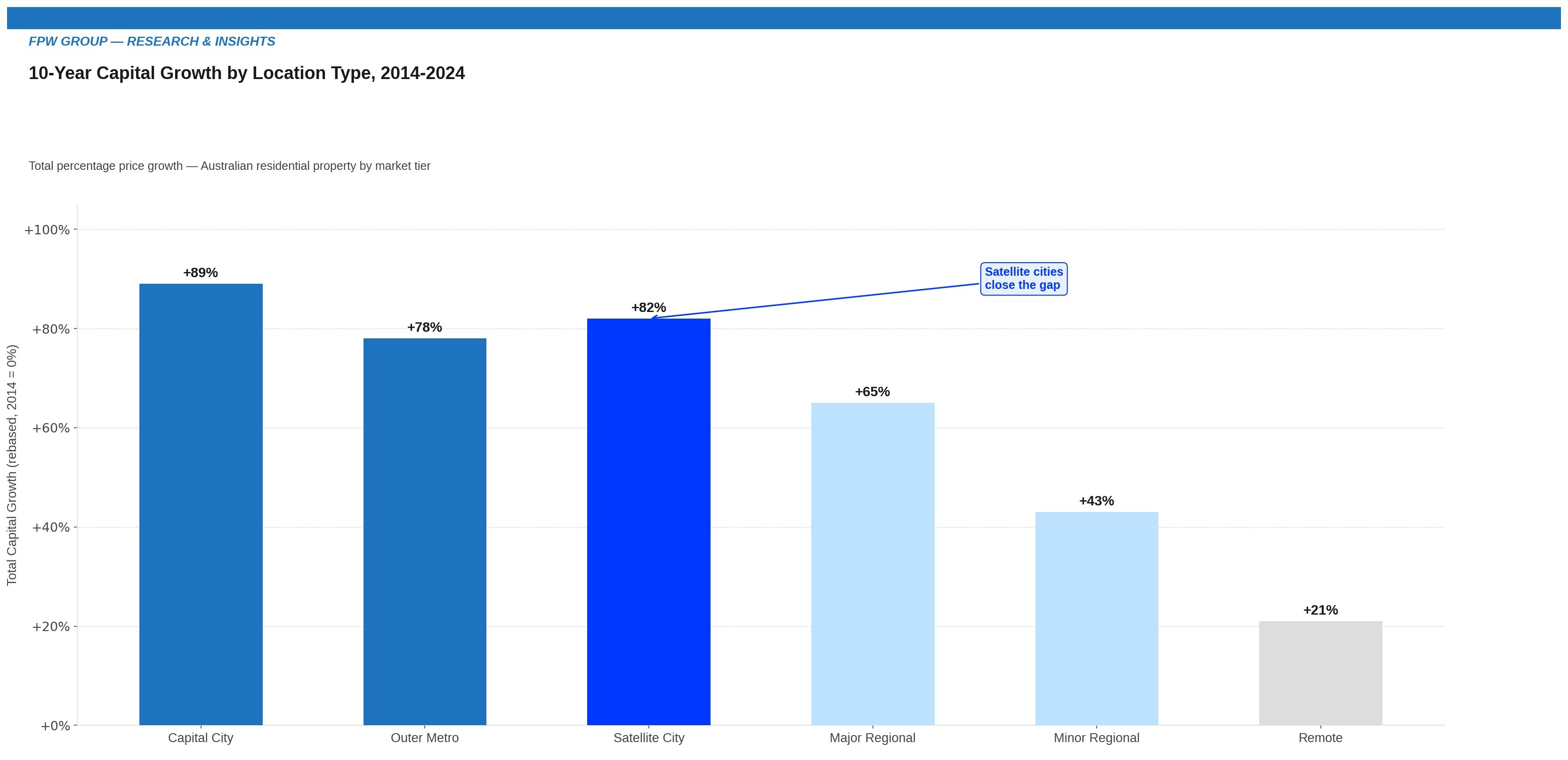
Major satellite cities that have developed their own employment base often outperform smaller markets closer to the capital. Geelong relative to Melbourne, Wollongong relative to Sydney, and Ipswich relative to Brisbane have demonstrated that proximity to a capital city, combined with independent local economic drivers, can produce strong capital growth and rental returns simultaneously.
10-Year Capital Growth by Location Type, 2014-2024
Source: CoreLogic Home Value Index, 2024; ABS Regional Statistics, 2024.
When Distance Becomes a Disadvantage
The further a market sits from a capital city, the thinner the buyer pool becomes. In a downturn, this becomes a serious problem. A capital city property facing reduced demand still has a substantial pool of buyers at lower price points. A remote market facing the same headwind may have only a handful of active buyers, which means prices can fall sharply and stay down for extended periods.
Capital City vs Regional Property: Which Offers the Better Investment?
This is the wrong question. The better question is: does this specific property, in this specific location, have the fundamentals to deliver the return I need, given my borrowing position and investment strategy?

Capital City Advantages
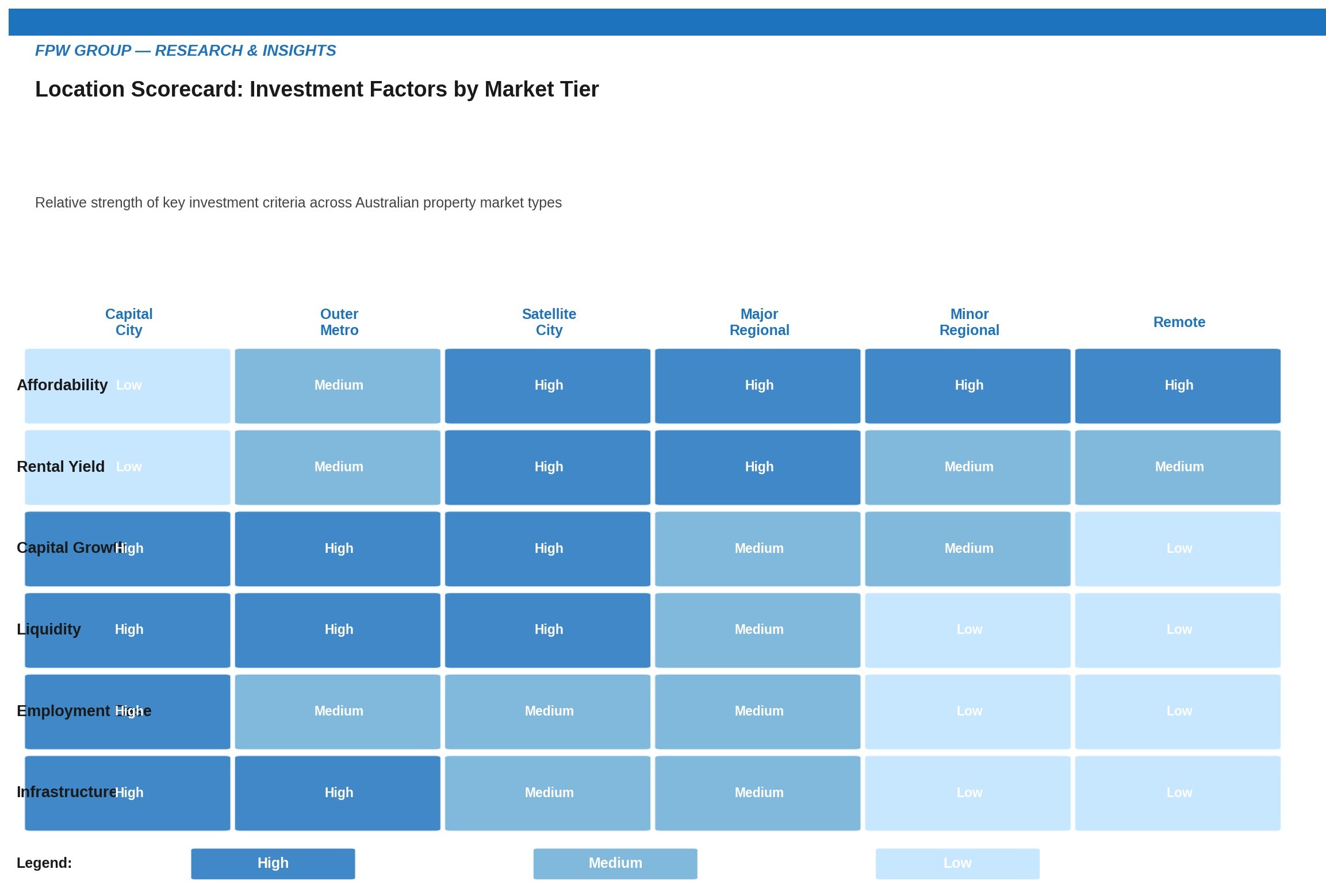
Capital city markets offer the deepest buyer pools, the highest transaction volumes, and the strongest long-term track records of capital growth. CoreLogic data shows Sydney and Melbourne produced the highest compound annual growth rates of any market tier over 30-year periods. Liquidity in a downturn is materially better. Entry prices are high, yields are lower, and competition for quality stock is persistent.
Regional Market Advantages
Regional markets offer lower entry prices, stronger gross rental yields, and in many cases faster population growth in the current cycle. The supply pipeline in many regional centres is constrained, which creates structural support for both rents and prices. Affordability is genuinely better, which opens the market to a broader pool of tenants and potential future buyers.
Location Scorecard: Investment Factors by Market Tier
Source: FPW Group analysis; CoreLogic, 2025; PropTrack, 2025.
Why Market Fundamentals Matter More Than the Two-Hour Rule
The framework that consistently outperforms the two-hour rule is the same one used by institutional investors: assess the market on population growth, employment diversity, infrastructure investment, vacancy rates, and supply pipeline before assessing any individual property. Understanding yield vs growth in a balanced property portfolio is the investor-level question that sits underneath the location question.
How to Apply the Two-Hour Rule When Choosing a Property Investment Location
The two-hour rule is most useful as Step 1 of a location assessment, not as a standalone decision. Here is how to use it properly.
Step 1: Identify the Capital City Connection
Map the location relative to its nearest major capital city. Note both distance and travel time, since road quality varies significantly. Then assess economic connectivity: do residents commute to the capital, do major regional employers serve the capital's economy, and does the infrastructure pipeline connect to capital city networks?
Step 2: Test Population and Employment Growth
Use ABS Regional Population Statistics to check 5-year and 10-year growth trends. Cross-reference with employment data. A location growing by more than 1.5 percent per year with diversified employment is structurally different from one with flat population and a dominant single employer.
Step 3: Check Rental Demand and Vacancy
PropTrack and REIA publish vacancy rate data by region and suburb. Sustained vacancy below 1.5 percent indicates genuine supply-demand tension. Review the 12-month trend, not just the current rate. A market moving from 2 percent to 1 percent vacancy is more attractive than one sitting at 1.2 percent with rising new supply hitting the market.
Step 4: Assess Infrastructure and Accessibility
Check state and federal infrastructure announcements for road, rail, health, and education projects. Infrastructure funding is a leading indicator, not a lagging one. Locations currently receiving investment sit in a structurally better position than those where the investment cycle has already peaked. Your borrowing capacity formula determines what you can access, but market fundamentals determine what is worth accessing.
Step 5: Examine Supply and Future Development
A tight rental market created by constrained supply is a different investment proposition from one where tightness is temporary and a wave of new supply is already approved. Check DA approvals, ABS building approvals data, and local council planning amendments. Excess supply entering a market reverses yield and price expectations faster than most investors anticipate.
Step 6: Compare the Numbers Against the Purchase Price
Run the actual numbers: gross yield, net yield after costs, estimated capital growth based on suburb fundamentals, and total holding costs against your borrowing position. The best property investment opportunity becomes clear when the location fundamentals are strong enough to justify the price.
Final Thoughts
The two-hour rule is not wrong. It is incomplete. Distance from a capital city is a useful starting filter because it correlates with liquidity, buyer depth, and economic connectivity. But it is a filter, not a decision.
The locations that produce the best property investment returns in Australia are those where population is growing, employment is diversifying, infrastructure is arriving, and supply is not keeping pace with demand.
Satellite cities and well-connected major regional centres often combine those conditions with lower entry prices than the capital. That is not because they are within two hours. It is because they have the fundamentals to sustain demand across a full property cycle. The investors who apply a rigorous framework to location selection, rather than defaulting to a single rule, consistently make better decisions.
Distance is a filter. Fundamentals are the decision.
Frequently Asked Questions
Recommended Reading
Two pages selected based on what readers of this article are most likely to need next.
Recommended Video
Most investors are still positioned in capital cities — but in 2026, that allocation gap is creating real opportunity cost. In a market where timing, positioning, and yield profiles compound into long-term outcomes, that disconnect matters more than most people realize.