

Why Investors Sell at the Worst Possible Time
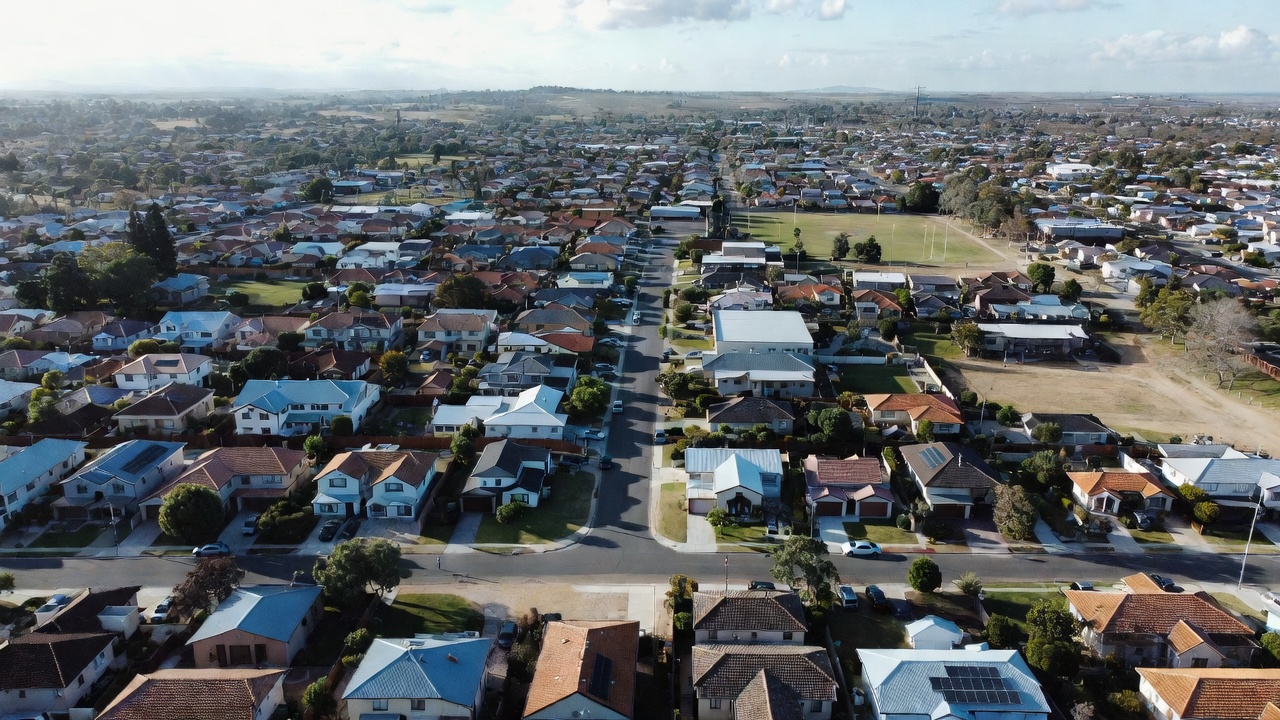
The right time to sell an investment property depends on four things working together: whether the asset has reached its practical growth ceiling, whether cash flow still supports your goals, what selling would trigger for capital gains tax, and whether the same outcome could be achieved by holding or refinancing instead.
There is rarely a single market signal that makes the decision for you.
What makes this hard is that most investors sell for the wrong reasons. Price falls, negative headlines, and rising holding costs create pressure to act, even when the underlying investment case has not changed. Understanding the difference between a temporary problem and a structural one is what separates investors who compound wealth from those who crystalise losses and start again.
Why Investors Sell at the Worst Possible Time
Fear is the most common driver of premature selling. When property prices fall, the instinct is to act. Watching an asset drop in value feels like watching money disappear, even when the rental income is steady, vacancy is low, and the suburb's long-term demand fundamentals remain intact.
The problem is that short-term price movement and investment performance are not the same thing. A property can fall 8 percent in value during a broader market downturn while still generating a strong rental yield and sitting in a suburb where population growth and employment remain solid. Selling that property to avoid further paper losses does not protect capital. It locks in the loss and removes the asset from a recovery that, historically, Australian property markets tend to deliver.
What investors often discover after the fact is that the decision to sell was not driven by analysis. It was driven by anxiety. Anxiety almost always peaks at exactly the wrong moment, near the bottom of the cycle rather than the top.
This is not an argument against ever selling. It is an argument for making the decision deliberately, based on what the data says about your specific property, rather than what the broader market narrative is saying this week.
Australian Property Prices: Every Downturn Has Been Followed by a Full Recovery
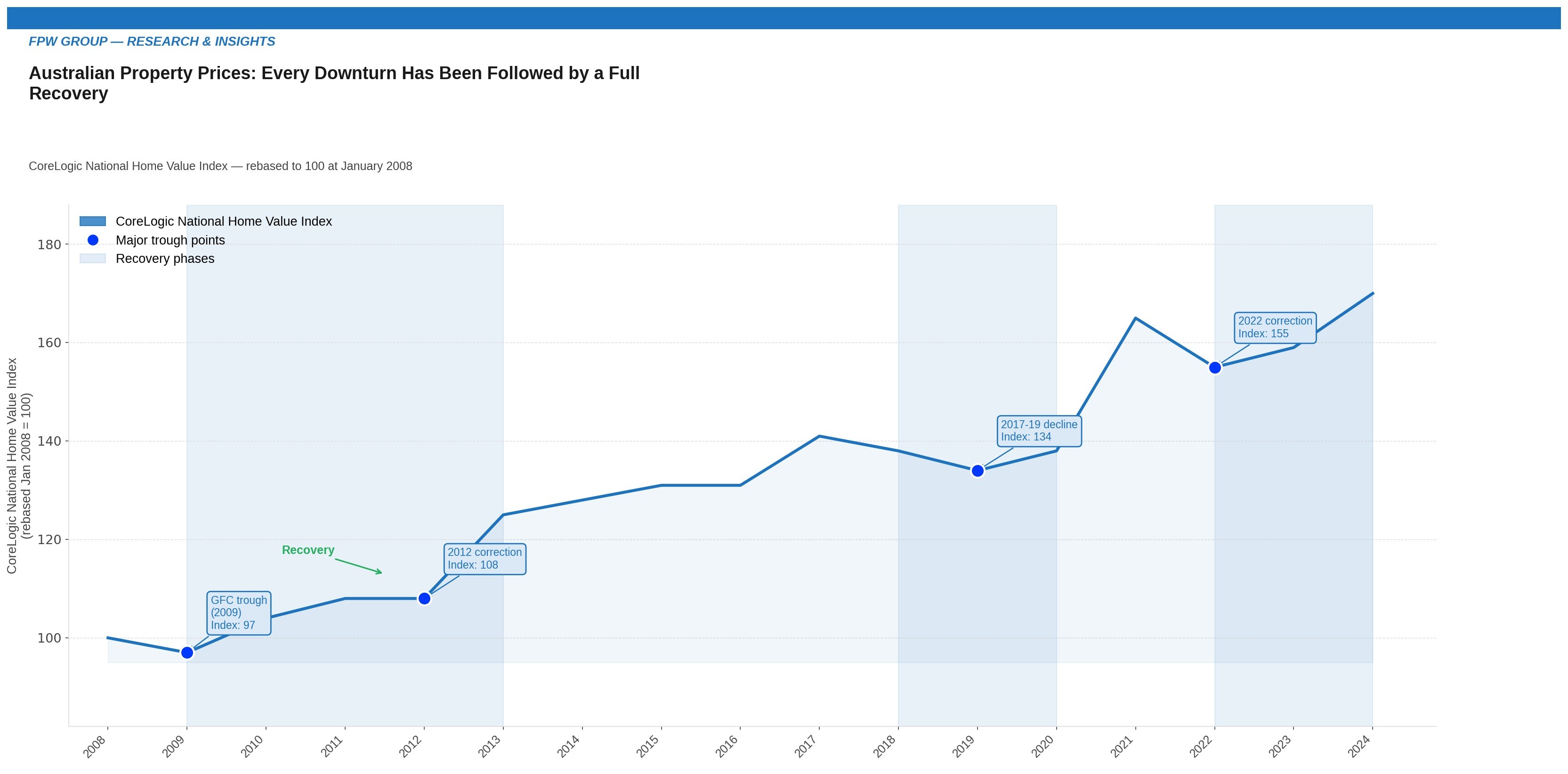
Source: CoreLogic Home Value Index 2024
When to Sell an Investment Property: The Five Questions to Ask First
Before making any exit decision on a property, work through each of these questions in order. They replace the headline with the actual analysis.
1. Has the property's long-term investment case changed?
The investment case for a property is built on specific assumptions: expected capital growth driven by population and employment trends, rental demand supported by the local economy, and a supply-demand balance that keeps vacancy tight. If those assumptions are still intact, price softness is almost certainly temporary. If they have materially changed, that is a different conversation.
2. Is the property still generating acceptable returns?
Rental yield matters. A property generating a gross rental yield of 4.5 percent in a market where comparable assets yield 3.8 percent is outperforming even if its capital value has softened. National residential vacancy rates sat at 1.2 percent as of March 2025 according to PropTrack, meaning rental demand across most markets remains structurally tight. Yield deterioration, not price softness, is the genuine warning sign.
3. Are the suburb's fundamentals improving or deteriorating?
Not all locations have the same trajectory. A property in a suburb where major infrastructure is being built, population is growing, and new employment is being established sits in a structurally different position from one in a suburb with stagnant population and rising vacancy. The framework for choosing investment grade suburbs applies equally when reviewing whether a location still meets your criteria.
4. Can you comfortably afford to hold it?
Cash flow pressure is real. If rising interest rates have pushed your holding costs to a point where servicing the loan is genuinely unsustainable, that is a legitimate reason to review your options. But review all options. Refinancing to a better rate, reviewing the borrowing capacity formula your lender applied, or restructuring debt may resolve the pressure without requiring a sale.
5. Could your capital produce a better outcome somewhere else?
Opportunity cost is the question most investors skip. The right benchmark is not whether this property is performing perfectly in isolation. It is whether the capital tied up here, after tax and transaction costs, could produce a materially better risk-adjusted return in a different asset or location. This calculation sometimes points toward selling. More often it reveals that switching costs and tax consequences make staying the more rational choice.
Sell or Hold? How to Read the Five Signals
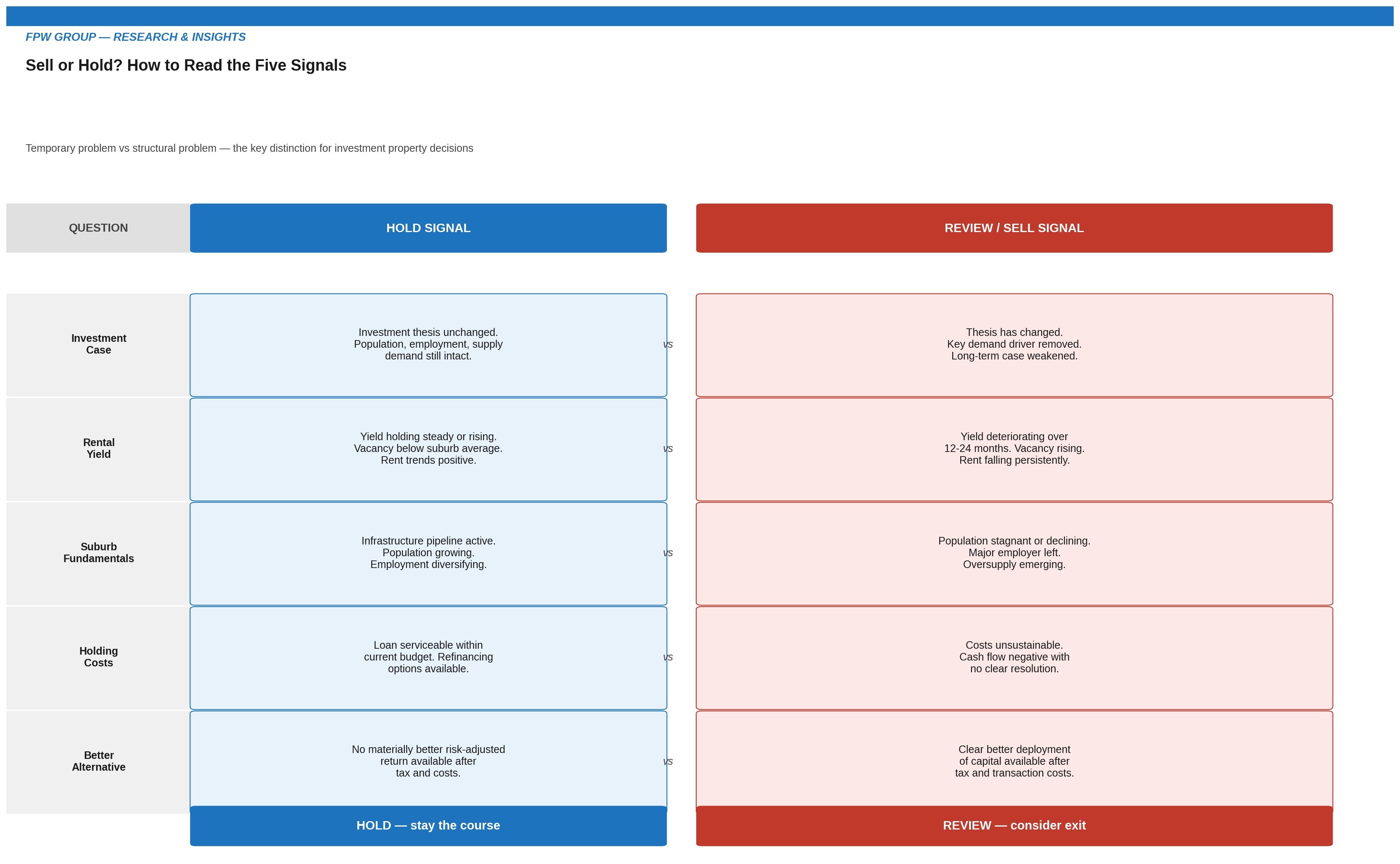
Source: FPW Group analysis
Signs It May Be Time to Sell an Investment Property
There are genuine reasons to sell, and they have nothing to do with short-term price movement. The patterns worth watching are slower-moving and structural.
The property's rental performance has deteriorated persistently
A single vacancy period is noise. A sustained pattern of rising vacancy, falling rents, and difficulty attracting quality tenants over 12 to 24 months is signal. If the rental market in your suburb has materially weakened and the trend is not reversing, the property is underperforming by the only short-term measure that matters: cash flow.
The location's long-term fundamentals have structurally changed
Population decline, a major employer leaving, or a fundamental shift in the suburb's economic base are changes that alter the investment thesis permanently. Australia's housing shortage is broad but not universal. Some specific markets face genuine oversupply or structural demand problems that will not resolve in the near term.
Holding costs have become unsustainable
Interest rate increases since 2022 materially increased holding costs for many investors. According to the Reserve Bank of Australia, the average outstanding mortgage rate on investor loans reached approximately 6.2 percent by mid-2024. If your loan structure means holding costs now exceed your capacity to service without ongoing financial strain, the analysis shifts.
The property no longer fits your investment strategy
Investment strategies evolve. A property that made sense as a growth play a decade ago may now be better suited to someone pursuing a different outcome. If the asset no longer serves your current portfolio goals and there is a clear better use for that capital, that is a legitimate strategic reason to sell, independent of what the market is doing.
When You Should Hold Instead of Sell
Holding is almost always the right decision when the only pressure to sell is coming from price weakness or market sentiment. Here is what genuine hold evidence looks like.
The hold case is strongest when: rental demand remains healthy, with low vacancy and stable or rising rents; the suburb's underlying fundamentals, population growth, employment diversity, and infrastructure investment, are intact or improving; holding costs are manageable within your broader financial position; and selling would trigger significant CGT or transaction costs without producing a materially better outcome on the other side.
Understanding property investment strategy before making any exit decision helps you test the specific property against your broader portfolio goals rather than reacting to the short-term market cycle.

Calculate the Real Cost of Selling Before You Decide
One reason investors undersell this step: they focus on the sale price and ignore what arrives in their account after the process ends. The gap between the two can be substantial.
Capital gains tax
For investment properties held more than 12 months, the 50 percent CGT discount applies for individual owners. But the gross taxable gain is still added to your assessable income in the year of sale, which can push you into a higher marginal tax bracket. According to the ATO, the specific rate depends on your total income in the financial year the sale settles. Settling in July rather than June can make a material difference.
Agent commissions and transaction costs
Selling costs typically run 2 to 3 percent of the sale price in agent commissions alone. Add conveyancing, marketing, and presentation costs before listing, and total transaction friction on a 900,000 dollar property easily exceeds 25,000 dollars before any tax is calculated.
What holding continues to produce
Every dollar of equity tied up in the sell-or-hold decision is either generating a return or it is not. If the property is growing in value, generating rental income, and building equity that can be accessed through refinancing rather than a sale, the opportunity cost of selling is real. The question is not just what selling costs. It is what holding produces.
The Real Cost of Selling: What $900,000 Actually Delivers After Costs and CGT
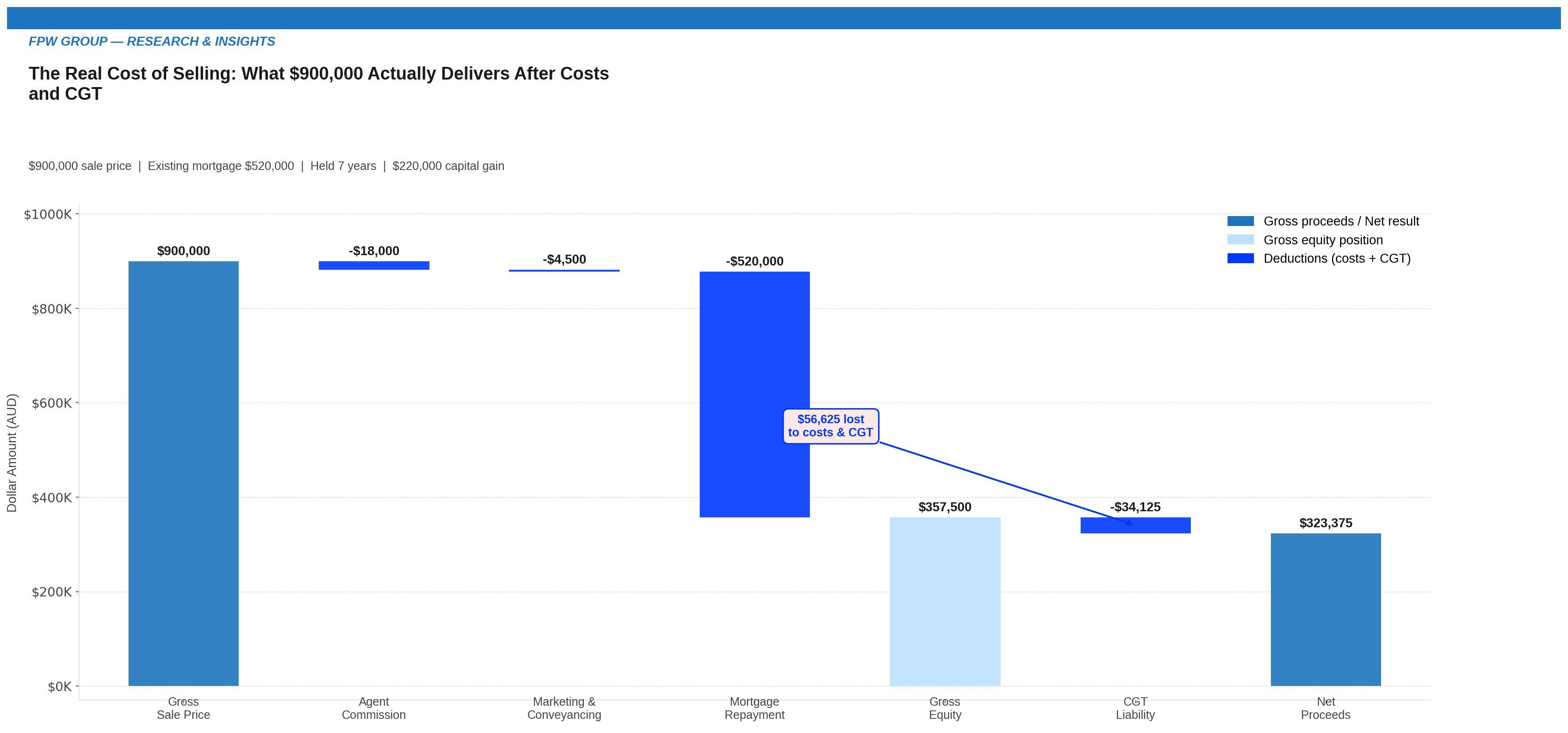
Source: ATO CGT Guidelines 2024; Australian agent commission market data
A Simple Sell-or-Hold Framework for Property Investors
Structured decisions beat reactive ones every time. This five-step process is designed to move you from feeling to analysis.
Step 1: Review the property's financial performance.
Calculate current gross yield, net yield after costs, and annualised capital growth since purchase. Compare to what was projected when you bought.
Step 2: Review the location's fundamentals.
Check current vacancy rates, population and employment trends, infrastructure pipeline, and supply levels. The property investment Australia pillar covers the structural drivers worth tracking in each market.
Step 3: Calculate the total cost of selling.
Agent fees, conveyancing, marketing, and potential CGT. Net this against the equity position to find the actual capital available after a sale.
Step 4: Model the cost of holding for three more years.
Estimate holding costs, expected rental income, and projected capital growth based on the suburb's fundamentals. If the three-year hold produces a better outcome than selling today and reinvesting, holding is the rational choice.
Step 5: Make the decision based on your strategy, not the market mood.
The sell-or-hold decision should reflect your long-term portfolio goals. If the property fits your strategy and the numbers support holding, the market's current mood is irrelevant. If it no longer fits and the numbers point toward an exit, act on that analysis.
Final Thoughts
Selling an investment property is not inherently bad. It can be the right move when the investment case has genuinely changed, when the location's fundamentals have deteriorated, or when the capital can be deployed to a better risk-adjusted return elsewhere.
What is almost never right is selling because the market is down, the headlines are negative, or the short-term pressure feels unbearable. Those feelings are consistent and predictable, and they peak at exactly the moments when selling produces the worst outcomes.
The investors who build lasting portfolios share one discipline: they separate price movement from investment performance, they run the analysis before they act, and they trust a structured framework over a market mood. This guide gives you the framework. The rest depends on running it honestly against your specific situation.
Frequently Asked Questions
Recommended Reading
Two pages selected based on what readers of this article are most likely to need next.
Recommended Video
With rising energy prices, back-to-back RBA rate hikes, and consumer confidence sitting at cycle lows, many Australians are asking the same question: is now really the time to buy? Instead of giving a simple yes or no, this episode goes deeper—unpacking what’s actually happening beneath the headlines.