
Should You Use the Equity in Your Home What the Numbers Show
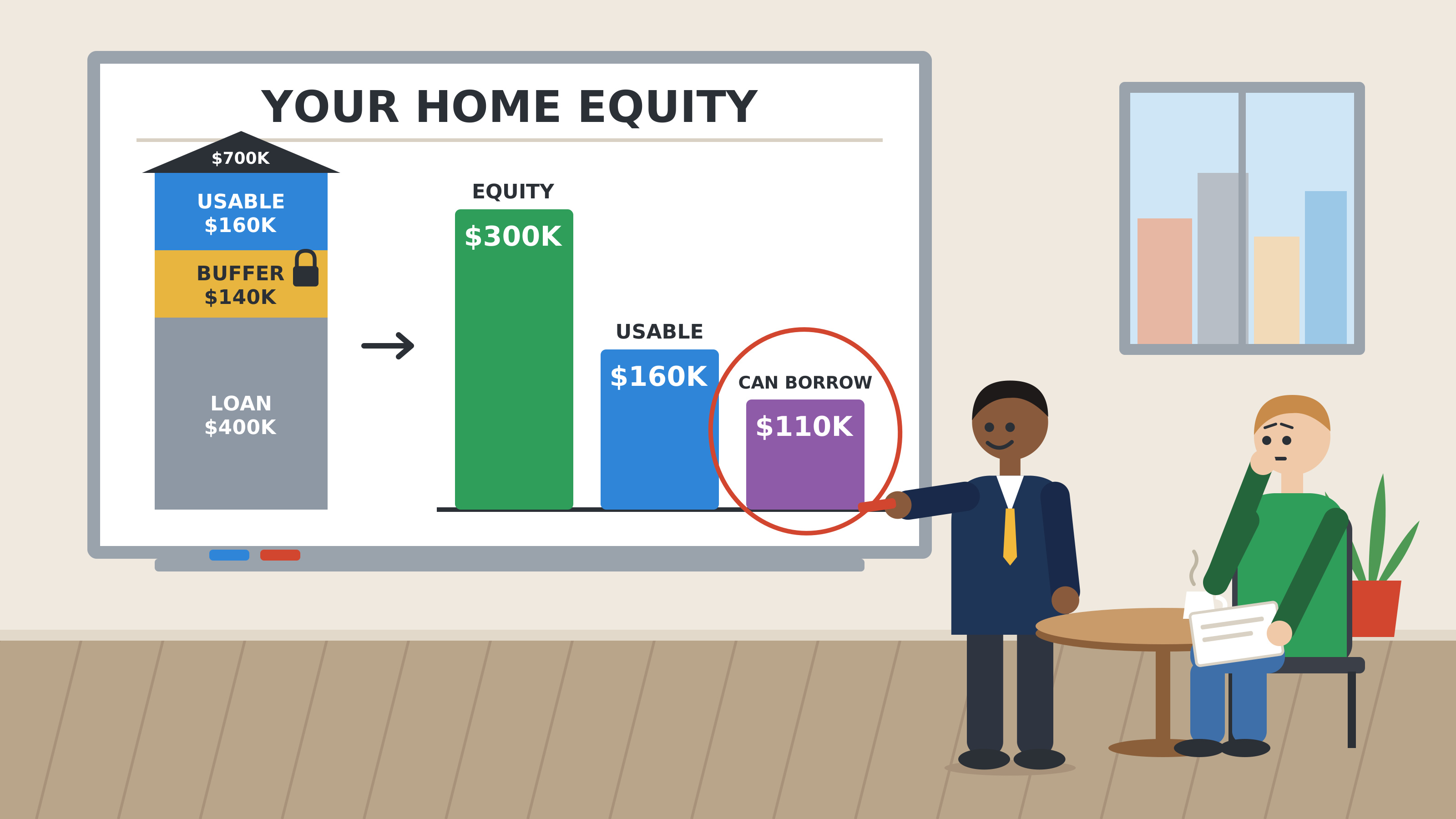
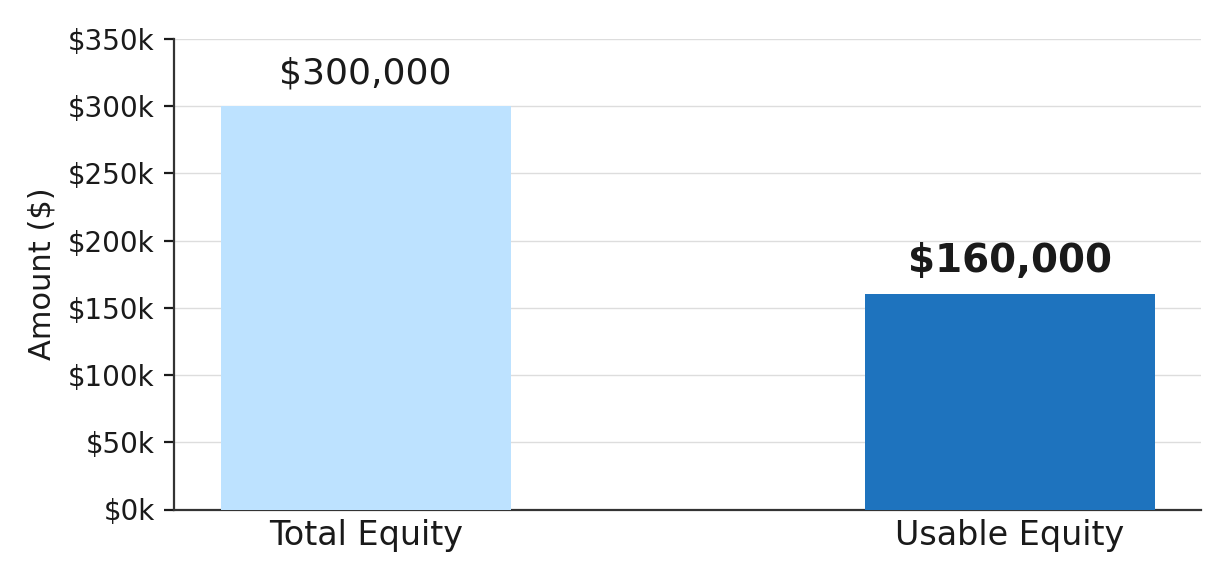
Home equity is your property's value minus what you still owe, but it is not the amount you can borrow. Lenders typically cap usable equity at 80 percent of your property's value minus your existing loan, so a homeowner sitting on $300,000 of equity might genuinely be able to access closer to $160,000.
That gap matters before you decide whether to use it. Working out your real number, rather than the headline equity figure, is the first step in improving your borrowing position without overextending it.
What Is Home Equity and How Much Can You Use?
The basic home equity calculation
Home equity is simply your property's current value minus what you still owe on your mortgage. A property worth $700,000 with a $400,000 loan against it has $300,000 in equity.
Equity is not the same as usable equity
Lenders will not let you borrow against all of your equity. The common convention is 80 percent of your property's value minus your existing loan, which keeps a buffer in case values fall.
Why usable equity does not guarantee additional borrowing
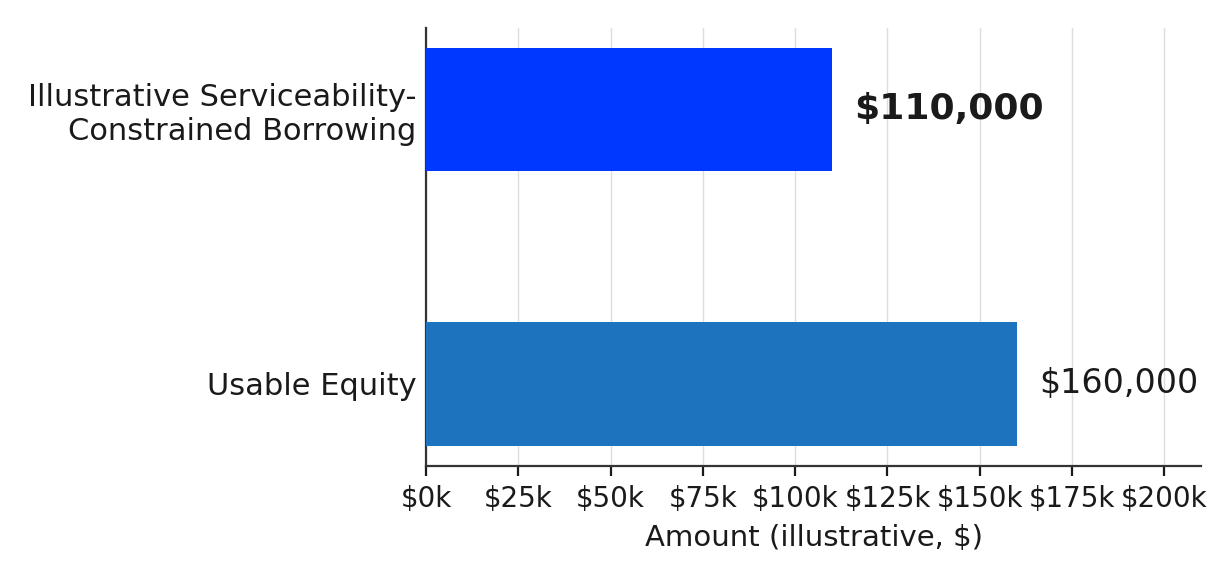
Usable equity tells you what a lender might allow against the property. It says nothing about whether your income, expenses and existing debt-to-income position can support the extra repayments that come with it.
How Can You Access the Equity in Your Home?
Topping up or refinancing your existing loan
The simplest route is increasing your current home loan or refinancing to a new one that includes the extra amount. Both add to your regular mortgage repayments from the point you draw the funds.
A separate or supplementary loan
Some lenders offer a second loan secured against the same property, kept separate from your original mortgage. This can make the additional debt easier to track, though you are still managing two repayment schedules against one asset.
Using equity to buy an investment property
This is the most common reason FPW clients look at their equity. Instead of saving a fresh cash deposit, usable equity can fund some or all of the deposit and costs on an investment property purchase, folding straight into a broader strategy rather than sitting idle.
Total Equity vs Usable Equity: A $700,000 Example
Source: FPW Group illustrative calculation
What Do the Numbers Look Like When You Use Home Equity?
Two Australian examples
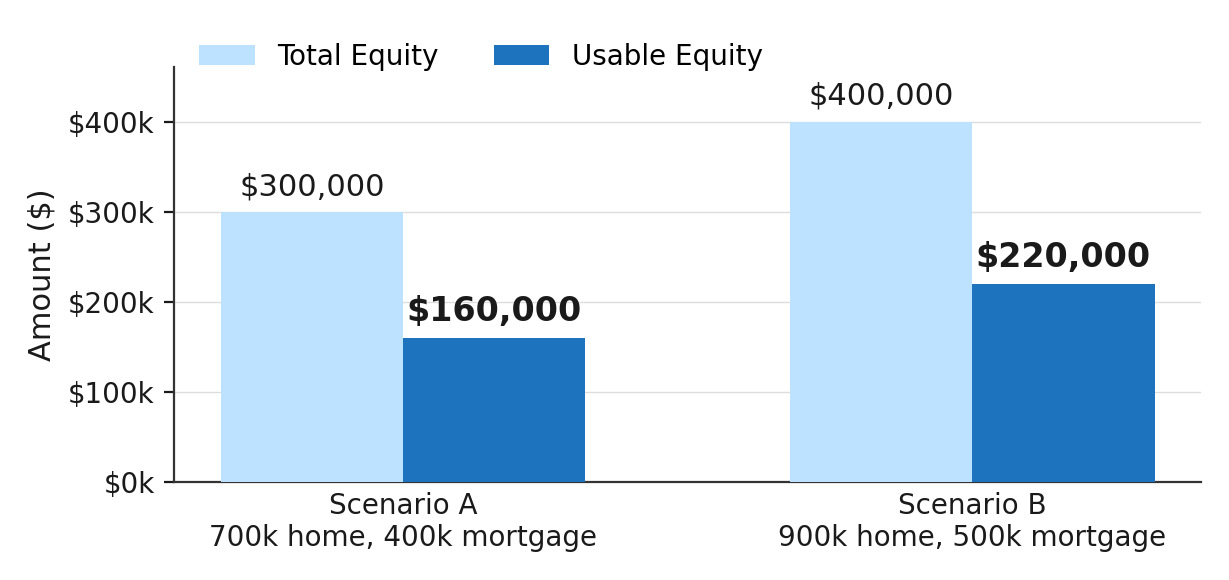
Take two homeowners. One has a $700,000 property with a $400,000 mortgage. The other has a $900,000 property with a $500,000 mortgage. Their total equity looks very different, $300,000 against $400,000, and so does their usable equity once the 80 percent convention is applied.
Usable Equity Across Two Scenarios
Source: FPW Group illustrative calculation
Why higher equity does not always mean higher borrowing capacity
Usable equity of $220,000 sounds like more borrowing power than $160,000. But if the higher-equity homeowner also has more existing debt or a lower income, how a lender assesses borrowing capacity could land at a similar level, or lower, than the other example.
Usable Equity vs an Illustrative Borrowing Capacity Limit

Home Equity vs Borrowing Capacity: What Is the Difference?
Equity tells you what you own
Equity is a snapshot of ownership. It moves with your property's value and how much you have paid off, but it says nothing about your income or your existing commitments.
Borrowing capacity tells you what a lender will approve
Your borrowing capacity is calculated from your income, expenses, existing debts and the interest rate buffer lenders are required to apply. It can sit well below your usable equity, or in some cases close to it, depending entirely on your financial position.
Why both numbers matter before making a property decision
Checking only your equity and assuming the rest will work itself out is one of the more common mistakes FPW sees. Both numbers need to be confirmed before you make an offer on anything.
What Are the Risks of Using Home Equity?
More debt secured against your home
Using equity increases the total debt secured against your home, not just against the new purchase. This is worth weighing against your maximum borrowing capacity, since the most you could technically borrow is not always the amount you should.
What happens if property values fall or the investment underperforms
A fall in property values can reduce your equity buffer faster than expected, and an investment property that underperforms still comes with its share of the new debt. Both risks are worth weighing before you commit, a pattern that also shows up in why so many Australians become investors without fully planning for it.
Should You Use the Equity in Your Home?
Questions to work through before borrowing
Before using equity, confirm your current property value and mortgage balance, your usable equity, your existing repayments and what a new loan adds to them, your income and other debts, and a cash-flow buffer for when things don't go to plan.
What to check before using equity for property investment
If the plan is to buy an investment property, add the property's own numbers and the location's fundamentals to the list. Working through this with a mortgage broker before you commit is the easiest way to avoid finding out the hard way.
Final Thoughts
Home equity and usable equity are not the same number, and usable equity and borrowing capacity are not the same number either. Each step narrows what you can do, and skipping straight from the headline equity figure to a property decision is where most of the risk sits.
The right question isn't how much equity is sitting in your home. It's how much of it you can genuinely use, what it costs to use it, and whether your income and existing debts can carry the result.

Frequently Asked Questions
Recommended Reading
Two pages selected based on what readers of this article are most likely to need next.
Recommended Video
Australia's record migration surge — peaking at over 528,000 people in a single year — created unprecedented housing demand almost overnight. We explain why the government used population growth as a deliberate tool to avoid recession, how that decision flows directly into property prices Australia-wide, and why rents have surged to record highs as a result.