

How Much Do You Need to Retire in Australia? Can Investment Property Help Close the Gap?

Most Australians asking how much they need to retire are really asking a harder question: am I already behind? For most, the honest answer is yes. A comfortable retirement in Australia costs about $72,148 a year for couples and $51,278 for singles, according to the ASFA Retirement Standard. Yet the median super balance for people aged 60 to 64 sits near $212,000 for men and $159,000 for women, enough to generate only a fraction of those targets at a sustainable drawdown rate.
That gap is the whole story. This article breaks down what retirement actually costs, where most Australians stand against that number, and how one, two, or three investment properties could realistically close the shortfall. You will see the specific income each portfolio size can produce, what is left to find, and how the numbers shift depending on when you start.
What Does Retirement Really Cost in Australia?
The ASFA Retirement Standard sets the benchmark for what Australians actually spend in retirement. It divides living standards into two categories: modest, where basic needs are covered with limited discretionary spending, and comfortable, which allows private health insurance, occasional travel, and a reasonable lifestyle.
As of the September 2024 quarter, a comfortable retirement costs around $72,148 a year for couples and $51,278 for singles. A modest retirement costs roughly $47,387 for couples and $32,930 for singles. Owning your home outright is assumed in both benchmarks, so renters typically need more.
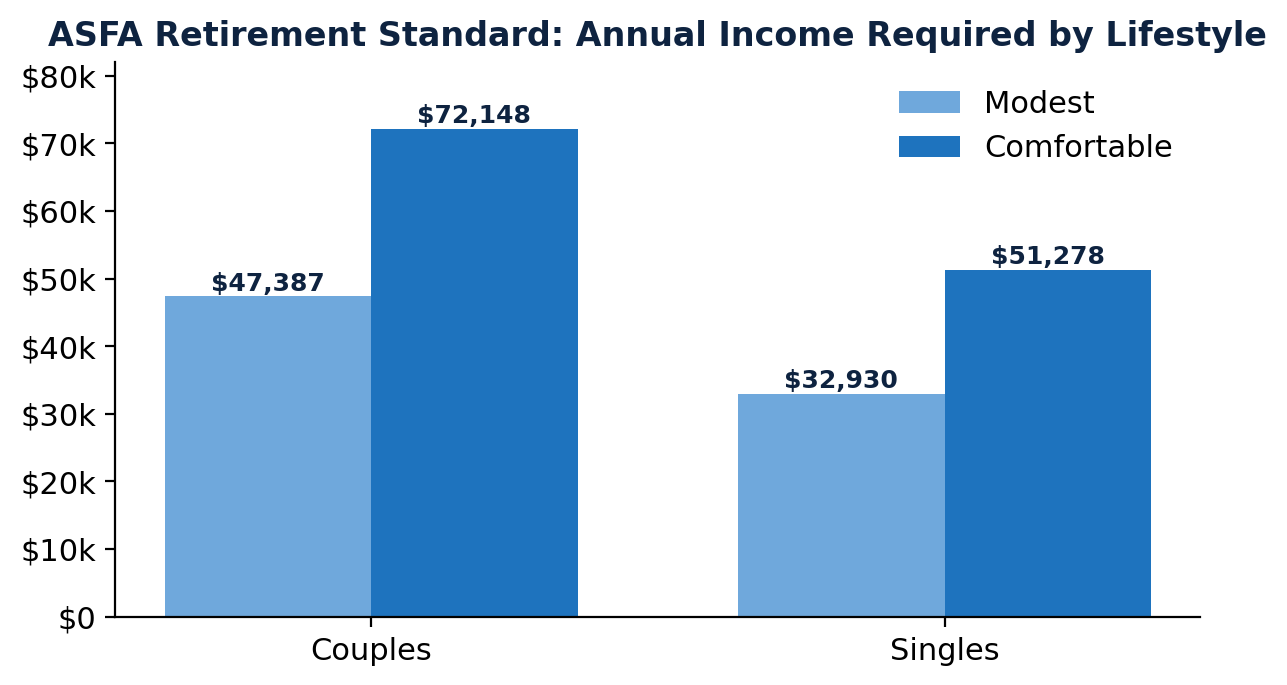
Source: ASFA Retirement Standard, September quarter 2024
How Much Super Do Most Australians Actually Have?
The numbers are confronting. ATO Taxation Statistics show the median super balance for Australians aged 60 to 64 sits at approximately $212,000 for men and $159,000 for women.
At a sustainable 4% annual drawdown rate, those balances produce roughly $8,480 and $6,352 a year respectively. The full Age Pension of about $29,754 a year for singles in 2025, per Services Australia, helps significantly, but the combined total still falls short of the ASFA comfortable benchmark for most retirees.
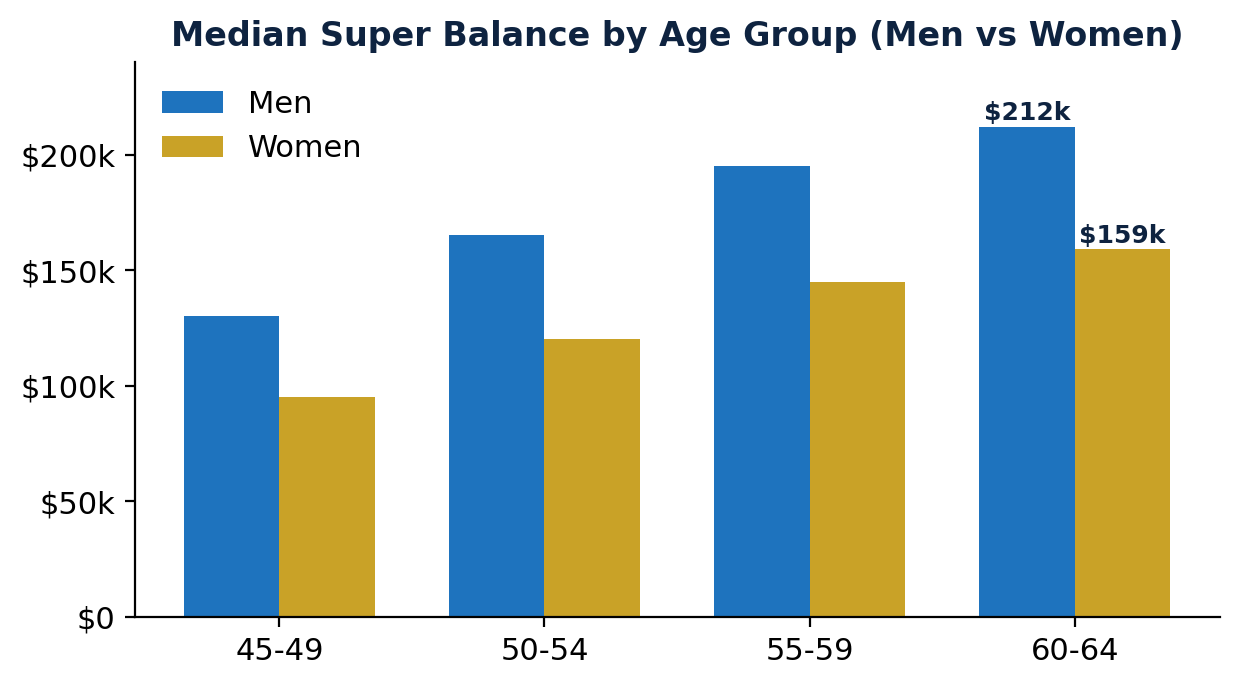
Source: ATO Taxation Statistics, via ASFA Super Stats (age bands 45 to 59 illustrative)
Why Many Australians Face a Retirement Gap
Three forces are working against Australian retirement savers at the same time.
Life expectancy is rising
According to ABS Life Tables, Australians born today can expect to live well into their late 80s. A retirement starting at 65 and running for 25 to 30 years puts enormous pressure on any fixed pool of savings.
Inflation erodes purchasing power
Healthcare costs in particular tend to rise faster than general CPI. That creates a compounding squeeze in the later retirement years, exactly when medical expenses typically increase.
The Age Pension is not a full fallback
The full Age Pension covers basic living for many retirees, but eligibility depends on assets and income tests. The amounts available do not bridge the gap to a comfortable retirement on their own.
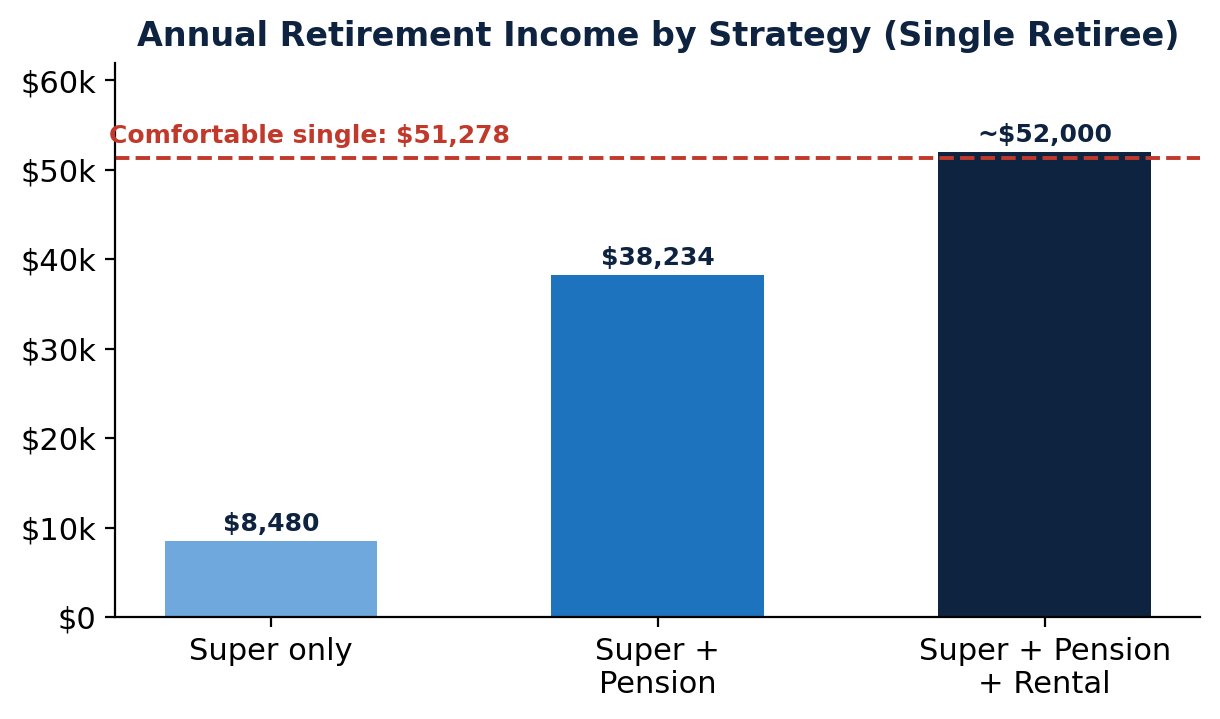
Source: ASFA Retirement Standard; Services Australia; FPW Group analysis
Can Investment Property Help Close the Retirement Gap?
Investment property works as a retirement strategy through two mechanisms: passive rental income now and long-term capital growth over time.
A well-located residential property generating 4 to 5% gross yield on a $700,000 asset produces $28,000 to $35,000 a year in rental income before expenses. Combined with a super drawdown and a partial Age Pension, that figure can bring total retirement income close to or above the ASFA comfortable threshold. For more on how property fits into a long-term wealth strategy, the FPW Group property investment guide covers the key selection principles in detail.
Capital growth adds a second dimension. Australian residential property has historically delivered average annual growth in the range of 5 to 7% over long holding periods, according to CoreLogic data, though past performance does not guarantee future results. Understanding how rental income affects your borrowing capacity is part of what makes building toward multiple properties viable.
Selecting the right property matters significantly to the outcome. The trade-off between yield and capital growth shapes whether a property generates strong income now or strong equity later, and most retirement strategies benefit from knowing which they are prioritising at each stage.
What Your Retirement Could Look Like With One, Two, or Three Properties
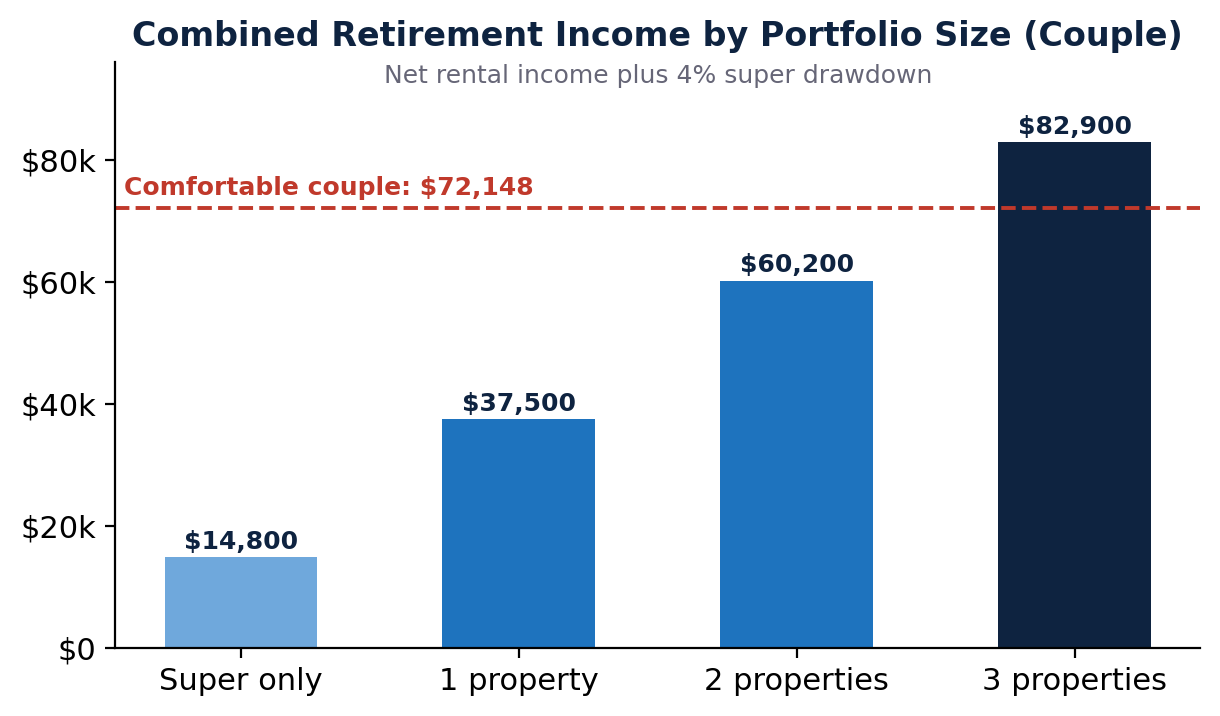
Generic retirement calculators stop at your super balance. The more useful question for an investor is different: if you own one, two, or three mortgage-free properties by retirement, what does your income actually look like against the comfortable benchmark?
The table below models exactly that for a couple. It assumes each property is worth $700,000 and mortgage-free at retirement, returns a 4.5% gross yield, and carries operating costs of about 28% of gross rent for rates, insurance, management, maintenance, and a vacancy allowance. Combined super of $370,000 is drawn at 4%.
What to Weigh Up Before You Invest for Retirement
Investment property is not risk-free. There are real costs and constraints to factor in before deciding.
Vacancy risk matters
An empty rental still incurs rates, insurance, loan repayments, and maintenance. This can strain cash flow during downturns or in markets with weaker tenant demand, particularly for investors who have not stress-tested their numbers.
Liquidity is a genuine constraint
Unlike super or shares, a property cannot be partially sold. If cash is needed quickly in retirement, selling takes months and involves significant transaction costs.
Finance access is not guaranteed
Understanding your borrowing capacity before you invest is essential. Lenders assess income, existing debt, and spending patterns carefully, so not everyone who wants to invest can access finance at the level they expect.
Interest rate sensitivity is real
A loan that feels manageable at 5% may feel stretched at 7%, particularly if rent does not fully cover repayments. Reviewing the common mistakes first-time investors make and how interest rate changes affect returns helps you avoid the pitfalls that derail even well-intentioned strategies.
How to Start Planning Your Retirement Strategy
Getting clear on where you stand is the most valuable first step most Australians can take.
Estimate your income target
Use the ASFA Retirement Standard as a baseline, then adjust for your own lifestyle, whether you own your home outright, and whether you expect regular travel or higher healthcare costs later.
Review your current super
Compare it against average balances for your age group. If the gap is large, voluntary contributions, salary sacrificing, or additional investment strategies may need to come into the picture sooner rather than later.
Map the property question
Consider whether investment property fits your timeline and risk profile. A guide on how to build a property portfolio can help you think through the sequencing and the decisions most investors get wrong.
Get professional advice
Retirement planning involves tax structure, superannuation law, and lending strategy. Aligning all three requires specialists who work together, not generic online guidance.
Final Thoughts
The question of how much you need to retire in Australia has a clear answer: more than most people currently have saved. The ASFA benchmarks and ATO data both point to a genuine gap between what Australians are building and what a comfortable retirement requires.
Superannuation is a strong foundation, but it was never designed to carry the entire weight of a 25 to 30 year retirement by itself. Investment property, used strategically and early enough, can create a second income stream and a long-term capital position that materially changes what retirement looks like.
The time to close the gap is not when retirement is five years away. It is now, while compounding has time to do the heavy work.
Frequently Asked Questions
Recommended Reading
Two pages selected based on what readers of this article are most likely to need next.
Recommended Video
If you’re trying to understand how to use equity, improve borrowing power, structure your loans correctly, or build a long-term property portfolio, this video gives you a step-by-step roadmap.