

Ready to Invest in Property in Australia? Take Your Financial Readiness Checklist
Most people who want to invest in property in Australia start with the wrong question. They ask where to buy long before they ask whether they can carry the purchase safely. With the national median dwelling value now near $923,000, and lenders assessing your loan at rates well above the one you actually pay, financial readiness decides more outcomes than suburb choice ever will.
This guide is a practical checklist. It works through the deposit, the real cost of buying, your true borrowing capacity, and the monthly cash flow that lands after settlement. Run it before you speak to an agent. Understanding how banks calculate your borrowing power early will shape every decision that comes after.
What Being Financially Ready to Invest in Property in Australia Really Means
Financial readiness is not the same as having a deposit. A deposit gets you to the starting line. Readiness is whether you can hold the property through a rate rise, a vacancy, or a repair bill without being forced to sell at the wrong time.
This distinction matters because property is illiquid. You cannot sell one bedroom to cover a bad month. Investors pushed into selling during a downturn lock in the loss that patient investors simply wait out.
In practice, readiness comes down to four things. Enough cash to complete the purchase. Borrowing capacity that is not stretched to the ceiling. Cash flow that survives a higher repayment. And a buffer for the months when something goes wrong.
The Financial Readiness Checklist Before You Invest in Property in Australia
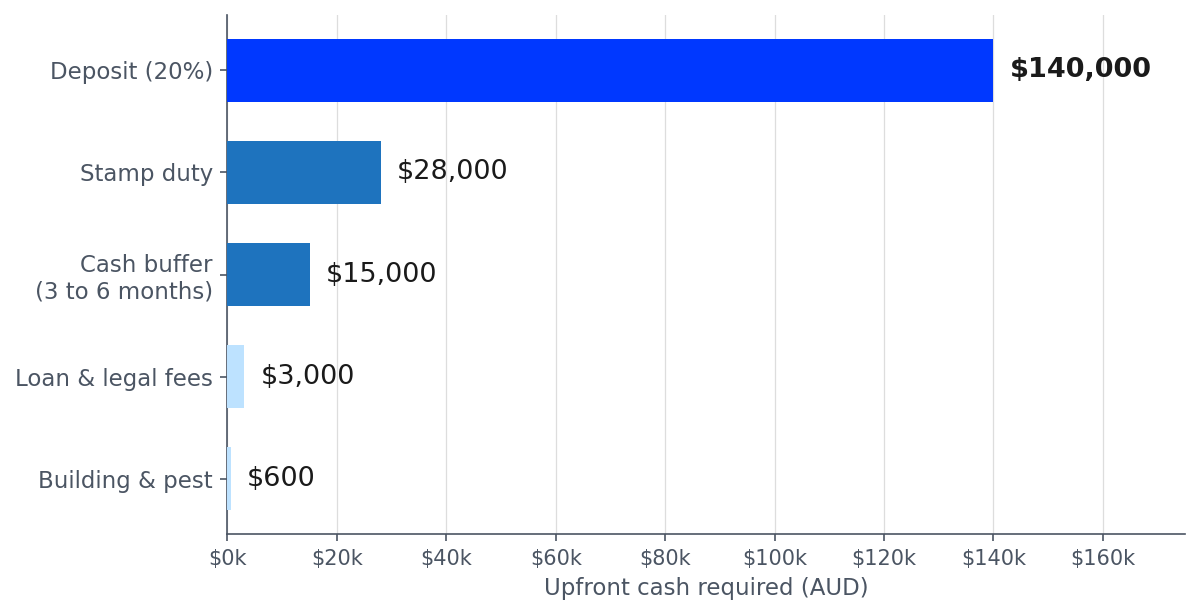
Start with the cash. A 20% deposit avoids lenders mortgage insurance, the premium banks charge when you borrow more than 80% of a property's value. On a $700,000 property that deposit is $140,000. It is rarely the only cost you need to cover.
Upfront Cash Needed to Buy a $700,000 Investment Property
Source: MoneySmart, 2026
Stamp duty is the second largest line, and it varies by state. Then come conveyancing, loan fees, and a building and pest inspection you should never skip. These are small next to the deposit, but they are real cash on settlement day.
Beyond settlement, keep a separate buffer. Three to six months of loan repayments and holding costs is the difference between riding out a vacancy and panicking through it.
FOR EXAMPLE
A buyer with a $140,000 deposit but no buffer is more exposed than a buyer with a $120,000 deposit and $20,000 set aside. The second buyer can absorb a vacancy or a broken hot water system. The first has to hope nothing breaks.
How Lenders Decide How Much You Can Borrow
Your income sets a ceiling, but it is not the whole calculation. Lenders subtract your living costs, your existing debts, and a margin for safety before they arrive at a number. The single biggest handbrake is the serviceability buffer.
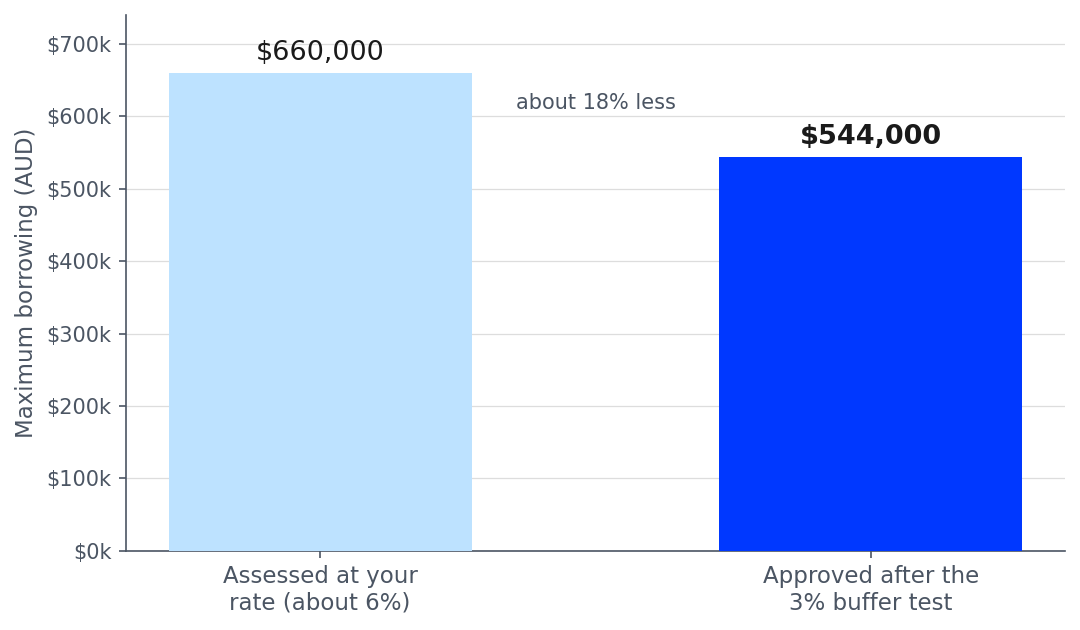
Lenders must test whether you can repay at your actual interest rate plus three percentage points. If your rate is 6%, they assess you at 9%. You can read more on how lenders stress-test your loan, but the effect is simple: you are approved for less than the sticker rate suggests.
How the 3% Serviceability Buffer Cuts Your Borrowing Power
Source: APRA, 2026
Your debt-to-income ratio matters too. From February 2026, a new APRA rule limits banks to no more than 20% of new lending going to borrowers whose total debt is six times income or higher. A high ratio can quietly cap your options even when the repayments look affordable.
Existing commitments shrink the number further. A credit card limit counts against you even at a zero balance, and car loans or HECS repayments reduce what is left to service a mortgage. Knowing your borrowing capacity in Australia before you shop stops you falling for a property the bank will not fund.
Can You Afford an Investment Property? The Real Monthly Numbers
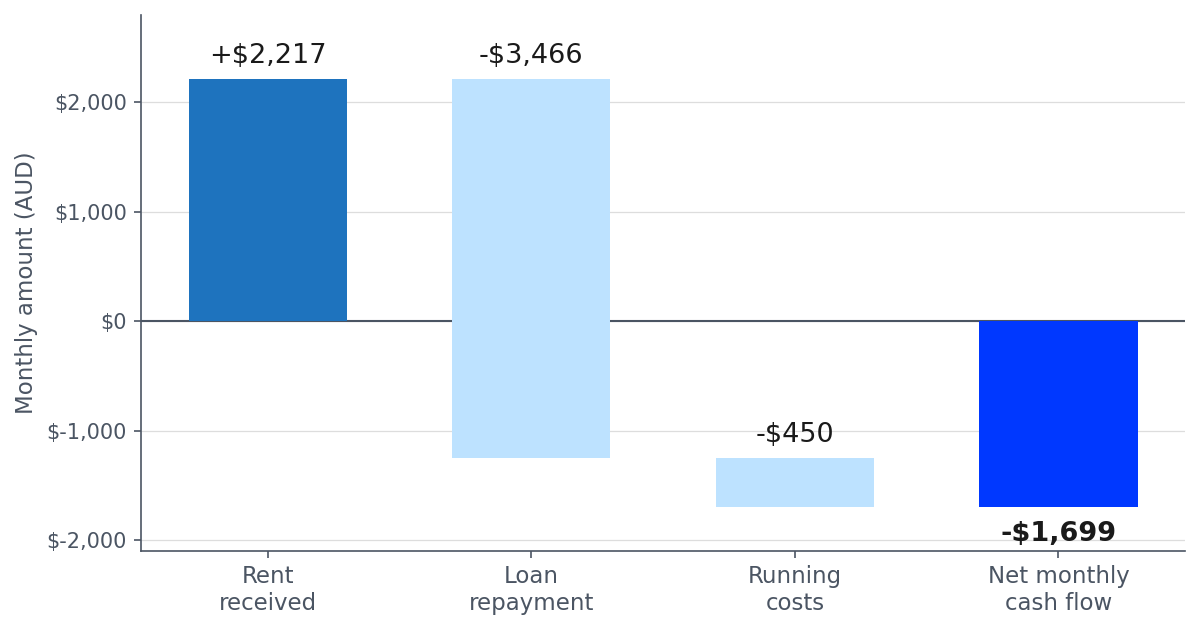
Approval tells you what you can buy. Cash flow tells you what you can keep. Most new investment properties in Australia run at a monthly shortfall, because rent rarely covers the full mortgage once rates sit near 6%.
Monthly Cash Flow on a Typical $700,000 Investment Property
Source: CoreLogic, 2026
That shortfall is normal for a geared property, and tax deductions soften it. The real danger is assuming today's rate holds. Test your numbers at a rate two to three points higher, because that is exactly what the bank already did.
Rental income is not guaranteed either. Model a few weeks of vacancy each year and a maintenance allowance, not a perfect tenant who never leaves. The rental market is tight right now, which helps, but tight markets still turn.
FOR EXAMPLE
A property that costs you $1,700 a month is $20,400 a year out of pocket before tax. If your household cannot carry that on top of normal expenses, the property owns you rather than the other way around.
Signs You Are Not Ready Yet, and What to Fix First
Some warning signs feel like ambition, which is why they get missed. Relying on your maximum approval is the clearest one. If the only way the numbers work is at the very top of your limit, you have no room for the rate rise the bank already built in.
Other signs are quieter. No cash buffer. Spending that swallows every pay cycle. No strategy beyond a feeling that property goes up. These are the mistakes first-time investors make most often.
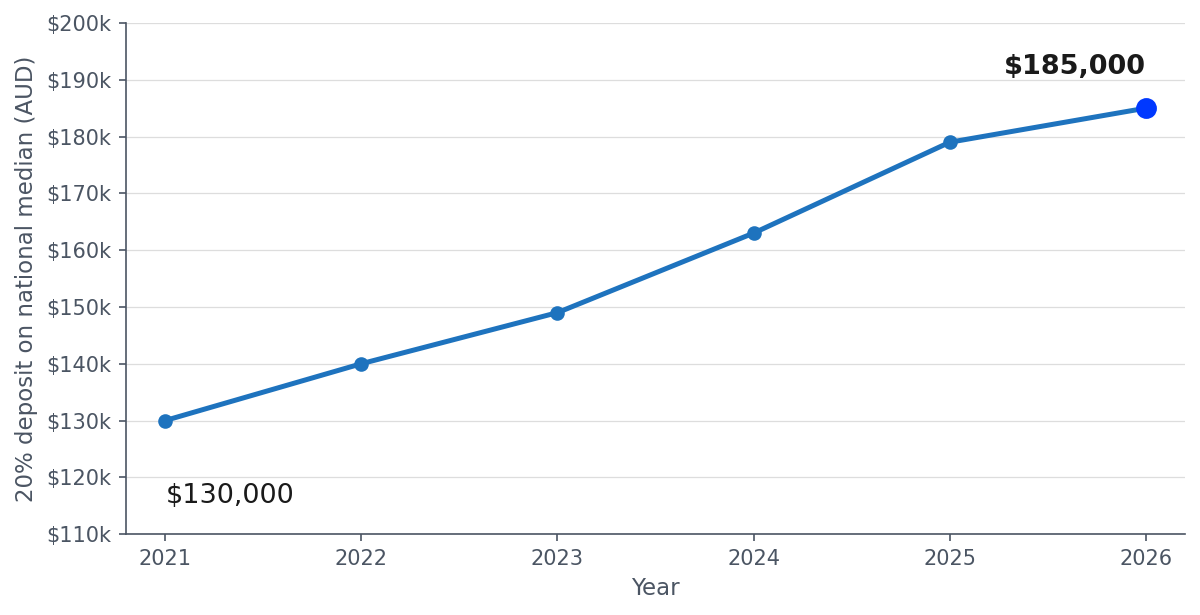
Why Waiting to Save Can Move the Goalposts
Source: CoreLogic, 2026
None of this means never. It means not yet. And waiting is not free, so treat it as a plan with a deadline rather than a drift.
If you are close, the fixes are practical. Build the buffer first. Reduce or close unused credit limits to lift capacity. Improve your borrowing position by clearing small debts before you apply. Then define what you are actually buying, using clear investment-grade suburb criteria rather than headlines.
When the numbers hold, the next moves are pre-approval, a defined strategy, and support that keeps you disciplined under competition. Many investors bring in a buyer's agent at this point to stay objective when good stock moves fast.
Final Thoughts
The decision to invest in property in Australia is really two decisions. The first is whether the asset is worth owning. The second, and the one most people skip, is whether your finances can hold it through everything that follows settlement.
Run the numbers honestly. Confirm the deposit and the buying costs. Get your real borrowing capacity, not the optimistic version. Stress-test the monthly cash flow at a higher rate. If it all holds, you can move with confidence. If it does not, you now know exactly what to work on. Either way, you are deciding with data instead of hope.
Frequently Asked Questions
Recommended Reading
Two pages selected based on what readers of this article are most likely to need next.
Recommended Video
As rates rise, many people immediately assume it is no longer a good time to invest. But in reality, the opportunity has not disappeared—it has simply shifted. This episode explains why higher interest rates do not automatically remove your ability to invest, but they do change your borrowing power, your cash flow, and the price point that makes sense for you.