

Investment Loans Property: Which Structure and Rate Makes Sense?
Wealth preservation in your 60s means shifting your goal from growing your net worth to protecting the income, cash and choices it gives you. For most property investors, that comes down to three checks: whether each property pays its way, whether you can reach cash when you need it, and how tax and the Age Pension will treat your next move.
This decade is when most Australians hold the most wealth they will ever have. It is also when a poor decision is hardest to undo, because there are fewer working years left to rebuild. Your 60s are the final stage of a longer property investment journey, and the costliest risks here are often invisible on a valuation.
Further down, we break down how much of a typical year of rent you really keep, and the asset test limits that can change the math on keeping or selling.
What Makes Investment Property Loans Different?
Why Investment Loans Usually Cost More
Lenders see investment loans as slightly riskier than loans for a home you live in. Rent can stop, costs can rise, and an investor under pressure is more likely to sell or fall behind than an owner-occupier.
That risk shows up in pricing. RBA lenders' interest rate data for July 2026 put the average new investor variable rate at about 6.4%, roughly 0.2 to 0.3 points above comparable owner-occupier loans, and the September rate rise has since pushed most rates higher.
How Lenders Assess an Investment Property Loan
Lenders look at your income, existing debts, living costs, credit history and the deposit or equity you bring. They also count only part of the expected rent, because they allow for vacancy and costs.
They then test whether you could still afford repayments at a much higher rate. Our guide to the borrowing capacity formula shows how those inputs combine, and why rental income does not count in full.
The Main Investment Loan Structures
Principal and interest (P&I). Each repayment covers interest and part of the loan, so the balance falls from day one.
Interest-only (IO). Repayments cover interest only for a set period, usually up to five years, then switch to P&I.
Fixed rate. The rate is locked for a period, often one to five years.
Variable rate. The rate moves with the lender's pricing, usually following the cash rate.
Split loan. Part fixed and part variable, to balance certainty and flexibility.
Interest Only vs Principal and Interest: What Do the Numbers Show?
To test this, we modelled a $600,000 investment loan over 30 years. The assumed rates reflect the RBA's July 2026 averages plus September's 0.25% rise: 6.65% for variable P&I, 6.85% for interest-only, and 6.60% for a three-year fixed rate.
Investment Property Loan Example: Five Years Compared
Source: FPW Group calculations, October 2026. Illustrative rates, 30-year term, no fees, rates held constant.
What Happens When the Interest-Only Period Ends?
Interest-only gives you about $427 a month of breathing room at the start. But the full $600,000 must then be repaid over 25 years instead of 30, so the repayment rises sharply.
Interest-Only Repayments Jump When the Interest-Only Period Ends
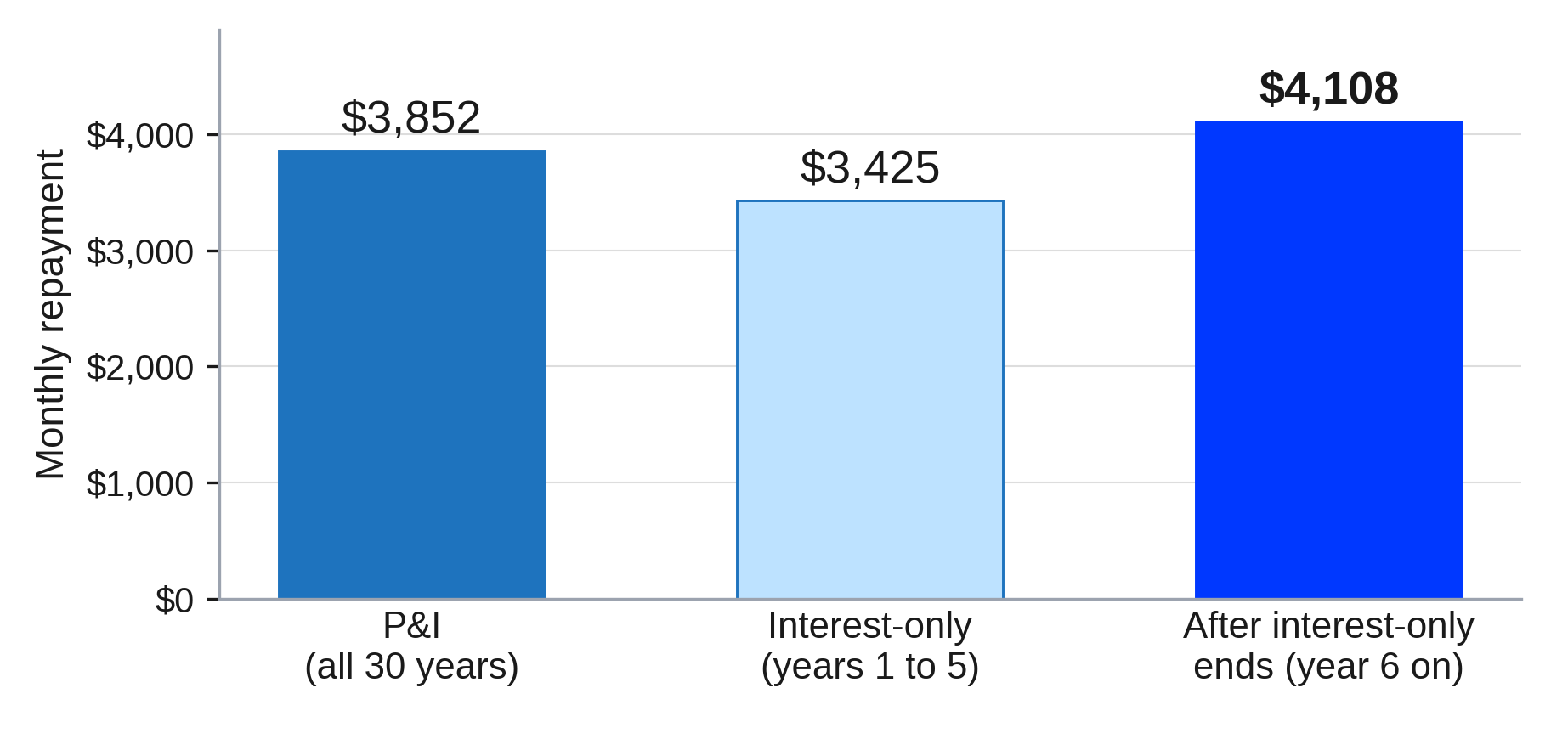
Source: FPW Group calculations, October 2026. $600,000 loan, 6.85% interest-only for 5 years, then 6.65% P&I over 25 years.
When Lower Repayments Become a Bigger Long-Term Cost
Because the balance does not fall for five years, interest keeps building on the full amount. Over the life of the loan, the interest-only version costs about $51,150 more in interest, even after rates are assumed to match once P&I starts.
Interest-Only Leaves the Loan Balance Higher for Longer
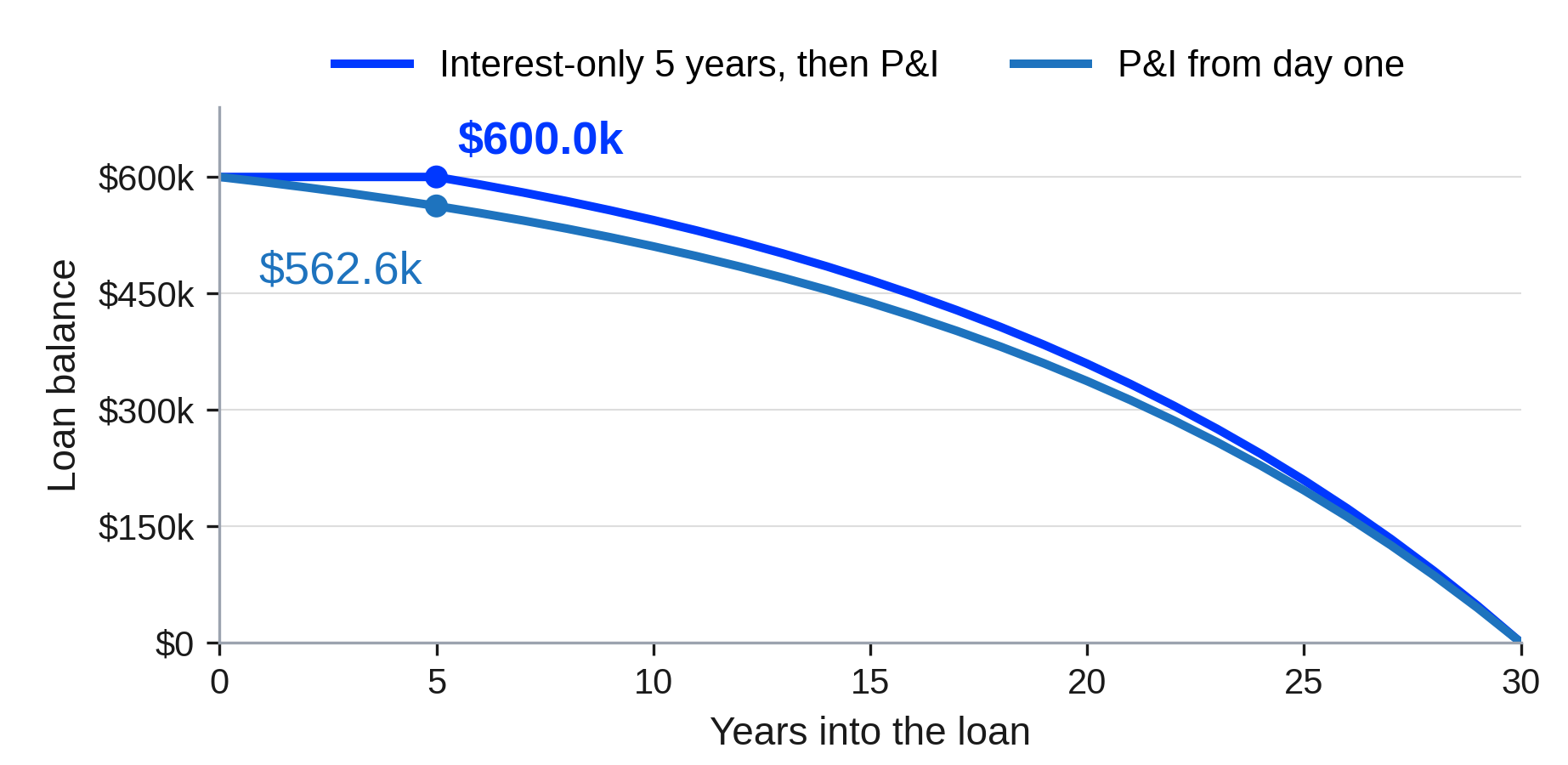
Source: FPW Group calculations, October 2026. Same assumptions as the table above.
The Cash-Flow Trade-Off Investors Need to Understand
Neither structure is better in every case. Interest-only buys cash flow now, which can help an investor holding several properties or saving for the next deposit. P&I builds equity and costs less in total, which suits investors who can comfortably carry the higher repayment.
Interest-only is common among investors. RBA research found around 40% of new investor lending has been interest-only since 2018, against 8% to 12% for owner-occupiers.

Fixed vs Variable Investment Property Loans
What Fixed and Variable Rates Each Offer
A fixed rate gives you certain repayments for the fixed period, which helps with budgeting while rates are rising. In July 2026, RBA data showed new investor fixed loans of up to three years averaging about the same as variable loans, so fixing did not cost much extra at that point.
A variable rate gives you flexibility. Most variable loans allow unlimited extra repayments and an offset account, and you can refinance or sell without a break fee.
Break Costs and Repayment Restrictions
Fixed loans often limit extra repayments, and many do not allow a full offset. If you sell or refinance during the fixed period and rates have fallen, you may pay a break cost that runs into thousands of dollars
Why a Split Loan Can Work for Investors
A split loan fixes part of the balance and keeps the rest variable. In our example, fixing for three years saved under $1,000 in interest over five years, so the real value of fixing is certainty, not savings
Is the Lowest Investment Property Loan Rate Really the Cheapest?
Advertised Rate vs Comparison Rate
Lenders must show a comparison rate beside the advertised rate. It folds in most fees, but it is calculated on a $150,000 loan over 25 years, so it can understate or overstate the effect of fees on a much bigger investment loan.
MoneySmart notes that even a 0.2% lower rate can save thousands over time. The catch is that fees and features can wipe out that saving
How Fees and Features Change the Real Cost
We compared three loan offers on the same $600,000 balance over five years.
The Lowest Rate Is Not the Cheapest Loan Over Five Years
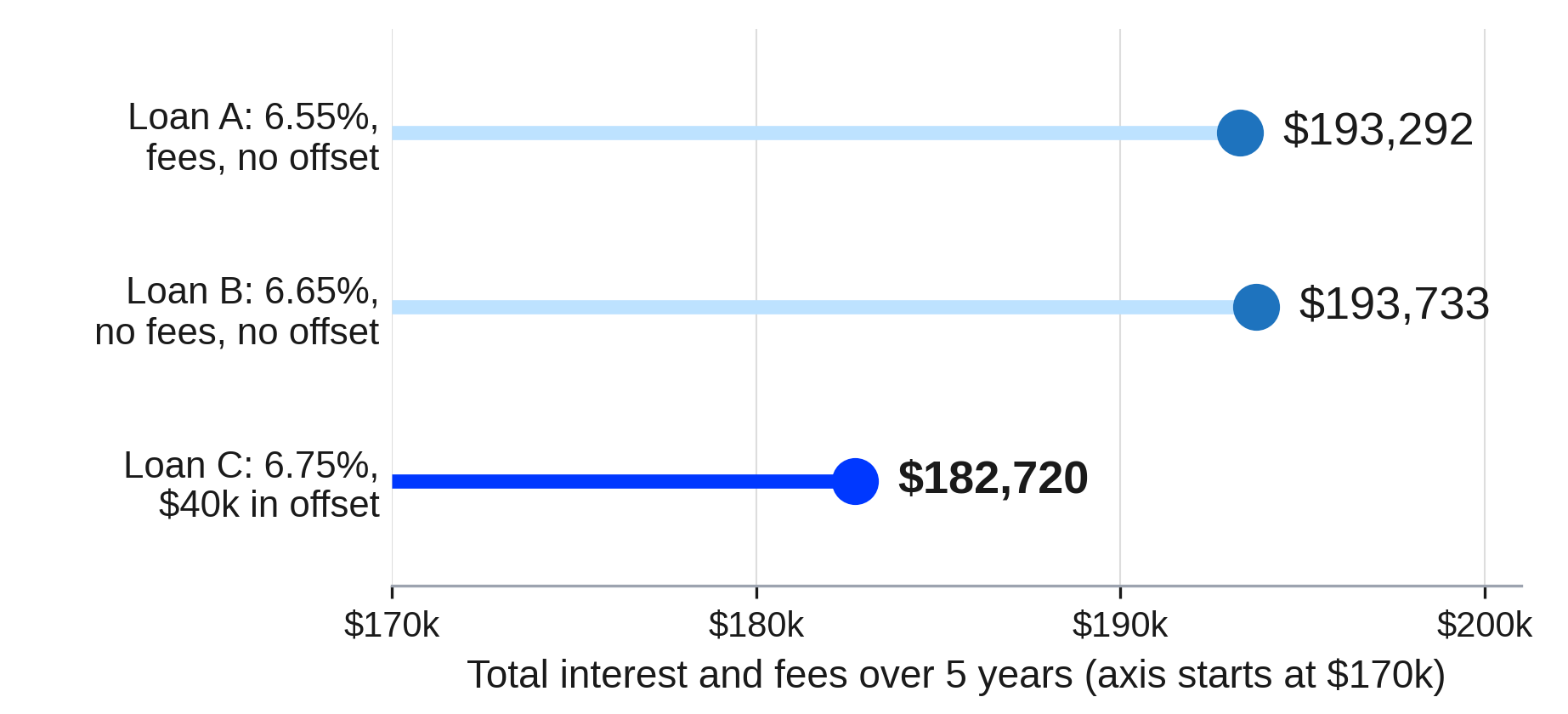
Source: FPW Group calculations, October 2026, on a $600,000 P&I loan over 30 years (Loan A: $600 upfront and $395 a year; Loan C: $395 a year with $40,000 kept in offset).
How Investment Loan Structure Affects Cash Flow
Rental Income Does Not Always Cover the Loan
MoneySmart warns investors not to assume rent will always cover the repayments, because properties sit empty between tenants. Your loan structure decides how much of a gap you need to fund from your own income,
How Sensitive Are Your Repayments to Rate Rises?
The Reserve Bank has lifted the cash rate four times in 2026, to 4.60%. Here is what further rises would do to our $600,000 loan.
What Higher Rates Do to Monthly Investment Loan Repayments
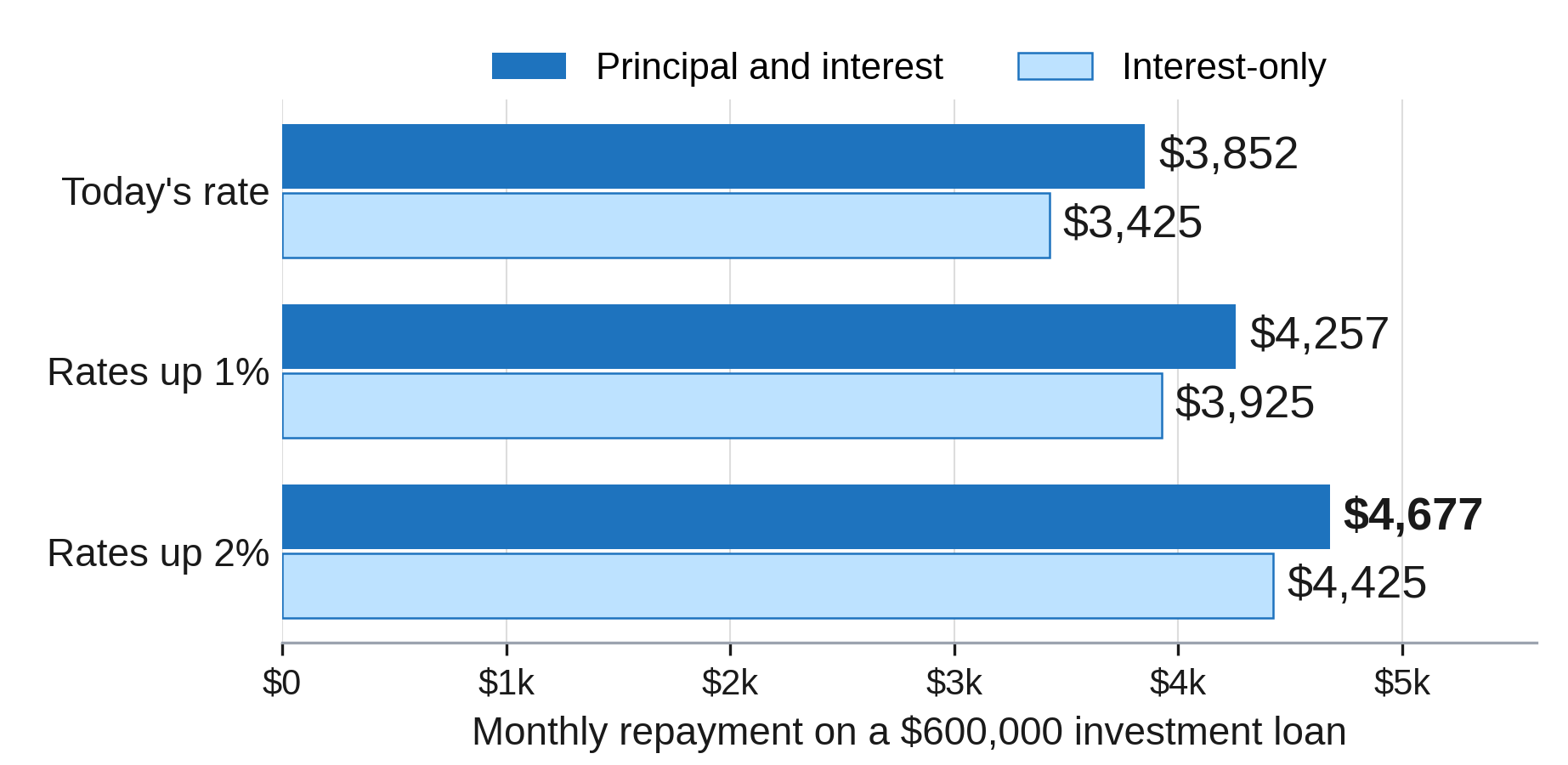
Source: FPW Group calculations, October 2026. $600,000 loan, 30-year P&I at 6.65% and interest-only at 6.85%, each tested at +1% and +2%.
The Costs Beyond the Loan
Repayments are only part of holding an investment property. Council rates, insurance, maintenance, property management, land tax, strata fees and vacancy all come out before you see any cash, though many of these costs are tax deductible.
Why Cash Flow Matters Beyond the First Property
The structure you choose now affects what lenders let you borrow next. A loan that keeps your cash flow steady can help you keep building a sound property investment strategy, while a stretched one can stall it.
How to Compare Investment Loans: Property Investor Checklist
Rate and comparison rate. Note both, and ask what fees sit behind the comparison rate.
Repayment type. Decide between P&I and interest-only based on your cash flow and plans.
Total cost. Add interest and all fees over three to five years.
Fees. Check setup, annual package, valuation and discharge fees.
LVR and deposit. Higher loan-to-value ratios often bring higher rates.
Offset and redraw. Work out how much cash you would realistically keep in an offset.
Fixed-rate conditions. Check break costs and limits on extra repayments.
Refinancing flexibility. Make sure you can change lenders later without heavy costs
Our investment property loan approval checklist covers the paperwork side. If you would like the comparisons run for you, an investment property strategy session is a good place to start.
So, Which Investment Property Loan Structure Makes Sense?
Longer loan terms are another lever some lenders now offer, as our look at the 40-year investor home loan explains. Like interest-only, they lower repayments by stretching out the cost.
Final Thoughts: The Right Loan Fits the Plan, Not Just the Rate
The lowest advertised rate is a reasonable place to start, but it is rarely the whole answer. Our $600,000 example showed that structure, fees and features can move the real cost far more than a small rate gap.
Interest-only can free up cash, but it lifts total interest and brings a repayment jump later. Fixed rates offer certainty, variable rates offer flexibility, and an offset account can be worth more than a cheaper rate.
The best investment property loan is the one that balances cost, cash flow and flexibility with your longer-term plan. Before you sign, test it at higher rates, add up every fee, and check how it affects your ability to buy again.

Frequently Asked Questions
Recommended Reading
Two pages selected based on what readers of this article are most likely to need next.
Recommended Video
Australia's record migration surge — peaking at over 528,000 people in a single year — created unprecedented housing demand almost overnight. We explain why the government used population growth as a deliberate tool to avoid recession, how that decision flows directly into property prices Australia-wide, and why rents have surged to record highs as a result.