

9 Things Banks Check Before Approving an Investment Property Loan
Banks check nine distinct areas before approving an investment property loan, and most applications fail not on income but on factors the borrower never thought to prepare for. The nine checkpoints cover your complete financial profile, your debt position, and the property itself.
A weakness in any single checkpoint can determine the outcome regardless of how strong the others are. Understanding the full assessment framework before you apply shifts the conversation from 'I hope I get approved' to 'I know exactly what the bank will see, and I have prepared for each checkpoint in advance.'
This article covers all nine checkpoints, the hidden factors most borrowers miss, and how to position your application for the strongest possible result. Getting a clear picture of your property investment in Australia strategy before approaching a lender is often what separates clean approvals from conditional declines.
1. Your Financial Profile: Income, Expenses, and Credit History
What income types banks accept and what gets discounted
Base salary from PAYG employment is the cleanest income type for a bank assessment. Casual income, contract income, and self-employment all carry additional documentation requirements and are often treated more conservatively.
For self-employed applicants, most lenders require two years of tax returns, and the average of both years typically forms the assessment basis rather than just the most recent. The more variable your income, the more conservative the assessment.
Rental income from properties you already hold is included but shaded to 70% to 80% of gross before being added to your income position. Overtime and bonus income may also be included if it is consistent and documented across multiple years.
Why living expenses and credit history carry more weight than most borrowers expect
Banks are required under responsible lending obligations to verify actual living expenses, not rely on a self-declared minimum. That means bank statements are reviewed, and unexplained high spending, gambling transactions, buy-now-pay-later accounts, and recurring subscription costs all reduce the disposable income available to service debt.
An investor earning $150,000 who spends aggressively will often borrow less than an investor earning $120,000 with controlled outgoings. The number that matters is not gross income but income net of all assessed commitments and living costs.
Your credit file shows every credit application from the past five years, any defaults, and any late payments or hardship arrangements. A single missed payment does not automatically decline an application, but a pattern of late accounts or multiple lender inquiries in quick succession signals risk and narrows your options significantly.
2. Your Debt Position and Borrowing Capacity
How the APRA serviceability buffer affects what you can borrow
Lenders are required by APRA to assess your ability to service the loan at your actual interest rate plus a minimum 3% buffer. If you are borrowing at 6.5%, the bank tests your capacity to repay at 9.5%.
This single policy setting is the most commonly misunderstood reason investors find their approved amount substantially lower than expected. Your borrowing capacity is not what you can afford at today's rate. It is what you can afford at today's rate plus three percentage points.
The buffer exists to ensure borrowers can continue servicing debt if rates rise. Understanding how interest rate buffers reduce borrowing power before you set a purchase budget prevents the most common planning error investors make.
Why your debt-to-income ratio is increasingly the hard ceiling
APRA has flagged the debt-to-income ratio as a key risk metric for the banking system. Most major lenders now have internal caps, typically around 6 times gross income, above which they will not lend regardless of serviceability calculations.
An investor earning $120,000 who already holds $450,000 in existing debt against a $600,000 investment property sits at 8.75 times income. That investor will find most lenders reluctant to extend further credit regardless of demonstrated cashflow.
The debt-to-income ratio is the factor most investors discover only after their first approval and when trying to acquire a second or third property. Managing it proactively from your first purchase is what determines whether you can build a portfolio or get permanently stuck at one property.
Personal loans, car finance, and credit card limits all count in full, whether or not you use them, as covered in our article on how personal loans affect borrowing capacity in Australia.
FOR EXAMPLE
Two investors each earn $130,000. Investor A has no personal debt and an investment property worth $600,000 with a $400,000 loan. DTI: 3.1x. Banks see clear headroom and Investor A gets approved for a second property with minimal friction. Investor B has the same property loan, plus a $40,000 car loan and $25,000 in credit card limits. Effective DTI: 3.6x with the credit limits counted in full. One additional lender policy threshold away from a soft decline. Same income. Very different approval.
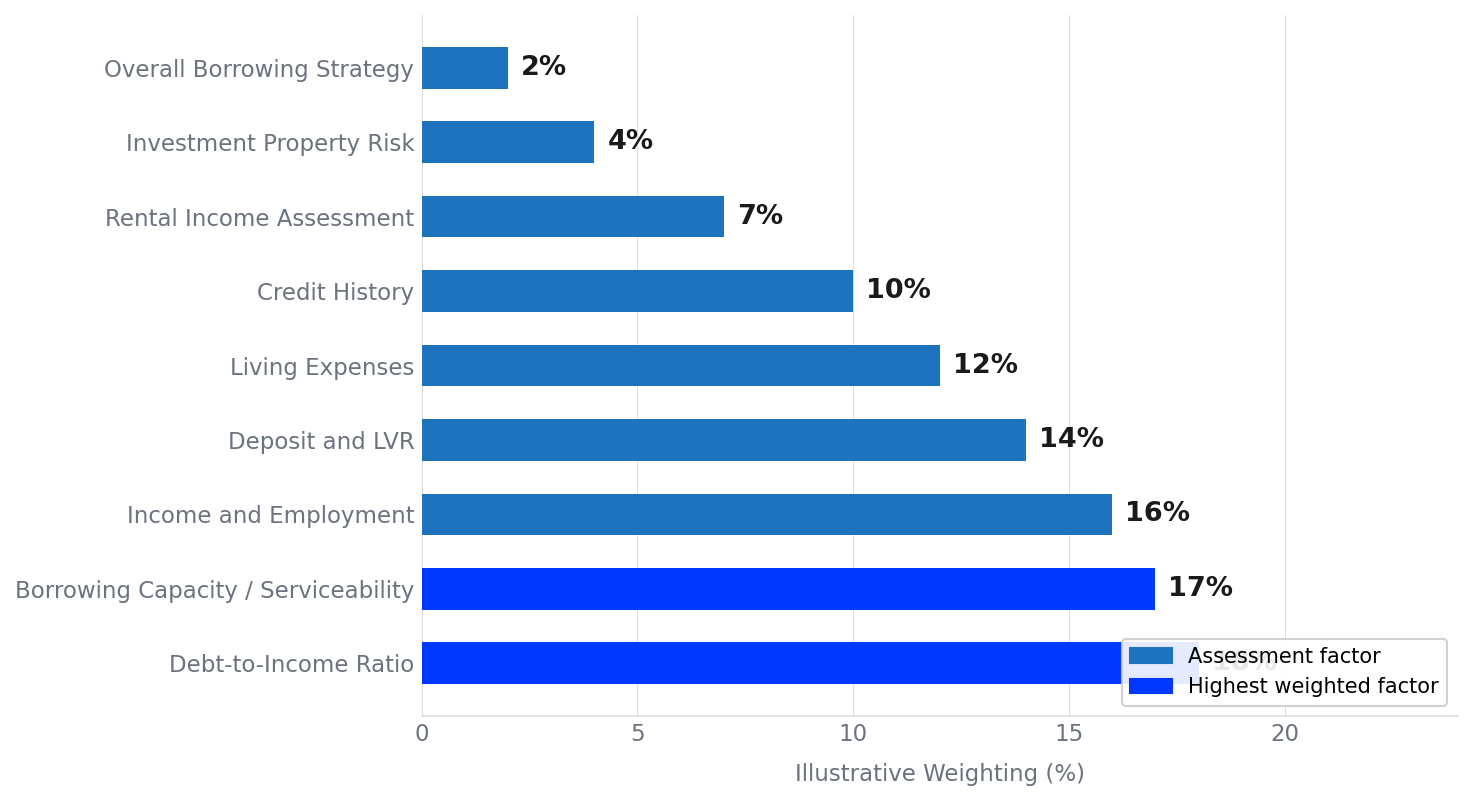
The 9 Lender Assessment Factors: Illustrative Weighting on Approval Decisions
Source: APRA: Residential Mortgage Lending Data and Macroprudential Policy
3. Your Deposit and Loan-to-Value Ratio
LVR thresholds and what each zone triggers for investment property lending
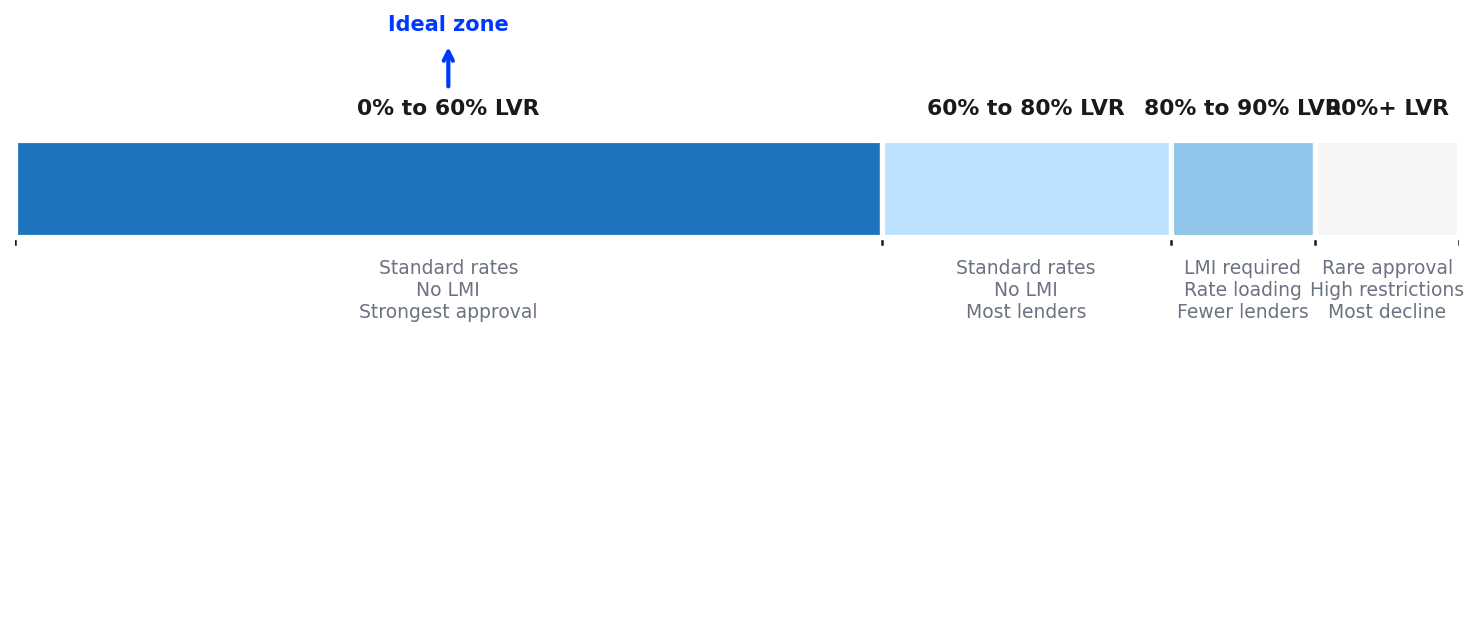
Loan-to-value ratio (LVR) is the loan amount expressed as a percentage of the property's assessed value. On a $700,000 property with a $560,000 loan, the LVR is 80%.
For investment lending, most major lenders will approve to a maximum of 80% LVR without Lenders Mortgage Insurance. Above 80%, LMI is typically required and adds $8,000 to $20,000 on a typical investment property purchase.
Many lenders further restrict investment lending above 80% LVR, apply rate loadings, or restrict the types of properties they will accept as security. Above 90% LVR, investment property approvals become rare among mainstream lenders.
LVR Zones and Their Impact on Investment Property Loan Approval
Source: ASIC MoneySmart: Understanding Lenders Mortgage Insurance
4. The Investment Property Itself
How property type and location affect a lender's security assessment
A bank does not lend money to a borrower. It lends money secured against an asset, which means the property must pass its own separate risk assessment before approval is granted.
Some properties fail this assessment regardless of how strong the borrower's financial position is. Apartments above a certain number of storeys, properties in postcodes with historically high default rates, studio apartments under 40sqm, and regional properties outside major centres all attract restricted lending.
Some lenders will not lend on these property types at all. Others will lend but reduce the maximum LVR to 70% or 60%. Understanding what makes a good investment property from a lending risk perspective is as important as understanding it from an investment return perspective.
5. Rental Income: What Banks Actually Count
The rental shading rule and why market rent is not your assessed income
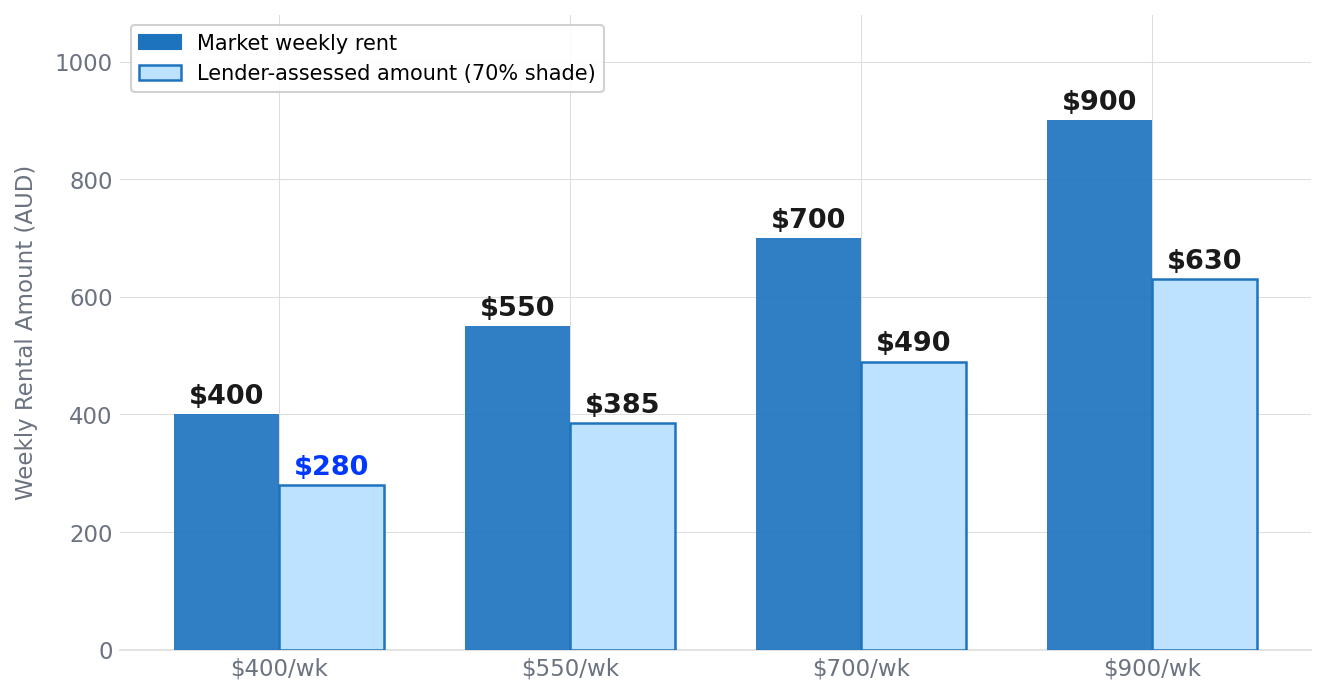
A property renting at $700 per week does not add $700 per week to your assessed income. Lenders apply a shading factor, typically 70% to 80% of gross rental, before crediting the income to your borrowing position.
On a $700-per-week rental, a lender applying 70% shading counts $490 per week. The gap between market rent and assessed rent reduces the income advantage of the investment property and requires a stronger base income to compensate.
This shading also applies to properties you already hold, and the gap compounds across multiple assets. The full detail on how this calculation works across lenders is covered in our article on whether rental income increases borrowing capacity.
Rental Income: Weekly Market Rent vs Lender-Assessed Amount at 70% Shading
Source: ATO: Residential Rental Property Income and Expense Assessment
6. Your Overall Borrowing Strategy
Why banks look beyond this loan to your future borrowing position
A lender approving an investment property loan is not just assessing this transaction. They are assessing the total debt position they will hold against you and the risk that the full position creates.
For investors planning to build beyond their first property, how you structure your first loan has direct consequences for what becomes possible at the second and third. Understanding the relationship between mortgage serviceability and portfolio expansion is what separates investors who scale from those who plateau.
How your loan is structured, the lender you choose, and how you document your income all affect how a future lender assesses your total exposure. This is why working with a specialist mortgage broker who understands the investment lending environment can change the outcome across a multi-property portfolio, not just on the first purchase.
7. How to Improve Your Chances of Investment Property Loan Approval
The most effective pre-application actions
The most impactful actions to strengthen an investment property loan application require lead time, not complexity. Reduce or close credit card limits you do not use, since the full limit counts against your DTI regardless of the current balance.
Pay down personal loan balances where feasible. Review your bank statements from the past three months and eliminate recurring spending that a lender might categorise as high discretionary. Build and maintain three to six months of genuine savings history.
On the income side, ensure your employment history shows stability and that any bonus or overtime income has been consistent enough to be documented across multiple tax years. Learn how to increase borrowing capacity before you begin comparing properties, and read our guide on how to get approved for a home loan for the documentation checklist you will need.
Final Thoughts
Getting approved for an investment property loan is a structured process, not a matter of luck or simply having enough income. Banks run nine distinct checkpoints, and a strong result on seven of them with a weakness on two can still determine the outcome.
The investors who move through the process quickly and cleanly are those who understood all nine criteria before they applied. That preparation is most effective before you have a property under offer, not after.
A specialist mortgage broker who works with investment property applications regularly will know which lenders are most favourable for your specific profile and which assessment policies create the most headroom. The nine checkpoints in this guide are not obstacles. They are a complete map of what the bank will measure.
Frequently Asked Questions
Recommended Reading
Two pages selected based on what readers of this article are most likely to need next.
Recommended Video
While many investors spend time researching growth areas and property types, this discussion highlights a different reality—your ability to continue investing is often determined not by what you buy, but by how your loans are structured and how your borrowing power is managed over time.