

Renovate or Hold? We Investigated Which Strategy Delivers Higher Returns
The property renovation industry is built on a powerful idea: renovate, and you will always come out ahead. Before-and-after shows, weekend flips on social media, and glossy property magazines have spent twenty years reinforcing it.
We decided to test it properly. We pulled CoreLogic capital growth data across five capital cities, ABS construction cost figures, and ATO tax treatment guidelines. Then we ran the numbers on two identical investors, one who renovates and one who holds, across five and ten-year periods in realistic Australian market conditions.
The findings are not what the renovation industry would want you to see. In high-growth markets, holding a well-located property and doing nothing often delivers a stronger net return than renovating, once every cost is properly accounted for. There are situations where renovation clearly wins. But they are more specific, and more conditional, than most investors realise.
Here is what the evidence actually shows.
Why Everyone Believes Renovating Always Wins
Start with the media. Every renovation program on Australian television follows the same structure: a tired property is bought, transformed over a few weeks, and sold or revalued at a number significantly higher than the purchase price. The presenter celebrates. The gross profit is announced. Credits roll.
What the credits never show is the invoice. Not the full one. Interest accrued during the project, weeks of lost rental income, the structural issue discovered in week two, the council approval that added six weeks to the timeline, the trades who quoted $30,000 and invoiced $41,000. The gross number is real. The net number tells a completely different story.
There is also selection bias at work. Investors who renovated and came out ahead talk about it. The ones who broke even or fell short usually do not. The renovation industry, which includes builders, designers, real estate agents who charge more on a renovated sale, and TV producers, has a financial interest in keeping the myth alive.
None of this means renovation is always wrong. It means the narrative around it is almost always incomplete.
What the Data Actually Shows
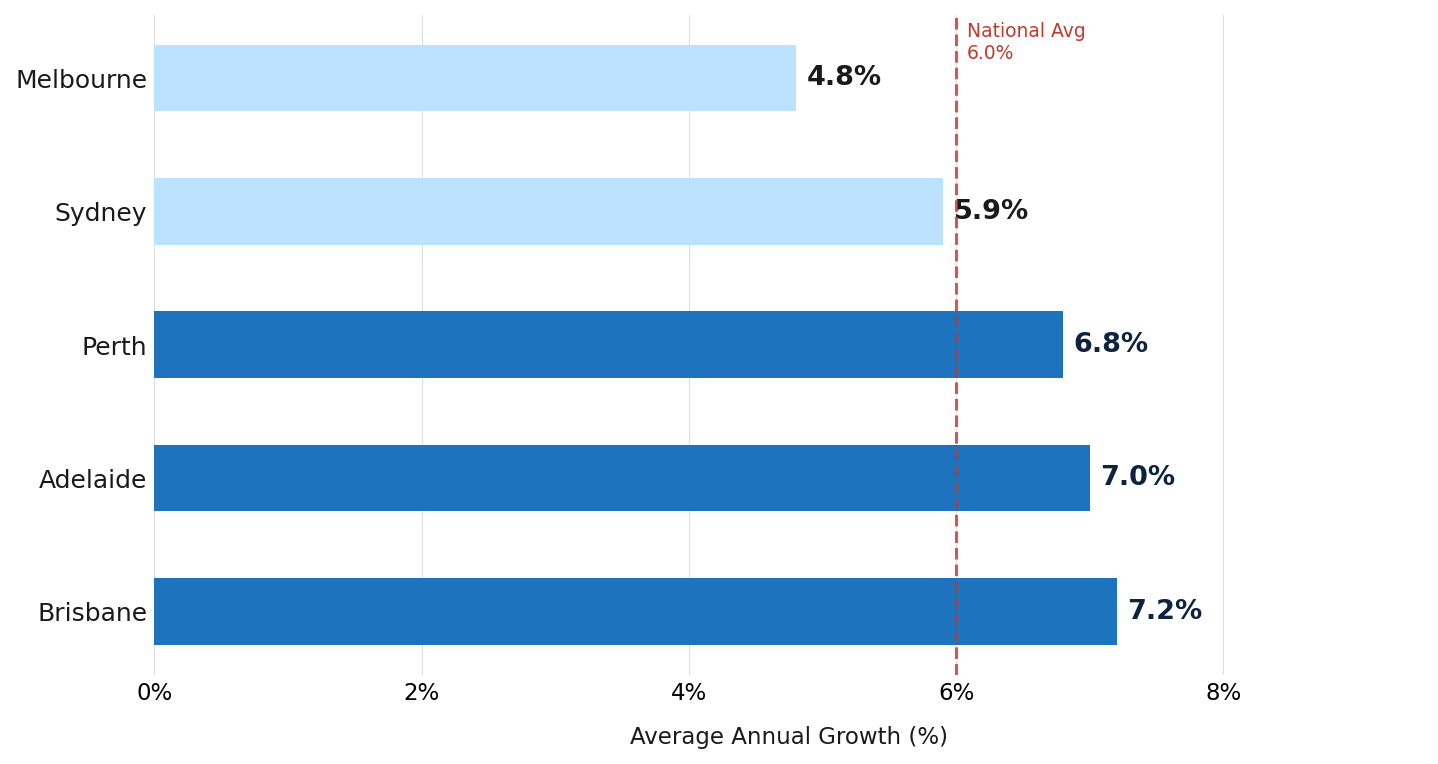
Australian residential property in major capital cities has compounded at rates most renovation projects struggle to beat. CoreLogic data for the ten years to 2024 shows Brisbane averaging 7.2% annual growth, Adelaide at 7.0%, and Perth at 6.8%. Sydney sits at 5.9% and Melbourne at 4.8% over the same period.
Run the mathematics on a $700,000 Brisbane property growing at 7.2% per year for ten years, and you arrive at approximately $1,402,000. That is $702,000 in capital growth from doing absolutely nothing. No trades, no dust, no budget meetings, no vacancy.
Now consider a typical cosmetic renovation: fresh paint, new carpet, kitchen update, bathroom refresh. ABS survey data puts the average residential renovation at $28,000 to $45,000. A well-executed $50,000 renovation in a strong market might add $60,000 to $70,000 in value at revaluation. The gross gain is real. But in a market already growing at 7%, that same property would have added approximately $50,400 in value in the twelve months the renovation took, simply by sitting there.
The renovation did not dramatically accelerate the outcome. It slightly improved the starting point while introducing significant cost and risk. That is a fundamentally different proposition to what most investors expect.
10-Year Average Annual Capital Growth: Major Australian Cities
Source: CoreLogic / Cotality Australian Property Market Review 2024
Renovate vs Hold: A Direct Comparison
Before we get to numbers, the side-by-side picture of both strategies across the factors that matter most to a property investor.
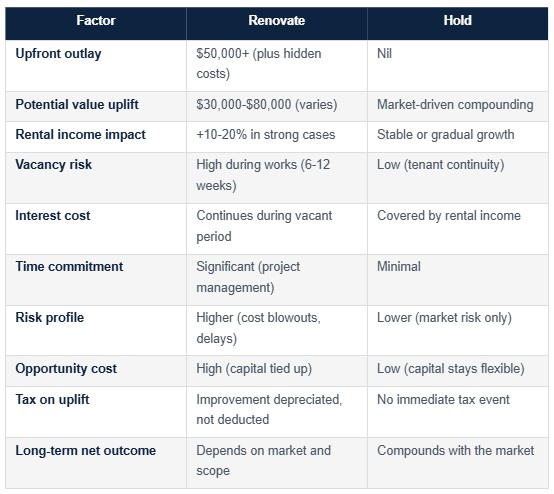
Two factors in that table consistently get underweighted in investor planning: vacancy and interest. For a $700,000 property with a $500,000 loan at a 6.5% interest rate, twelve weeks of vacancy during a renovation costs approximately $9,750 in interest and lost rent before a single tile has been grouted. That money is gone regardless of how good the renovation turns out. Understanding your borrowing capacity before committing to a renovation strategy determines whether the cash flow pressure during works is manageable or dangerous.
The True Cost of a Renovation
The renovation budget conversation in Australia has become almost comically predictable. An investor gets quotes, selects a figure they are comfortable with, adds a 10% contingency, and considers themselves prepared. They are not.
ABS data shows construction cost inflation ran at 9.7% in 2022-23. Trades that quoted $40,000 in early 2023 were invoicing $45,000 to $48,000 by mid-year as material costs rose mid-project. This is not exceptional. It is the baseline expectation for any renovation that extends beyond six weeks.
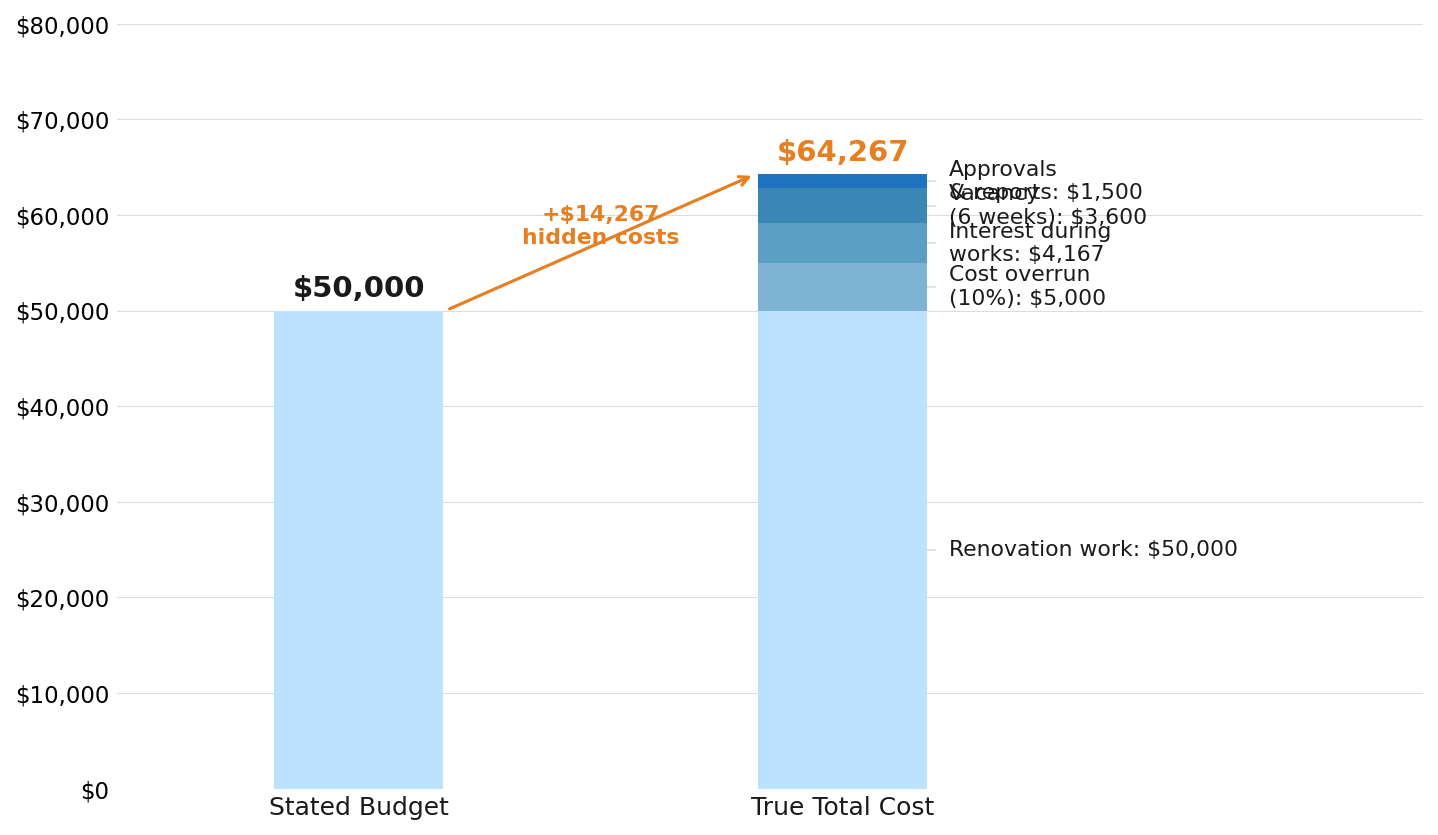
Then there are the costs that never appear in the renovation quote at all. Interest accrues on the investment loan whether the property is tenanted or not. Vacancy for even a modest six-week renovation at $600 per week in rental income is $3,600 that simply does not arrive. Council development approval for anything beyond cosmetic work adds two to six weeks and $1,500 to $3,000 in fees. Strata approval, where relevant, adds another layer. Structural engineering reports for load-bearing changes run $800 to $2,000.
Add it together and a stated $50,000 renovation budget in practice costs closer to $64,000 to $72,000, depending on the project scope. That is the number every investor should be modelling before they pick up the phone to a builder.
The True Cost of a "$50,000 Renovation"
Source: ABS Survey of Building Activity 2023; ATO rental property guidance
There is also the tax treatment to consider. The ATO distinguishes sharply between repairs and maintenance (fully deductible in the year incurred) and capital improvements (depreciated over time, with rate depending on the asset type). A full kitchen replacement is a capital improvement. Replacing a broken tap washer is a repair. Most investors know this in theory and get it wrong in practice, creating unexpected tax liabilities that further erode the net renovation return. Your investment property tax position is worth reviewing with a specialist before a renovation is planned, not after.
When Renovating an Investment Property Makes Clear Sense
This article is not arguing that renovation never works. It is arguing that it works in specific, identifiable circumstances that most investors need to be far more disciplined about checking before they start.
Cosmetic renovations with a sub-$20,000 spend are the clearest positive case. Fresh paint, new carpet, updated light fittings, and a kitchen respray can lift rental income by 10-15% in a competitive rental market. At that spend level, the true cost hurdle is low enough that even a modest yield improvement pays back quickly. Knowing whether your suburb rewards yield improvement or just growth is the first call to make, and the relationship between yield and capital growth across different markets shapes the entire renovation calculation.
Adding a bedroom or functional bathroom in a market that demonstrably pays a premium for that configuration can generate strong returns. A three-bedroom property in a suburb where families are competing for rental stock will command meaningfully higher rent than a two-bedroom. The key word is demonstrably: this needs to be verified by comparable rental data, not assumed.
Buying below market value specifically because of condition is the cleanest renovation case. If you purchased a property at a genuine 15% discount because it needed work, renovating it back to market condition is not optional; it is recovering the discount you captured at purchase. The renovation was built into the acquisition strategy. That is different from renovating a property you paid market value for.
Flat or slow-growth markets change the arithmetic significantly. In a suburb where capital growth is running at 2-3% per year, holding delivers modest compounding gains. A well-executed renovation that generates even a 10-15% value uplift and a meaningful rental improvement can genuinely outperform the hold strategy. The characteristics of a good investment property include understanding which growth profile applies to the suburb before a capital commitment is made.
When Holding Delivers Better Returns
The case for holding in a strong growth market is straightforward but chronically underappreciated. When a suburb is growing at 7% per year, every dollar of property value is working. The growth compounds on itself. A property worth $700,000 today does not need to be touched for it to deliver $677,000 in capital gains over ten years at that rate. No trades, no vacancy, no budget overruns.
The opportunity cost of renovation capital is the factor that separates sophisticated investors from everyone else. When you spend $64,000 on a renovation, you are not just spending $64,000. You are also forgoing whatever that capital could have achieved if deployed elsewhere.
That same $64,000 used strategically as leverage toward a second property can generate compounding growth on an entirely separate asset. Two properties growing in a strong market produce more total wealth than one renovated property over a ten-year period in most scenarios. The mechanics of using equity to buy another investment property is how sophisticated investors compound their portfolios without spending renovation dollars.
There is also the tenant continuity argument, which rarely gets the attention it deserves. A long-term tenant in a well-maintained property is a financial asset. Vacancy to renovate disrupts that relationship. Finding and settling a new tenant typically costs four to six weeks of rent plus a property management fee. In high-demand rental markets, the relationship between rental income and your overall financial position is worth protecting rather than interrupting.
FOR EXAMPLE
An investor holds a $700,000 property in Brisbane with a long-term tenant paying $620 per week. Instead of spending $64,000 on a renovation, they use that capital as a deposit contribution toward a second property in Adelaide valued at $550,000. Both properties grow at approximately 7% per year. After ten years, the combined capital growth from two properties significantly exceeds what the renovated single property would have produced. The renovation budget became a portfolio builder instead of a refurbishment.
The Case Study: Investor A Renovates, Investor B Holds
Two investors. Identical properties. Identical suburbs. Identical starting prices. One renovates. One holds. We ran both scenarios using CoreLogic's historical Brisbane growth rate of 7% per year and realistic renovation cost figures from ABS and industry data.
Investor A spends $50,000 on a cosmetic renovation. The true all-in cost after interest during works, vacancy, council approval, and a 10% cost overrun is $64,267. The renovation delivers a $65,000 gross value uplift at revaluation. Net position improvement at year zero: $733. The property value at year zero post-renovation is $765,000.
Investor B holds. They do not touch the property. They keep the $50,000 liquid, either in offset against the loan or building toward their next deposit. Their property value at year zero is $700,000.
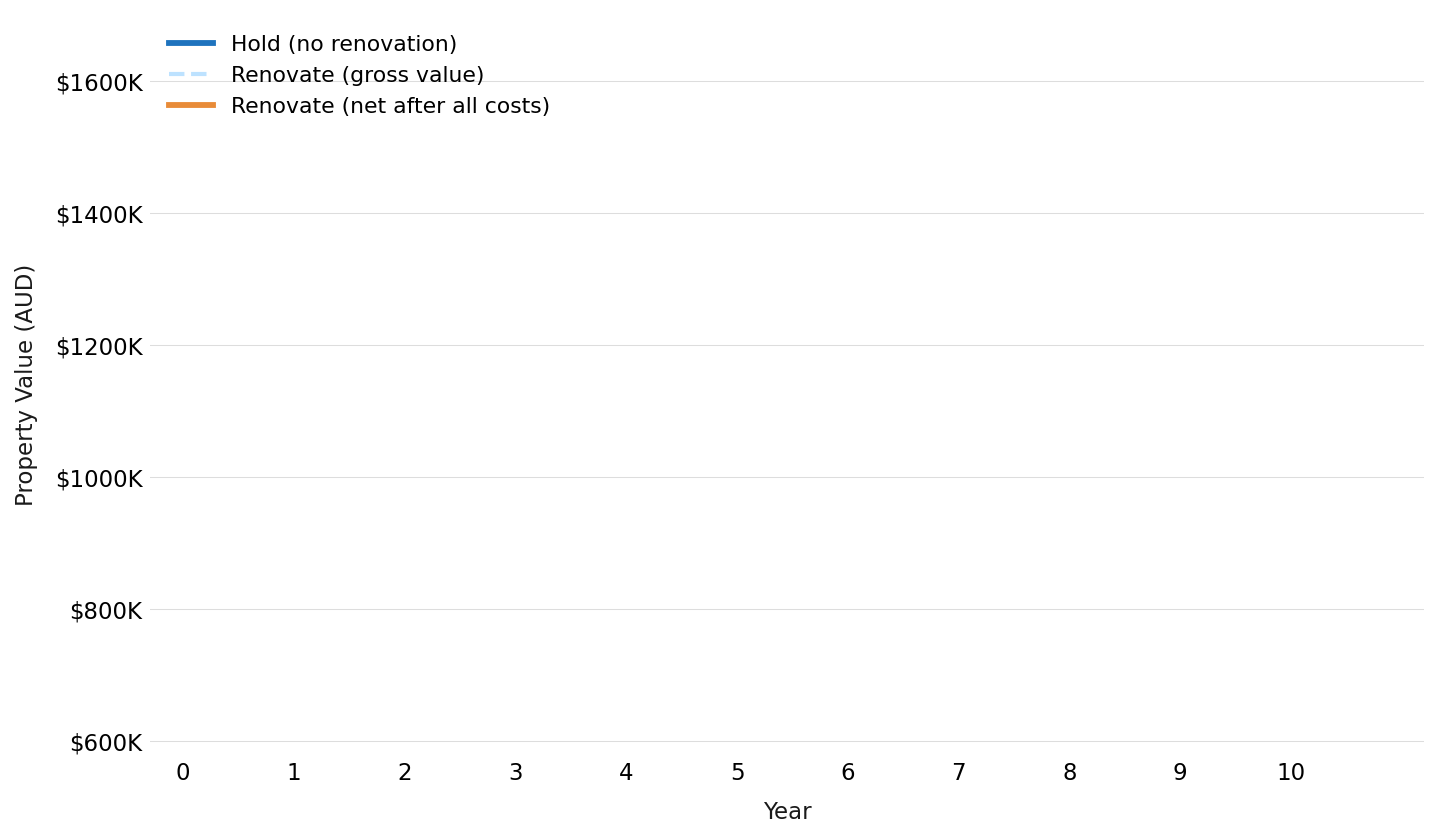
10-Year Value Trajectory: Renovate vs Hold on a $700,000 Property (7% Annual Growth)
Source: CoreLogic Brisbane median growth data; FPW Group analysis; ABS renovation cost data 2023
The gross renovation line (dashed light blue) looks significantly better on the chart. That is the number the renovation industry would show you. The net line (orange) is what the investor actually experienced after paying for the strategy.
Now change one variable: Investor B deploys the $50,000 toward a deposit on a second property instead of leaving it in cash. Over ten years, two compounding assets producing returns at historical rates generates a total wealth position that no single-property renovation strategy can match.
Questions Every Investor Should Ask Before Renovating
Before committing renovation capital, these are the questions that change the answer:
Will this renovation generate more value than the market would have delivered on its own? Calculate what the property would be worth in 12 months at current suburb growth rates without touching it. If the renovation needs to outperform that baseline to justify the true cost, confirm the numbers actually support it.
What is the true all-in cost, not the quote? Add interest during works, expected vacancy, council and strata approvals, a 10-15% cost overrun buffer, and the opportunity cost of the capital tied up. That is your real renovation budget.
Could this capital buy another property instead? If the renovation budget is $50,000 or more, it is worth running the two-property scenario. The mechanics of building a property portfolio often show that the second acquisition produces more wealth over ten years than a renovation on the first.
Is this a capital growth market or a yield market? In a suburb growing at 7% per year, holding compounds. In a suburb growing at 2-3%, renovation has to do more work. Know which environment you are operating in before deciding which strategy to apply.
Am I renovating for the tenant, the market, or myself? Investors consistently over-renovate to personal preference. Stone benchtops and custom joinery in a property where tenants are paying $450 per week do not return what they cost. Property investment mistakes made by first-time investors frequently involve renovating to a standard the market will not pay for.
What happens if the renovation runs over time or budget? Model the scenario where the project takes four weeks longer than planned and costs 20% more than quoted. If that scenario creates a cash flow problem, the renovation is carrying more risk than the expected return justifies.
Final Verdict: A Decision Framework
After reviewing the data, the case studies, and the real cost structures of renovation in the Australian market, the evidence points to a clear conclusion. Renovation is a tool. It is not a default strategy, and it is not a reliable path to superior returns in every market condition.
The investors who use renovation successfully treat it as a precision instrument: deployed in specific circumstances, with a rigorous cost model, and a clear rationale for why the renovation will outperform what the market would have done anyway. The investors who struggle with renovation treat it as an intuition, spending on what feels like an improvement without confirming the numbers support the decision. The FPW Group property investment framework is built around the second question, not the first: is this the right use of capital at this moment, in this market, given everything else available to you?
Renovate when:
The property was purchased below market value specifically because of its condition.
The renovation scope is cosmetic and the budget is under $20,000 with a clear rental yield improvement.
Adding a bedroom or bathroom in a market where comparable sales confirm the configuration premium.
The suburb has flat or slow capital growth and renovation is the only realistic path to return improvement.
The rental income improvement is measurable, immediate, and supported by comparable leasing data.
Hold when:
The suburb has strong historical capital growth above 6% per year and supply constraints support continuation.
The renovation capital could be deployed toward a second property acquisition instead.
The renovation is structural or cosmetic above $30,000 with no clear yield improvement data to support it.
A long-term tenant is in place and disruption would create vacancy risk in a tight cash flow situation.
The honest answer to "am I renovating for the market or for myself?" is not the market.
The most important realisation from this investigation is that in Australia's strongest growth markets, the market itself is the strategy. Buying the right property in the right suburb, managing it well, and holding long enough for compounding to do its work is a genuinely competitive approach to wealth creation. The question is not whether you can make a renovation work. It is whether the renovation will outperform the alternatives. More often than the renovation industry would like to admit, the answer is no.
Frequently Asked Questions
Recommended Reading
Two pages selected based on what readers of this article are most likely to need next.
Recommended Video
Most buyers think success comes from timing the market, but the real difference between people who build wealth and people who get stuck comes from buying the right asset with the right strategy, structure and support.