

What Investors Should Do Before the SMSF Borrowing Ban Takes Effect
For anyone tracking SMSF property investing in Australia, 2026 has delivered a genuine shock.
The Albanese government confirmed a deal on 23 June 2026 to ban new limited recourse borrowing arrangements (LRBAs) for residential property held inside self-managed super funds. The law takes effect around mid-August. But the practical window is already closing, as lenders pull their SMSF residential products before the deadline arrives.
Most coverage has focused on what is shutting down, and we have included it here as well. However, far less has been written about what stays open, what the numbers look like across structures after the 2026 Budget changes, and where the real opportunity now sits for property investment in 2026.
That is the gap this article fills.
What Is an LRBA?
LRBA stands for Limited Recourse Borrowing Arrangement. It is a type of loan that allows an SMSF to borrow money to purchase a single asset, which is held in a separate bare trust until the loan is repaid.
The "limited recourse" part is the defining feature. If the fund defaults on the loan, the lender can only claim that one asset. The rest of the super fund stays shielded.
How an LRBA Works: The Structure
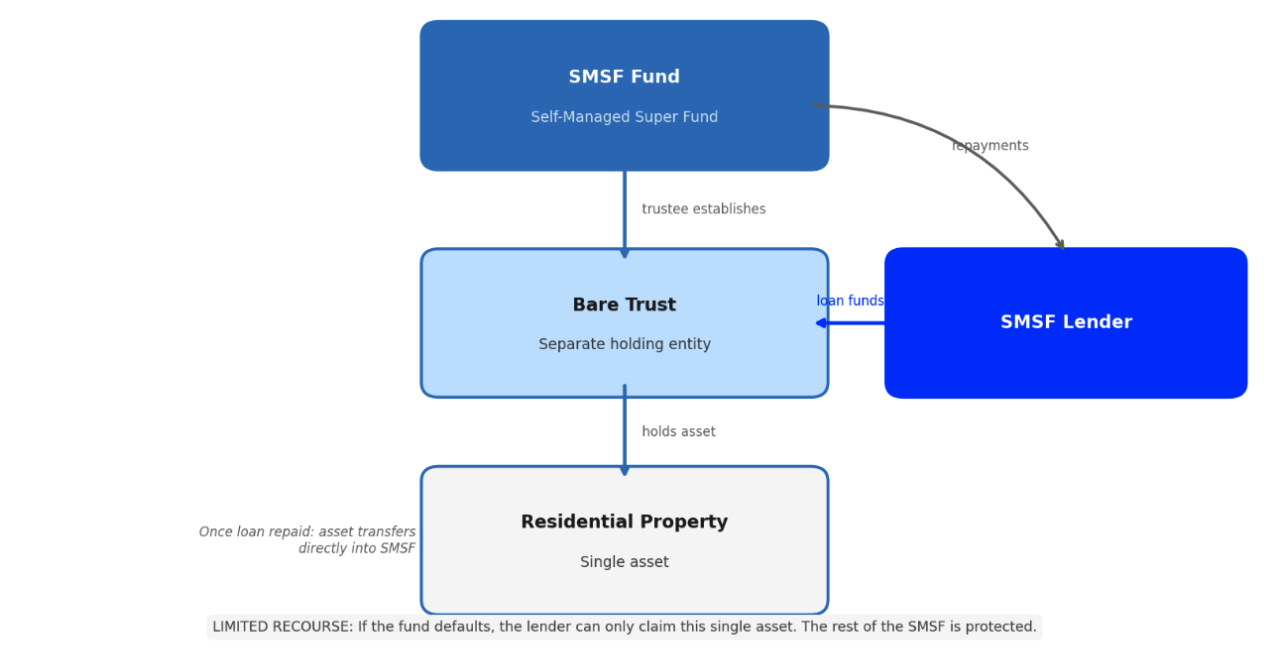
Source: Diagram based on Superannuation Industry (Supervision) Act 1993, s.67A
The structure works in three steps. The SMSF sets up a bare trust to hold the property during the loan period. The fund makes loan repayments over time. Once the debt is cleared, the asset transfers from the bare trust directly into the SMSF.
LRBAs have been available since 2007. Tens of thousands of Australian SMSF trustees used them to leverage into investment property inside super. The structure was always controversial among regulators, who argued it increased risk concentration inside retirement savings. The ban is the culmination of that concern.
What Exactly Is Being Banned
The ban is narrower than the headlines suggest.
The government is not shutting down SMSFs as investment vehicles, and it is not touching the broader superannuation tax settings. What it removes is one specific borrowing mechanism: the LRBA used to buy residential property.
The amendment, moved by the Greens in the Senate on 23 June 2026 and tied to the government's Tax Reform No. 1 Bill, removes this pathway for residential property only. Commercial property LRBAs are untouched. SMSF investing in shares, ETFs, and managed funds is untouched. Outright residential purchases without borrowing are untouched.
When Does the Borrowing Ban Start?
The Senate deal was confirmed on 23 June 2026. Royal Assent was expected before parliament breaks for winter on 2 July 2026. The ban takes effect roughly 45 days after that, pointing to mid-August 2026 as the operative date.
SMSF Borrowing Ban: Key Dates
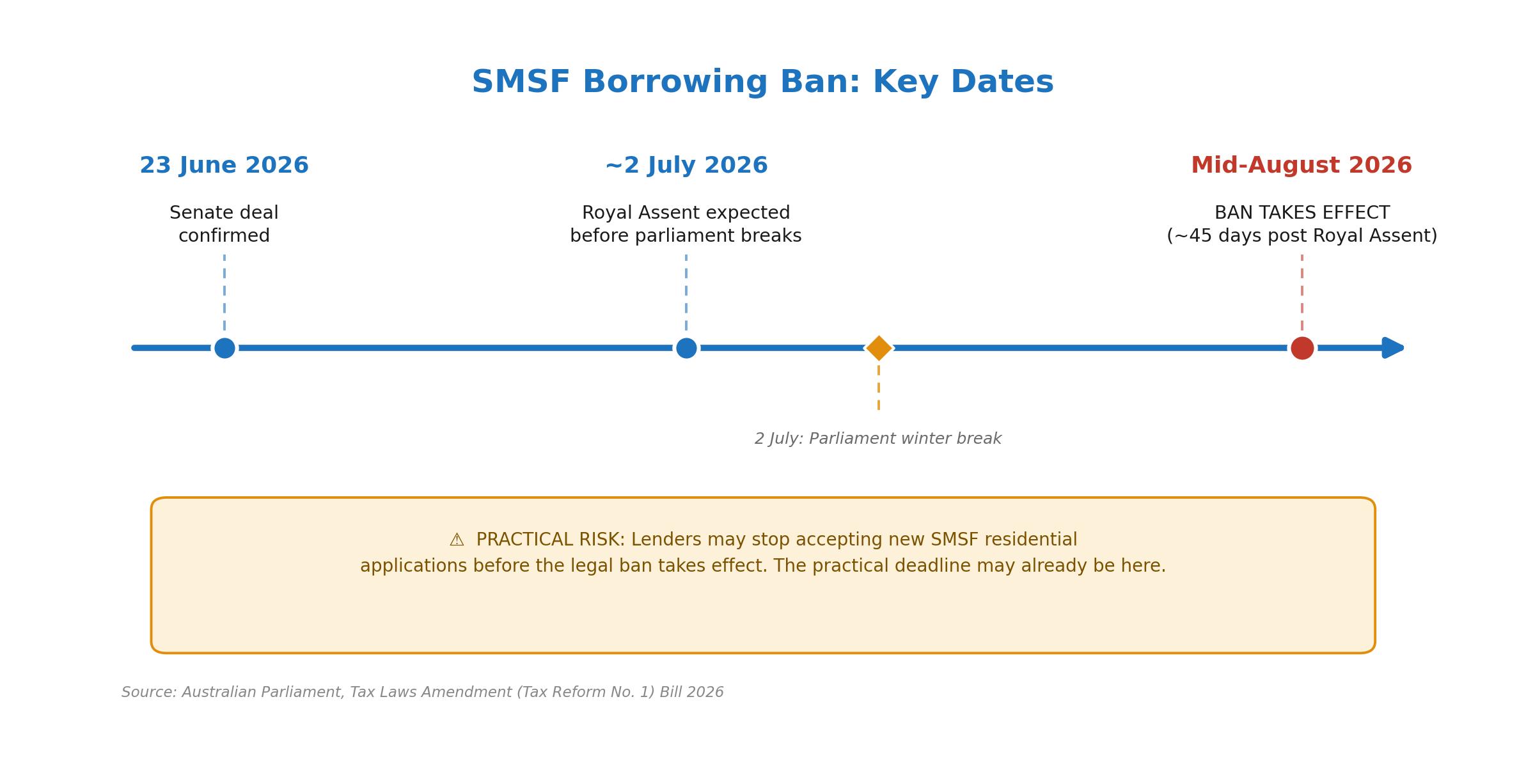
Source: Australian Parliament, Tax Laws Amendment (Tax Reform No. 1) Bill 2025
But the legal deadline and the practical deadline are not the same thing.
Banks and specialist SMSF lenders are already reviewing their product offerings. Some are expected to stop accepting new SMSF residential applications before the law officially starts. If your approval depends on a lender product that gets pulled, the mid-August date no longer applies to your situation.
There is also the contract protection rule. Contracts exchanged before the ban start date are grandfathered, even if settlement occurs after. But a conditional offer or a verbal commitment does not qualify. You need a signed exchange.
Can an SMSF Still Borrow to Buy Property?
Yes. But only for commercial property.
The ban is specifically on new LRBAs for residential real estate. If your SMSF wants to borrow to buy a commercial premises, industrial property, or business real property under section 66 of the SIS Act, nothing has changed.
For business owners, this is still one of the most tax-efficient structures available. Borrow inside the SMSF to buy the premises your business operates from, lease it back at market rent, and pay 15% tax on that income in accumulation. Zero in pension phase.
For residential property, new LRBAs are closed from mid-August. There are no exceptions based on fund size, borrower type, or history. Every new residential LRBA from that date is prohibited.
What Happens to Existing SMSF Loans?
Nothing changes.
Existing LRBAs are fully grandfathered. If you already hold residential property inside your SMSF through an LRBA, your arrangement continues exactly as structured. You are not required to exit the loan, refinance, or sell the property.
This is a prospective ban. It closes a door for new transactions. It does not reach back and unwind what already exists. The negative gearing grandfathering rules that apply to property held outside super follow a similar principle. Existing arrangements are preserved. New ones face the updated settings.
That said, this is a sensible time to review your loan terms, check expiry dates, and make sure your records for CGT valuation purposes are current. Not because the ban forces any of that, but because it is sound management of any long-term loan.
What Is Still Allowed Inside an SMSF After the Ban
Commercial Property LRBAs Are Fully Preserved
The ban targets residential property only. LRBAs for assets that meet the business real property test under section 66 of the SIS Act are explicitly untouched. This includes commercial, industrial, and business premises used wholly and exclusively in a business.
For business owners, this remains one of the strongest plays in the market. You can borrow inside your SMSF to buy the premises your business operates from, lease it back at market rent, and pay 15% tax during accumulation. Nothing in pension phase.
Outright Residential Purchases Are Still Allowed
The ban is on borrowing to buy residential property, not on holding it. An SMSF with enough cash or liquid assets can still purchase residential investment property outright, with no LRBA required.
The tax treatment stays the same. The 2026 Budget changes to negative gearing and the CGT discount apply to property held outside super. Inside an SMSF, the pre-reform settings still apply to new purchases of existing residential property.
Shares, ETFs, and Managed Funds Are Unaffected
SMSF investment in listed shares, ETFs, managed funds, bonds, and other non-property assets sits completely outside this legislation. The ban is surgical in its reach.
The Tax Case for SMSFs Has Not Weakened
This is the part getting lost in the coverage.
The tax advantages of the SMSF structure are completely intact. Income inside an SMSF is taxed at 15% during accumulation. Capital gains on assets held longer than 12 months are taxed at an effective 10% (15% applied to two-thirds of the gain). Once members move to pension phase, both income and gains drop to 0%.
Compare that to holding the same property in your personal name after the 2026 Budget: no 50% CGT discount, tighter negative gearing rules on new purchases, and marginal rates on rental income that reach 47% for high earners.
Tax on $30,000 of Rental Income, by Ownership Structure
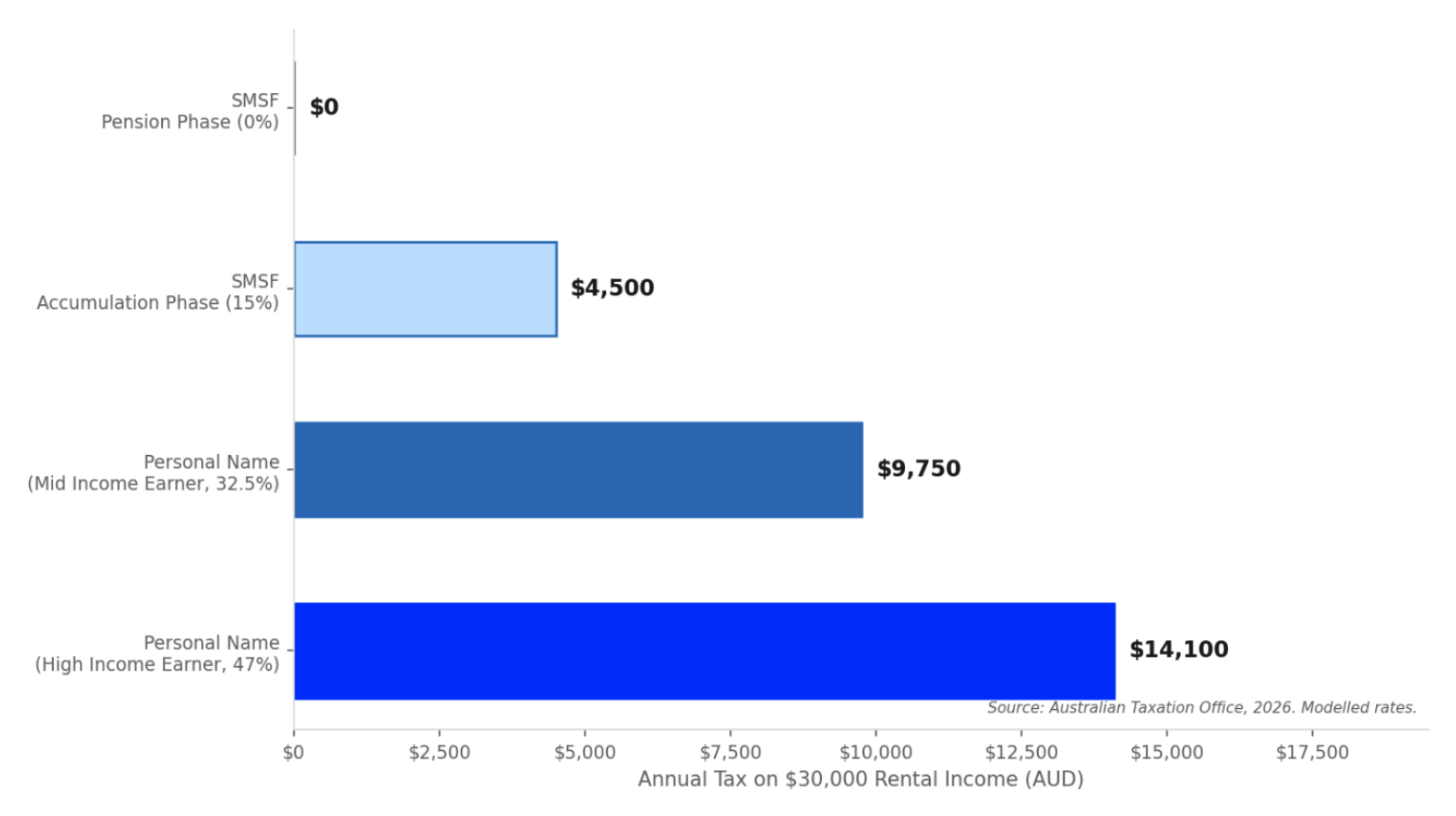
Source: Australian Taxation Office, 2026. Modelled tax rates.
The ban removed leverage for new residential deals. It did not remove the tax advantage. Those are different things, and conflating them leads to poor decisions in both directions.
Alternatives if the Ban Proceeds
If the residential LRBA pathway is closing permanently, what are the realistic options?
Outright SMSF Purchase
An SMSF with sufficient cash or liquid assets can still buy residential property outright. The same 15% and 0% tax treatment applies. The constraint is capital. Funds that can do this are in a relatively stronger position now, because the pool of SMSF residential buyers has just been narrowed significantly.
Commercial LRBA
If your investment thesis includes commercial property, the borrowing pathway inside an SMSF is completely open. For business owners buying their own premises, the value proposition has become more differentiated now that residential LRBA competition has been reduced. Whether rental income and long-term capital growth make sense depends on weighing yield vs capital growth carefully against your fund's timeline and pension phase plan.
Personal Name or Family Trust
Both are simpler to set up, but neither offers the SMSF's tax treatment. After the 2026 Budget, personal name ownership of new investment property no longer qualifies for the 50% CGT discount. A family trust distributes income to beneficiaries at their marginal rates. Neither structure gets close to 15% on income or 10% on capital gains.
Capital Gains Tax on a $200,000 Property Gain
Image here
Source: Australian Taxation Office, 2026. Asset held more than 12 months. Modelled at highest marginal rate.
Should Investors Buy Before the Changes?
Only if you were already committed.
Buying purely to beat a deadline, without due diligence, confirmed finance, and a clear investment thesis, is how investors make expensive decisions that take years to recover from.
Here is what protection actually means. Contracts exchanged before the ban start date are grandfathered, even if settlement happens after mid-August. But that requires a signed contract, not a verbal commitment or a conditional offer. The protection applies to the exchange date, not the intention date.
Finance matters too. Some lenders are already pulling SMSF residential products ahead of the legal deadline. If your approval has not been confirmed in writing, your actual window may already be closed. Rushing to beat a policy change without solid numbers behind you is a property investment mistake that looks obvious in hindsight.
If you were already through due diligence and have confirmed finance, move quickly. Talk to your broker and SMSF administrator this week.
What Investors Should Do Right Now
The right move depends entirely on where you sit in the process.
If You Were Actively Planning an SMSF Residential Purchase
Move now. Speak to your SMSF administrator and your broker this week. If you can exchange contracts before the start date, you are protected. Check whether any conditional finance approval still holds. Some lenders may restrict new SMSF residential applications before the legal ban takes effect.
If You Already Hold Residential Property in Your SMSF
Nothing needs to change. Your arrangement is grandfathered. Review your loan terms, keep your records for CGT valuation dates, and continue managing the property as normal.
If You Were Considering SMSF Property but Had Not Committed
The residential borrowing pathway is closing, but the strategy still deserves a proper review. An SMSF with enough capital to buy without borrowing may still make sense, depending on your tax position and pension phase timeline. If you were eyeing a commercial premises, the LRBA route is fully open.
If You Are Building a Property Portfolio More Broadly
The combined effect of the 2026 Budget reforms, the CGT changes, the tightened mortgage serviceability requirements, and now the SMSF borrowing ban, makes structure more important than it has been in a generation. Which entity holds which property, in what sequence, with what finance, now carries tax consequences that compound significantly over time. If you do not have a clear structure mapped out, the time to fix that is before more policy lands on top.
Final Thoughts
The SMSF residential borrowing ban is real, it is close, and the practical deadline driven by lenders is likely earlier than mid-August.
It is also narrower than the coverage suggests. Existing arrangements are safe. Commercial borrowing is untouched. The tax advantages are intact.
For investors who can buy without borrowing, the SMSF may now be more attractive than ever, particularly next to holding property in a personal name under the post-2026 Budget rules.
The investors who fare worst will be the ones who panic without checking their actual position, or who delay assuming mid-August gives them more time than they have.
Frequently Asked Questions
Recommended Reading
Two pages selected based on what readers of this article are most likely to need next.
Recommended Video
Nine years later, one has $780,000 in equity and almost zero in friction costs. The other has $435,000 in equity and paid over $100,000 in tax and transaction costs getting there. Same market and asset class. Yet completely different outcomes because of one decision made early.
Disclaimer: This article is general information only and does not constitute financial, legal, or investment advice. The SMSF borrowing ban legislation was confirmed on 23 June 2026 but had not yet received Royal Assent at publication, and details may change. Always consult a qualified financial adviser, SMSF specialist, or legal professional before making decisions about your superannuation or investment structure. FPW Group holds an Australian Credit Licence.