
Brisbane Real Estate Australia: Is It a Good Place to Invest?
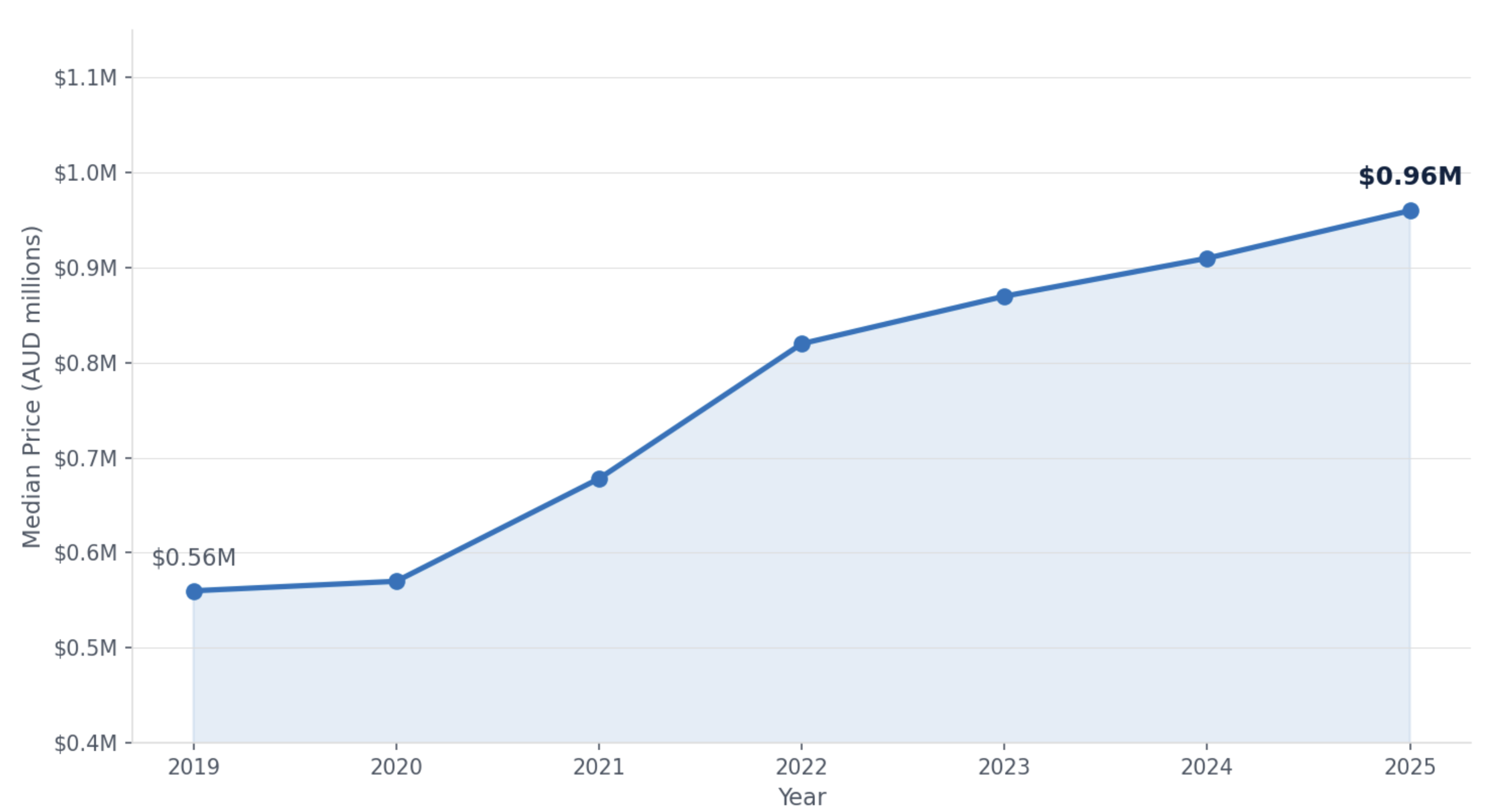
Brisbane real estate Australia has become one of the most-watched property markets in the country. In 2021, Brisbane's median house price sat below $700,000. By mid-2025, it had crossed $960,000 and is still climbing.
What's driving it? Population growth, interstate migration, a constrained housing supply, and a pipeline of infrastructure investment that rival cities haven't seen in decades.
The question investors are asking isn't whether Brisbane is growing, it’s whether the entry point still makes sense and where the best value now sits. Our guide on property investment in Australia explains the broader national picture if you want context beyond Brisbane specifically.
This article breaks down the Brisbane market, suburb by suburb, with the data investors need to make an informed call.
Why Brisbane Real Estate Is Attracting Investors
Population Growth and Interstate Migration
Queensland has recorded the highest interstate migration of any state over the past four years. Families priced out of Sydney and Melbourne have consistently chosen Brisbane, drawn by lifestyle, affordability, and employment opportunities.
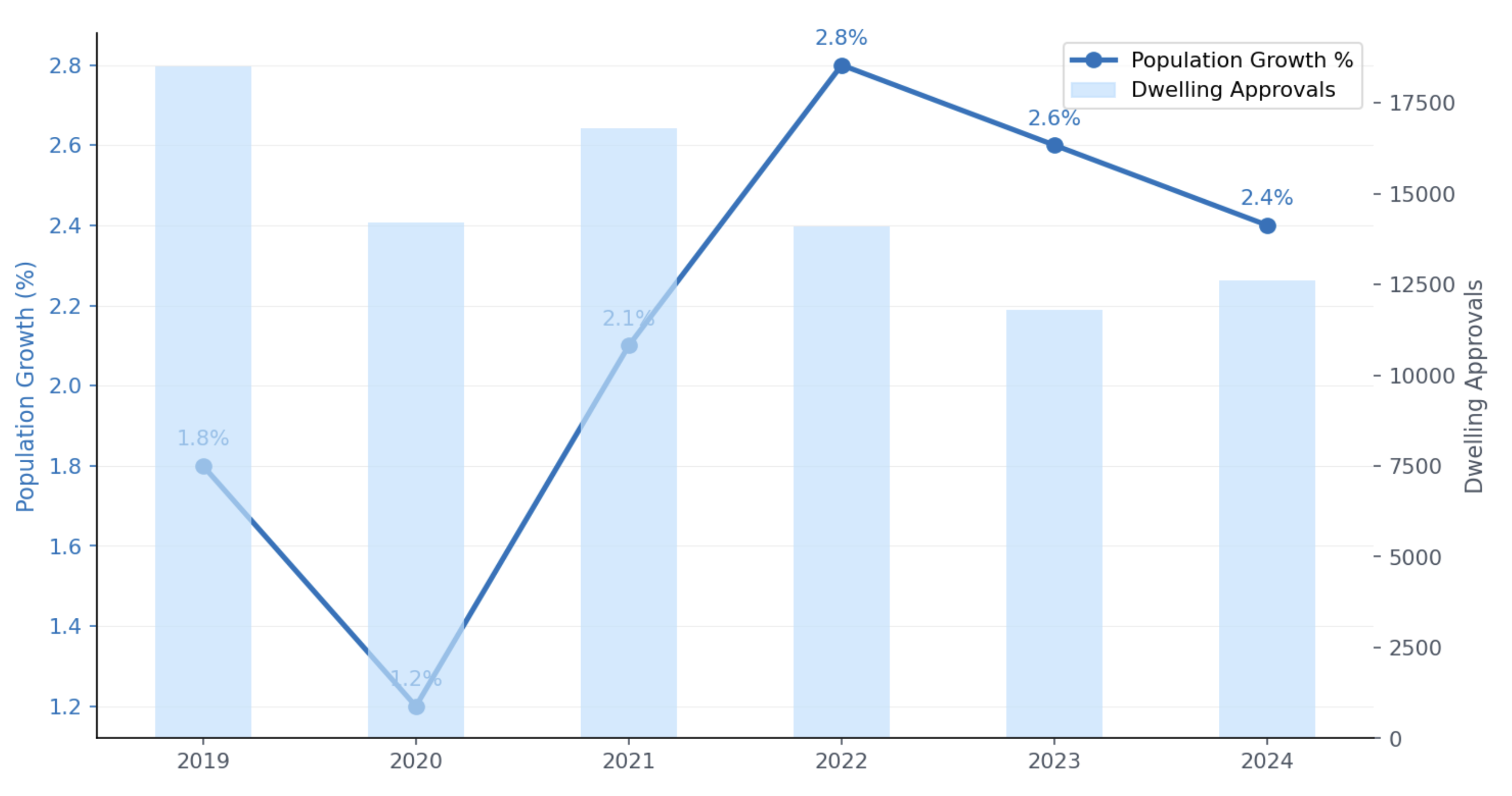
Greater Brisbane's population is expected to reach 3.1 million by 2041, up from 2.6 million today. That trajectory creates sustained demand for housing at every price point and every property type.
Population Growth vs Dwelling Approvals (2019-2024)
Source: ABS, Building Approvals Australia & Regional Population Growth, 2024
Employment and Economic Fundamentals
Brisbane's economy has diversified well beyond its traditional resources and logistics base. Technology, healthcare, education, and professional services now employ a significant share of the workforce, creating stable income households capable of supporting higher property prices.
Unemployment in Greater Brisbane sits below the national average. That matters to investors because sustained employment underpins both rental demand and owner-occupier buying capacity.
Major Infrastructure Projects Driving Demand
The Cross River Rail project, Coomera Connector, and ongoing Brisbane Metro expansion are each reshaping suburb catchments. Areas previously considered outer-ring are becoming commuter-viable, which typically triggers revaluations 12 to 24 months before project completion.
Queensland's preparation for major international events through 2032 also locked in billions in government spending on transport, venues, and urban renewal. That infrastructure commitment has a well-documented historical correlation with property price growth across Australian capital cities.
Brisbane Property Market Overview
Current Brisbane Property Prices and Recent Growth
Source: CoreLogic, Home Value Index, 2025
As of 2025, Brisbane's median house price sits at approximately $960,000. Units remain significantly more affordable, with a city-wide median around $620,000. That spread creates distinct entry strategies for investors depending on their budget and investment goals.
Brisbane's vacancy rate has held below 1.5% for the past two years. Anything below 2.0% is generally considered a landlord's market, giving investors significant leverage on lease terms and rental pricing.
Supply and Demand Dynamics
New dwelling completions have not kept pace with population growth since 2021. The housing shortage in Australia is especially pronounced in Brisbane, where development approvals have actually declined at a time when demand is accelerating. That mismatch is expected to persist through at least 2027 based on the current approval pipeline.
The combination of constrained supply, high migration, and rising construction costs has created a floor under Brisbane property prices that analysts view as structurally different from previous cycles.
Is Brisbane a Good Place to Invest?
Capital Growth Potential
Over the 10 years to 2025, Brisbane has delivered compound annual capital growth of approximately 7.2% for houses. That sits above the long-run national average and above Melbourne's equivalent figure for the same period.
The question is whether that rate is sustainable. The consensus among analysts is that Brisbane still has room to grow, not at the pace of 2021 and 2022, but at a steady rate supported by population and infrastructure fundamentals.
Rental Yield Opportunities
Source: REIA, Real Estate Market Facts, Q1 2025
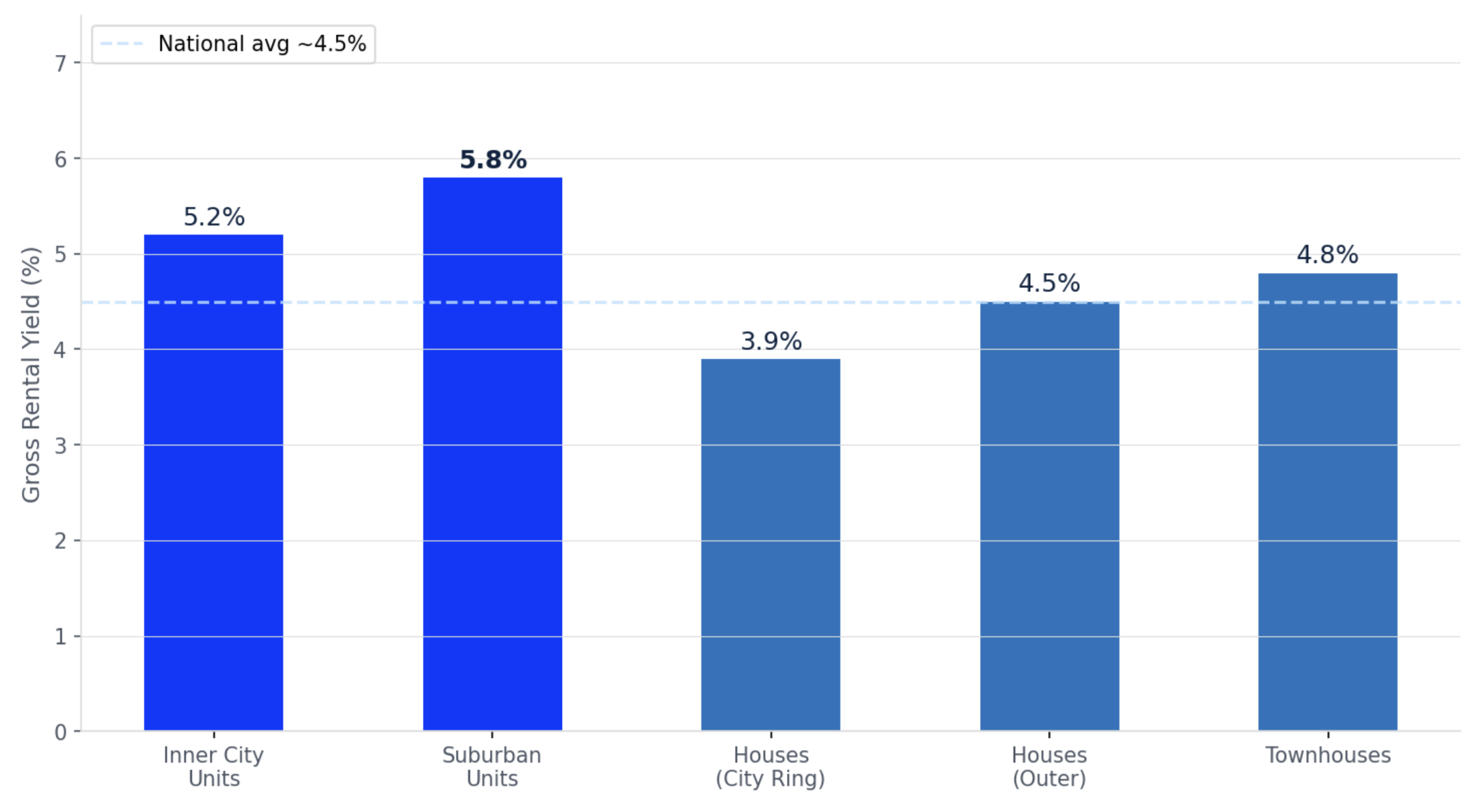
The yield profile in Brisbane has improved markedly since 2021 because rents have grown faster than property prices in many segments. That has narrowed the gap between yield-focused and growth-focused strategies, giving investors more flexibility than they had in 2019 or 2020.
Understanding how to balance yield against capital growth is worth examining carefully. Our article on yield vs growth in a balanced property portfolio explains how to build a position that manages both.
Long-Term Investment Outlook and Risks
The long-term case for Brisbane property investment rests on population growth, infrastructure spending, and relative affordability. Those drivers are structural, not cyclical. They do not disappear if the RBA raises rates by another quarter of a percent.
The risks are real, though. Flood-prone areas remain a material concern. Insurance costs in affected zones have risen sharply. Some inner-city apartment segments carry oversupply risk. And rising interest rates reduce borrowing capacity for buyers, which caps short-term price growth.
FOR EXAMPLE
An investor borrowing $700,000 at 6.25% carries a monthly repayment of approximately $4,312. At 5.75%, the repayment drops to $4,085. A 0.5% rate move changes the monthly cash flow by over $200, which can determine whether a property is positively or negatively geared. Understanding your borrowing capacity before you commit is essential.
Best Brisbane Areas for Property Investment
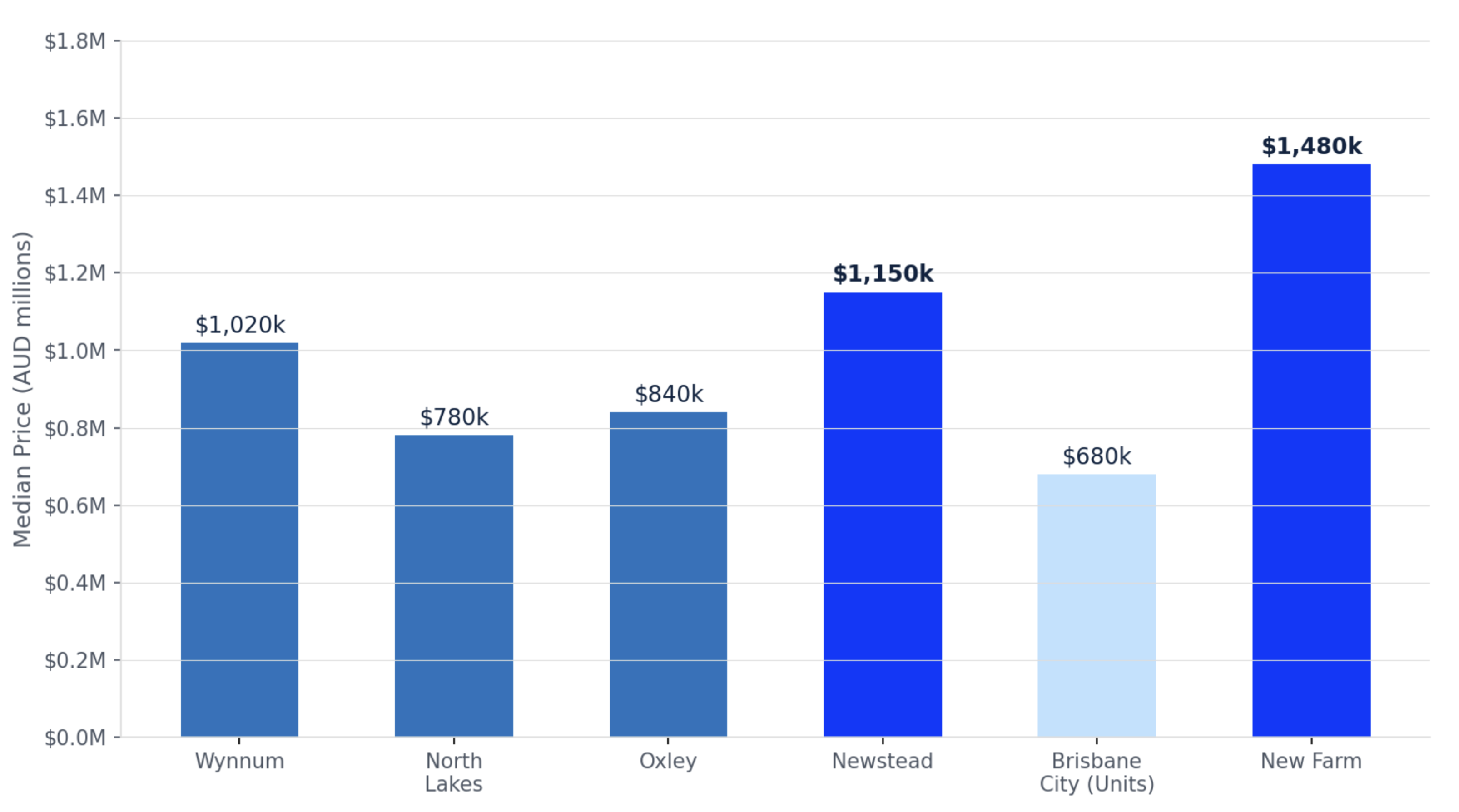
Brisbane Suburb Median Prices 2025
Source: Domain, House Price Report & Suburb Profiles, 2025
Brisbane North — North Lakes and Surrounds
For investors weighing real estate in Brisbane North, this is the standout pocket. North Lakes has evolved from a master-planned outer suburb into one of Brisbane's most sought-after family destinations. The area benefits from a strong retail and commercial core, proximity to Westfield North Lakes, and direct access to the Bruce Highway and Moreton Bay Rail Link.
Real estate in North Lakes, Brisbane appeals to families and yield-focused buyers alike. Median house prices around $780,000 offer a lower entry point than inner-city locations. Rental demand is driven by families, which typically means lower vacancy, longer tenancies, and lower turnover costs.
Brisbane City — Units and High-Density Opportunities
Real estate in Brisbane City is dominated by units and high-density apartments. Inner-city Brisbane units have historically carried oversupply risk, but the market has absorbed much of the excess stock built between 2016 and 2020. Newer stock in precincts close to the CBD now shows improved yield performance.
Unit buyers should examine individual buildings carefully. Owner-occupier ratios, body corporate levies, and building age all affect long-term performance in ways that suburb-level data cannot capture.
South Brisbane — Lifestyle-Driven Demand
Real estate in South Brisbane is driven largely by lifestyle demand. South Bank and West End continue to attract young professionals who prioritise walkability, food culture, and proximity to the CBD and University of Queensland. This demographic tends to rent for longer before buying, creating a deep and reliable rental pool.
Properties in this zone command premium rents relative to price, but the entry price is significantly higher. Investors buying here are typically prioritising long-term capital growth over immediate cash flow.
Brisbane West — Oxley and the Urban Fringe
Brisbane West real estate is centred on Oxley and the urban fringe. Oxley offers a different proposition. Median prices around $840,000, good access to rail into the CBD, and a significant volume of older housing stock that can be renovated or redeveloped. Investors with a value-add strategy often find better opportunities here than in more heavily analysed markets.
Real estate in Oxley, Brisbane benefits from improving rail access and relative affordability. The western corridor as a whole is benefiting from the Cross River Rail project, which is improving connectivity and commute times for residents who previously faced hour-plus journeys into the CBD.
Inner-City — Newstead
Real estate in Newstead, Brisbane sits at the premium end of the inner-city market. Newstead has transformed from a light industrial zone into one of Brisbane's most desirable lifestyle precincts. Development has been well-managed relative to other inner-city areas, and the retail and dining precinct around Gasworks Plaza acts as a sustained demand driver.
Median prices around $1.15 million reflect the precinct's premium status. Investors here are typically experienced, with higher equity backing and a primary focus on capital growth rather than yield optimisation.
Bayside — Wynnum
Wynnum Brisbane real estate offers a bayside lifestyle at a relative discount. Wynnum is one of Brisbane's more interesting value plays. A bayside suburb with a relaxed lifestyle, Wynnum has attracted a younger buyer demographic as city fringe prices pushed people further out. Median house prices around $1.02 million reflect a market that has moved significantly but still offers relative value.
Rental demand in Wynnum benefits from its lifestyle offering and improving road access to the Port of Brisbane employment corridor.
Residential vs Commercial Real Estate in Brisbane
Brisbane's commercial real estate market has experienced its own cycle. Industrial property, particularly logistics and last-mile warehousing, has been a standout performer, driven by e-commerce growth and supply chain restructuring after COVID-19 disruptions.
Office markets in the CBD have recovered more slowly, with hybrid working reducing the demand for traditional floor space. Retail commercial in lifestyle-driven precincts like Fortitude Valley and Paddington has outperformed sterile office-focused strips.
Residential vs Commercial: Quick Comparison
For most investors entering the Brisbane market, residential property remains the more accessible and manageable starting point. Commercial investment typically requires a larger capital base, specialist advice, and a higher risk tolerance for vacancy during lease transitions.
Types of Brisbane Real Estate Available
Brisbane's property market offers houses, apartments, townhouses, duplexes, subdivided land, and commercial stock. The right type depends on your strategy, budget, and how actively you want to manage the asset.
How Brisbane Property Values Are Determined
Real estate valuation in Brisbane follows the same principles as the rest of Australia: sales comparison is the dominant method. A registered valuer reviews recent comparable sales within the same suburb or comparable precinct and adjusts for land size, improvements, location, and condition.
In a fast-moving market, valuations can lag behind the sale price a buyer is willing to pay. This creates a common issue where a bank's valuation comes in below the agreed purchase price, requiring the buyer to contribute more equity. It's a risk worth understanding before you commit to an offer.
FOR EXAMPLE
A buyer agrees to purchase a Newstead apartment for $920,000. The bank's valuer comes back with a figure of $880,000. At an 80% LVR, the bank will lend against the lower figure: $704,000. The buyer needs to fund the $40,000 gap on top of their deposit and costs — a total shortfall they hadn't planned for.
Buying Brisbane Real Estate: Step by Step
Buying well in Brisbane starts well before you make an offer. Research suburbs aligned with your investment strategy. Determine your finance position early. Understanding your borrowing capacity before you inspect properties will save you from falling in love with something you can't service.
Engage a solicitor or conveyancer familiar with Queensland property law. Get a building and pest inspection, particularly on any property built before 1980. Review body corporate records if buying a unit or townhouse, because large levies or unresolved defects can materially affect your return.
In Queensland, once contracts are exchanged you have a five-business-day cooling-off period. Use it to complete due diligence you couldn't finish before signing. Settlement in Queensland is typically 30 to 60 days after contract exchange.
Risks of Investing in Brisbane
Brisbane's growth story is compelling, but the risks are real and should be assessed honestly before you commit capital.
Flood risk is the most Brisbane-specific risk. The 2011 and 2022 flood events demonstrated how severely certain suburbs can be affected. Check the Queensland Government flood maps before purchasing any property, and model the insurance cost before calculating your yield.
Oversupply risk is concentrated in the inner-city apartment market. While the market has absorbed much of the 2016 to 2020 construction wave, a new development pipeline could recreate conditions that suppressed unit prices and yields between 2017 and 2021.
Interest rate sensitivity affects Brisbane as it does every market. Understanding how lenders assess borrowing capacity and what rate buffers mean for your serviceability position is essential before committing to a purchase.
Brisbane Real Estate vs Other Australian Cities
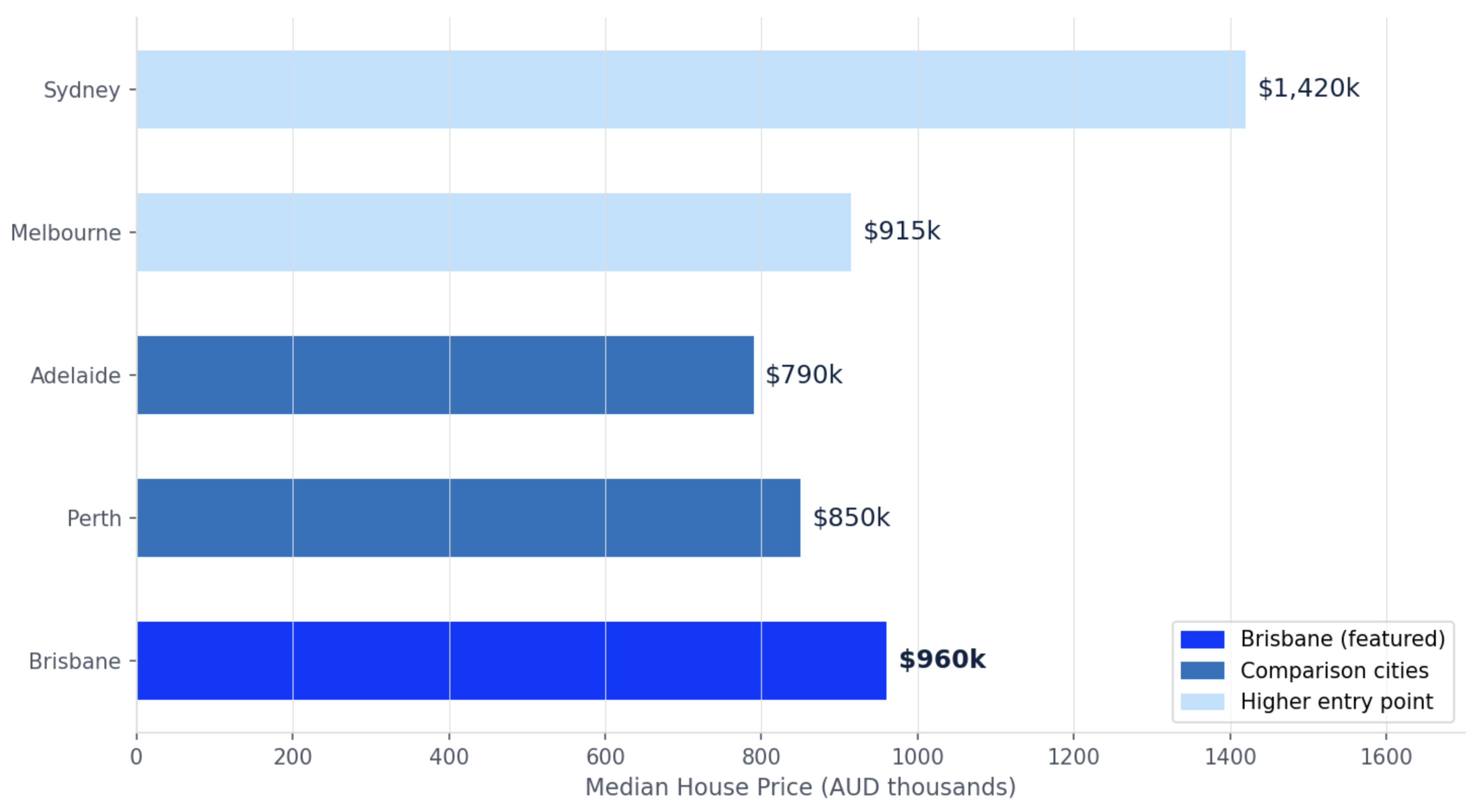
Capital City Investment Comparison 2025
Source: PropTrack, Property Market Outlook Report, 2025
Brisbane vs Key Australian Markets
Brisbane and Perth have been the strongest performers among Australian capital cities over the past five years. Brisbane's advantage over Perth lies primarily in its larger and more diversified economy, better university and healthcare infrastructure, and a more established property management sector.
Melbourne's relative underperformance reflects oversupply in its apartment sector and weaker interstate migration numbers. Sydney's affordability ceiling has effectively redirected investor attention to Brisbane and the south-east Queensland corridor.
Final Thoughts
Brisbane real estate Australia represents one of the more compelling capital city investment cases currently available. The combination of population growth, constrained supply, infrastructure investment, and relative affordability compared to Sydney creates conditions that favour sustained property price growth.
The risks are real: flood zones, rate sensitivity, and inner-city unit oversupply are all worth examining carefully. But for investors who understand the market and choose well, Brisbane has consistently rewarded long-term holders.
If you are a first-time investor, start by understanding what common mistakes first-time investors make before committing capital. If you are growing a portfolio, Brisbane deserves serious consideration as a complement to any holding already in Sydney or Melbourne.
Frequently Asked Questions
Recommended Reading
Two pages selected based on what readers of this article are most likely to need next.
Recommended Video
Most investors are still positioned in capital cities — but in 2026, that allocation gap is creating real opportunity cost. In a market where timing, positioning, and yield profiles compound into long-term outcomes, that disconnect matters more than most people realize.