

How Divorce Is Quietly Reshaping Australia's Property Market

A divorce property settlement rarely ends with one decision. The family home might be sold, kept, or refinanced onto a single income, and any investment property gets weighed against the same three choices: sell, keep, or restructure. What often gets missed is what happens next, when one household becomes two people who each need somewhere to live, on incomes that no longer combine the way they did when the original loan was approved.
Settlements are treated as a legal and personal matter, and rightly so. But every settlement also feeds into something bigger: household formation, borrowing capacity, and, multiplied across tens of thousands of cases a year, housing demand across the country.
What a Divorce Property Settlement Actually Covers
A divorce property settlement is not limited to the house. It covers the full pool of assets and debts built up during the relationship: the family home, any investment property, savings, vehicles, and often superannuation. Courts and family lawyers weigh this pool against each party's contributions and future needs, not a fixed formula.
This is also where a common assumption breaks down. Property is not automatically split 50/50 in Australia. The outcome depends on financial and non-financial contributions, the length of the relationship, and what each person needs going forward, including care of children.
For the property itself, there are usually three broad paths: sell everything and divide the proceeds, one party keeps a property and buys out the other's share, or a property, often an investment, is retained under continued or restructured ownership. Each path changes borrowing capacity, tax exposure and what either person can afford to buy next.
For the legal mechanics of finalising a settlement, family law specialists and Legal Aid remain the right first stop. This article focuses on what happens next, in the property market itself.
Why Separation Creates a New Kind of Housing Demand
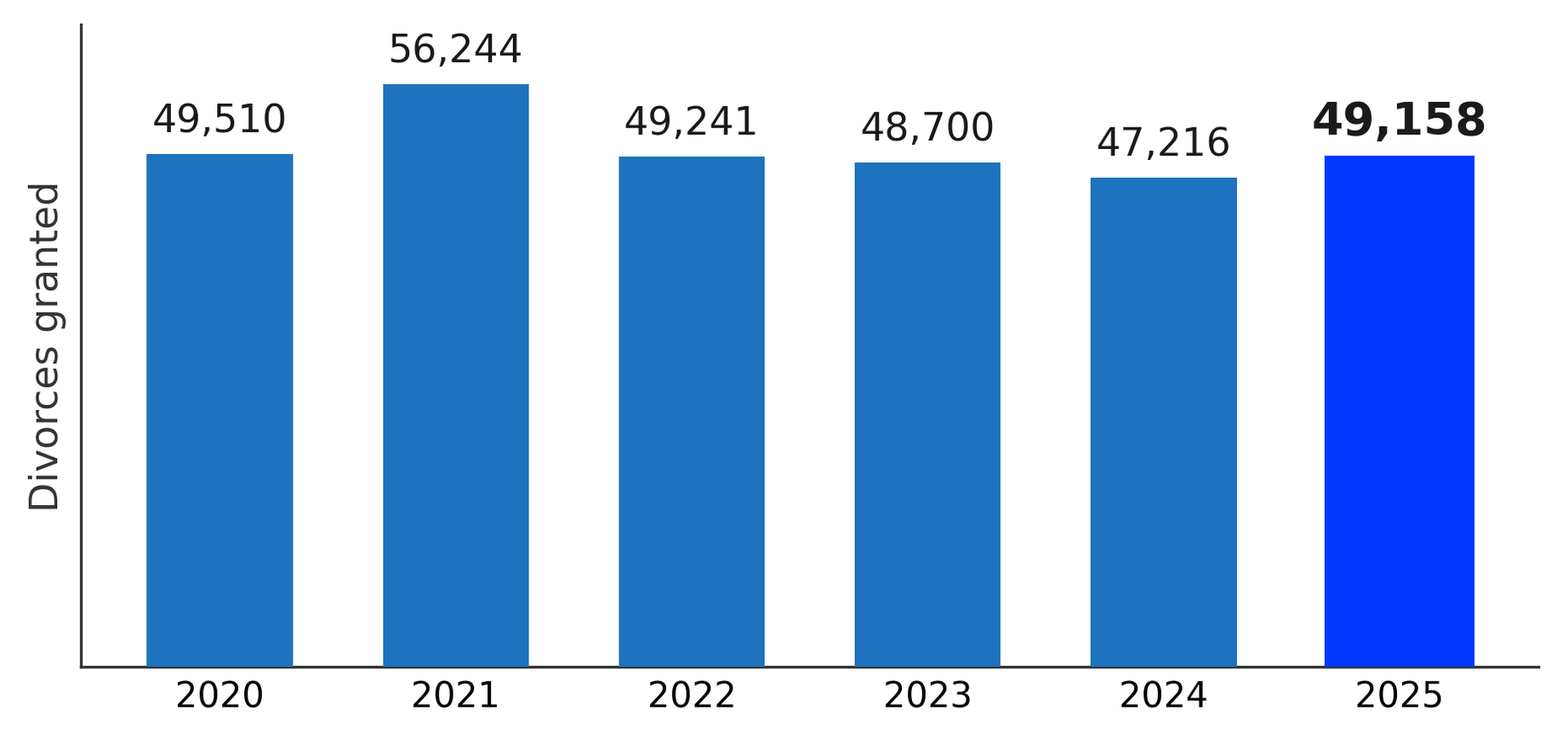
In 2025, the Australian Bureau of Statistics recorded 49,158 divorces, up 4.1 percent on the year before. Each of those cases can turn one household into two, creating demand for housing that did not exist the week before the separation was finalised.
Divorces Granted in Australia, 2020 to 2025
Source: ABS, Marriages and Divorces, Australia, 2025

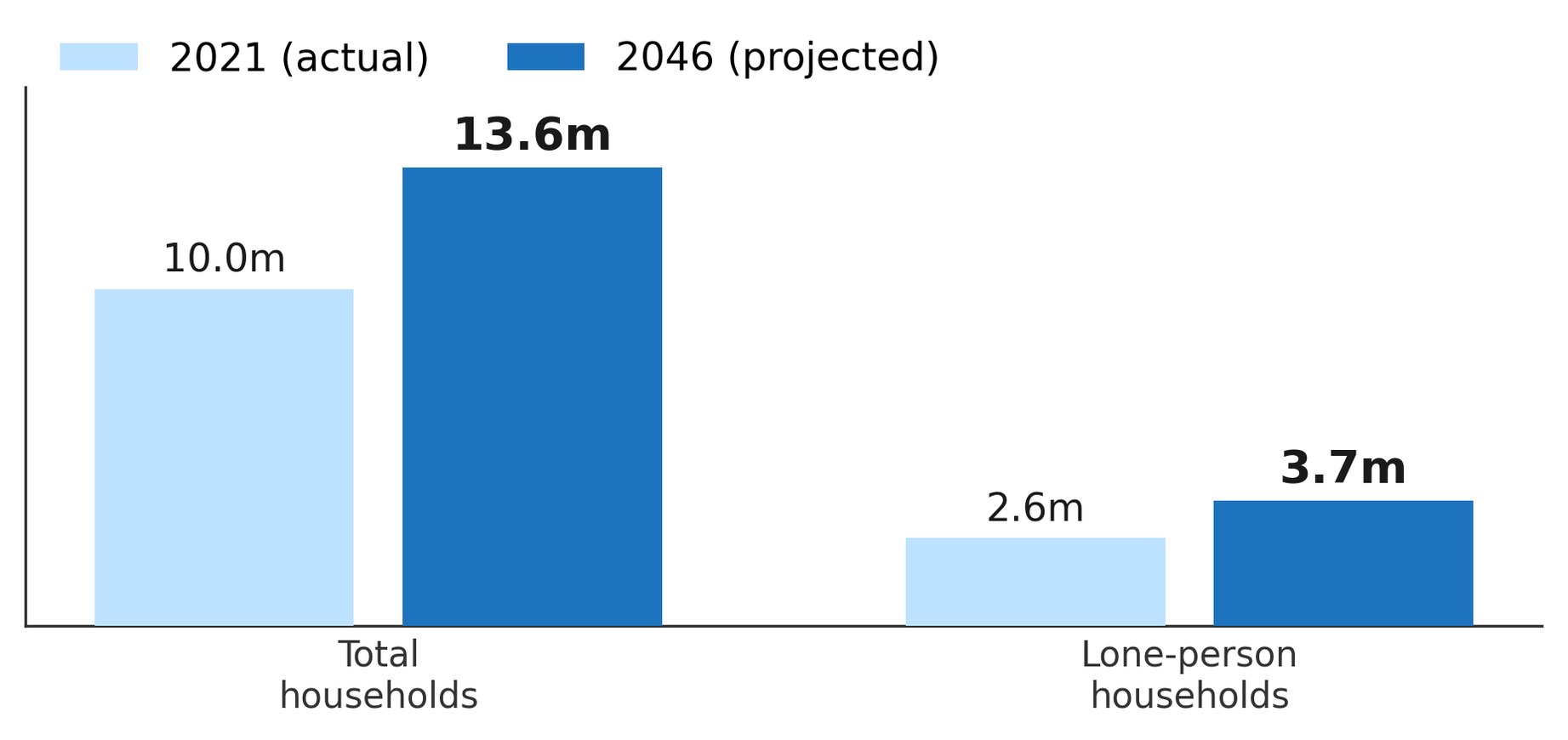
That demand does not disappear because a couple no longer lives together. If one partner keeps the family home, the other typically needs a new house or a rental elsewhere. The ABS projects total households in Australia will grow from around 10 million in 2021 to between 13.3 million and 13.9 million by 2046, with lone-person households rising to make up 26 to 28 percent of all households.
Household Growth Projected to 2046
Source: ABS, Household and Family Projections, Australia, 2021 to 2046
It is worth being precise here. More households do not automatically mean higher prices. Price movement also depends on supply, housing shortage conditions, population growth and interest rates. What separation reliably adds is pressure on the demand side of that equation, particularly for smaller dwellings, rentals, and homes closer to schools and existing support networks.
What Happens to the Family Home After Divorce
Selling the family home releases equity and gives both parties a clean financial break, but it also removes one household from the owner-occupier market and can trigger new stamp duty and moving costs for whoever buys next.
Keeping the home usually means one person buying out the other's share and refinancing the mortgage onto a single income, which is where the numbers can get difficult.
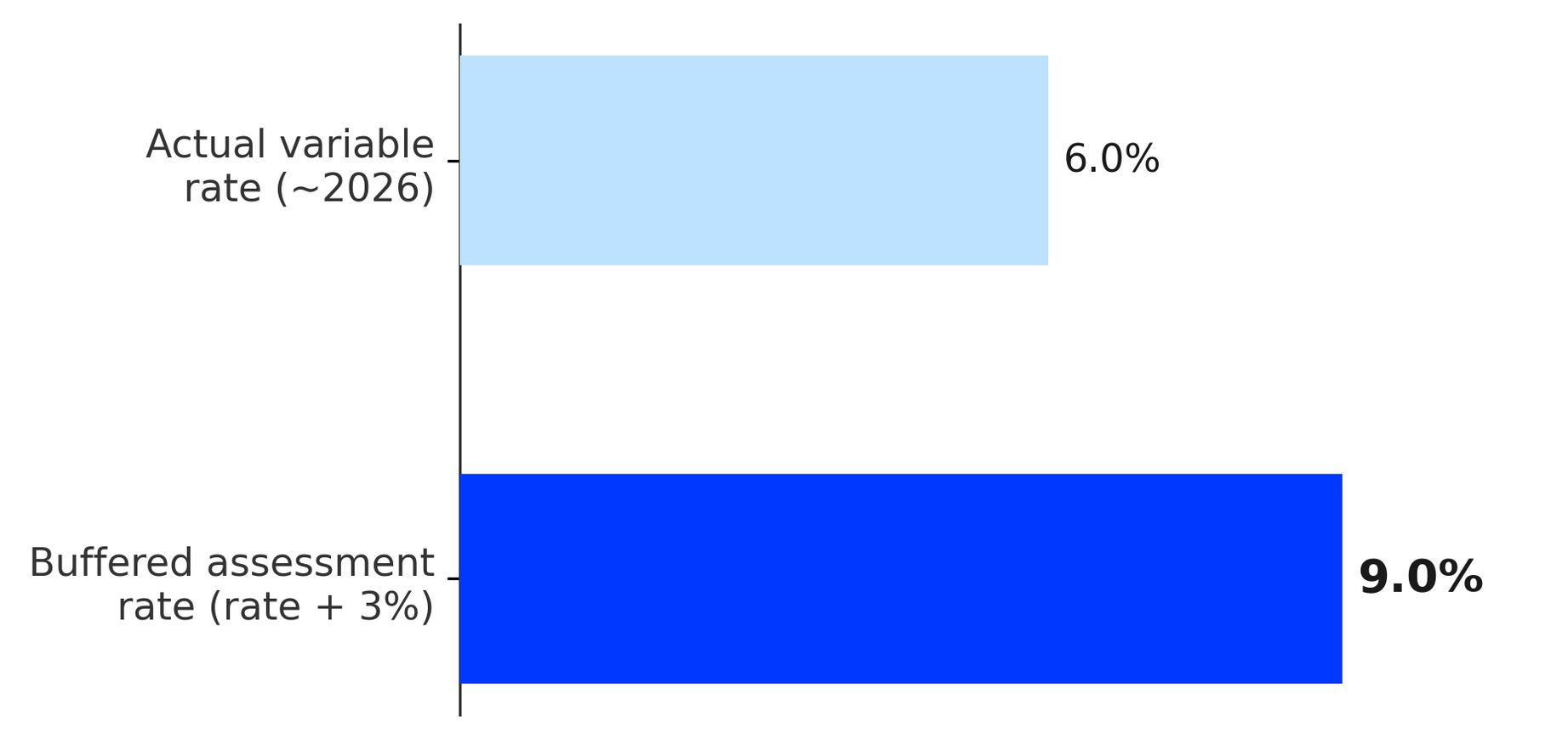
Every lender applies a serviceability buffer, testing the loan at the actual rate plus an extra margin, currently around three percentage points, to confirm repayments hold up if rates rise. This standard is set by APRA.
The Serviceability Buffer Added to Every Home Loan Assessment
Source: APRA, serviceability guidance, 2026

Anyone in this position benefits from checking their debt-to-income ratio before applying, since that figure often shifts more than expected once shared debts and a single income are reassessed together.
Understanding how banks calculate borrowing power also helps, since lender policy on spousal maintenance, child support income and buffers varies more than most people expect. A mortgage broker can test several lenders at once rather than assuming your existing bank will offer the best outcome.
What Happens to an Investment Property After Divorce
An investment property adds a second decision to the same settlement. Selling it can provide the liquidity needed to finalise a split cleanly, particularly if the family home is being retained by one party. It can also trigger capital gains tax, which needs to be modelled before the sale is agreed, not after.
Keeping the property is the other path, and it carries its own trade-offs. Rental income can support one party's finances after separation, but the mortgage, land tax and management costs still need to be serviced, often on a household budget that has just been cut in half.
The bigger question is strategic rather than transactional. A property purchased as part of a two-income plan, weighed for yield against growth, may no longer fit a single-income position. Some people choose to hold and rebuild slowly. Others sell and start again with a clearer, single-name strategy, ideally without repeating the mistakes first-time investors make the second time around.
Neither path is automatically right, but both deserve a fresh look at the numbers rather than a decision made under settlement pressure.
Could Household Breakdown Actually Move the Property Market
Zoom out from any single settlement and a market-level question appears. If tens of thousands of households split every year, each one needing new or different housing, could that meaningfully affect Australia's property market.
The honest answer is that it adds to demand without guaranteeing a price outcome. Housing demand from separation competes with population growth, migration and construction rates for the same limited supply. In tight markets, particularly for one- and two-bedroom dwellings in established suburbs, extra demand from separated households can show up as firmer rents and faster-moving sales, even if it never appears as its own line item in the data.
For anyone approaching property investment in Australia as a long-term strategy, household formation is a demand driver worth tracking alongside population growth and interest rates, not a headline. It rarely explains a market on its own, but it consistently adds to the pressure other factors create.
Final Thoughts
A divorce property settlement is a legal and financial event, but it is also a small, repeatable trigger for new housing decisions. Multiply it by close to 50,000 cases a year, and the mechanics of one household becoming two start to matter for the property market, not only for the people going through it.
For anyone on the other side of a settlement, the practical questions are the ones worth answering first: what can you borrow now, should you keep or sell what you have, and does your existing investment property strategy still make sense on your own.
None of those questions has a single right answer, but all of them are easier to answer with current numbers than with assumptions carried over from a life that has already changed.
Frequently Asked Questions

Recommended Reading
Two pages selected based on what readers of this article are most likely to need next.
Recommended Video
While many investors spend time researching growth areas and property types, this discussion highlights a different reality—your ability to continue investing is often determined not by what you buy, but by how your loans are structured and how your borrowing power is managed over time.