

What Happens Before Property Prices Move? The Hidden Indicators Investors Often Miss
Most investors watch property prices. Experienced ones watch what moves before prices move.
There is a meaningful difference between those two approaches, and it shows up in acquisition timing, suburb selection, and the long-run performance of a portfolio. Property investment strategy that relies on headline price data alone is, almost by definition, reactive. By the time a suburb appears in the top performer lists, the investors who benefited from the run have already bought.
This article covers the leading indicators that tend to precede price growth in Australian residential property markets and explains why most buyers overlook them.
Why Price Data Is a Lagging Indicator
The CoreLogic daily index and monthly median price reports are useful. They are not predictive. By the time they confirm that a suburb has grown, the growth has already happened. Prices are recorded after transactions settle, which means they reflect decisions buyers made three to six months earlier under the lending conditions and sentiment that existed at that time.
This lag is structural. It cannot be fixed by getting faster data. The only way to act before price movement happens is to track the conditions that produce price movement rather than the price movement itself.
Experienced investors understand this intuitively. They are not reading the same CoreLogic reports as everyone else and making different conclusions. They are reading different data entirely.
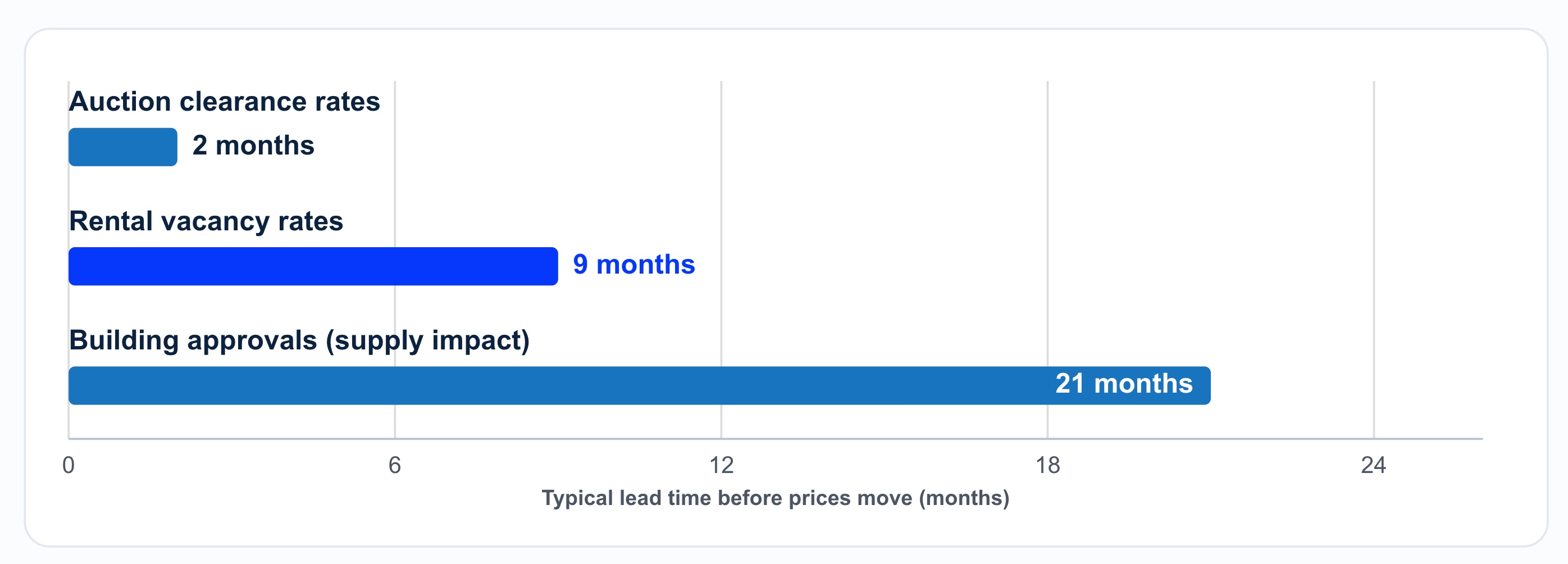
How Early Each Signal Appears Before Prices Move
Median price data is the baseline it confirms a move only after it has happened. Every leading indicator surfaces earlier, but by very different margins.
Rental Vacancy Rates: The Earliest Signal
Rental vacancy rates are arguably the most reliable leading indicator available to residential property investors in Australia. When vacancy falls below 2% and stays there, it signals that the existing rental stock cannot absorb demand. That supply pressure eventually converts into rental price growth, which attracts investors, drives purchasing activity and ultimately pushes values higher.
The sequence is not always clean, and it does not always move at the same pace. But the directional relationship between very low vacancy and subsequent price pressure has appeared repeatedly across Australian markets over the past two decades.
Perth saw vacancies drop below 1% in late 2021 and early 2022. Prices followed decisively. Parts of regional Queensland saw the same pattern. So did Adelaide through 2022 and 2023.
For example
A suburb with a vacancy rate of 0.8% and a rental yield of 5.2% is signalling something that headline price data won’t show for another six to twelve months: there are more tenants looking than rentals available. Owner-occupiers priced out of purchasing in that suburb begin renting there. Investors identify the yield. Competition for stock increases. Vendors start holding firm on price. Six months later, that suburb is in the growth statistics.
The SQM Research vacancy database and REIA state reports are the most accessible sources for this data at suburb level. A vacancy rate below 1.5% in a market with meaningful population growth is worth close attention.
Rental Vacancy Rate vs Subsequent Median Price Growth
Average price growth in the 12 months following, grouped by the prevailing rental vacancy band.
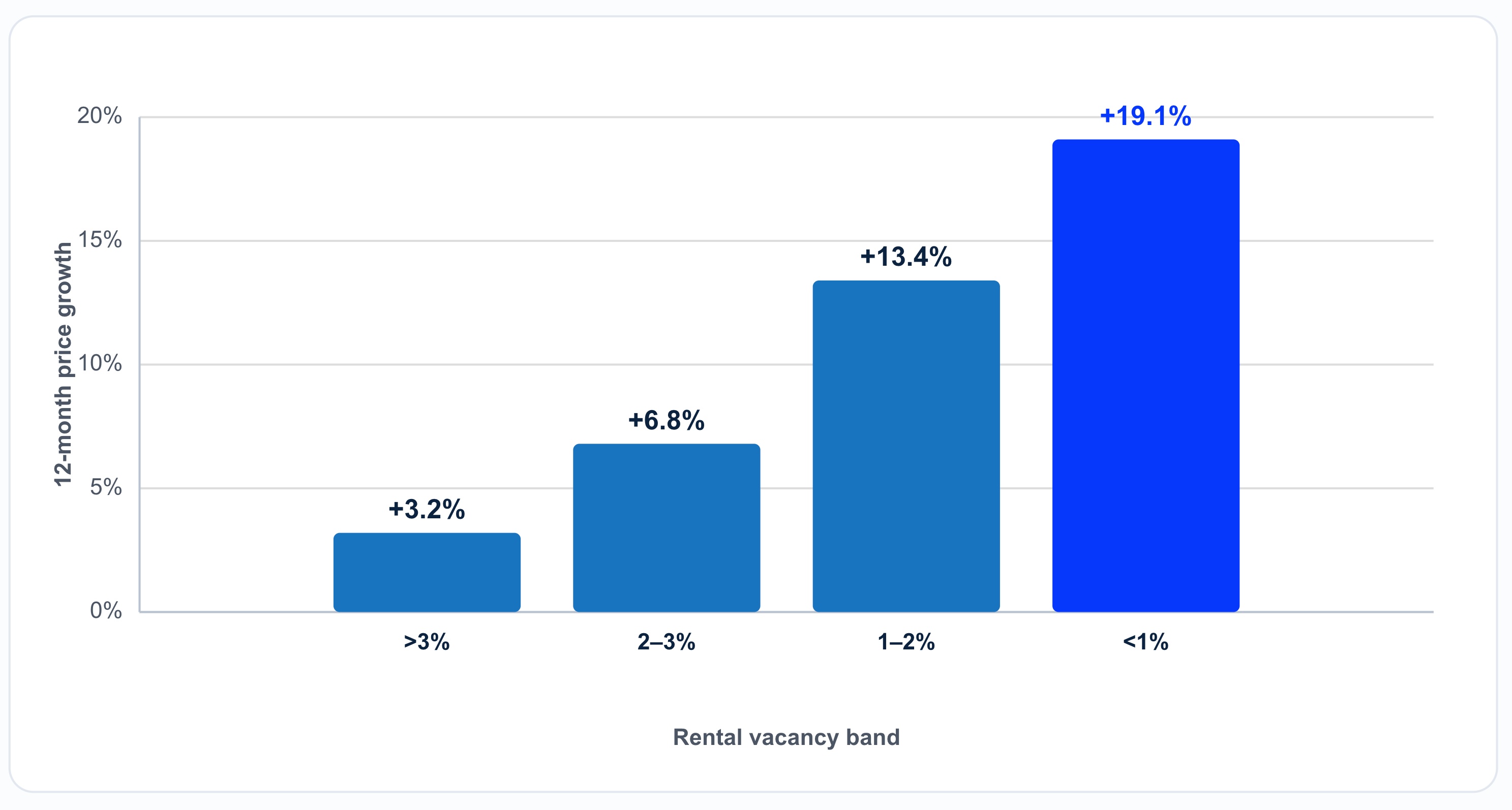
Source: FPW Group analysis; Domain rental vacancy data; CoreLogic median price indices, 2018 to 2025. Modelled average across selected Australian markets. Not a forecast.
Auction Clearance Rates and What They Actually Measure
Auction clearance rates are widely reported but frequently misread. A single week above 75% tells you very little. Six consecutive weeks above 70% in a major capital city market tells you that buyers are consistently willing to compete, that vendor pricing expectations are being met, and that stock is clearing faster than it is being listed. That combination is a reliable demand signal.
What clearance rates measure at their core is the balance between buyer urgency and vendor expectations. When that balance tips toward buyers, prices typically follow. When it tips toward vendors holding out and buyers retreating, prices stagnate or soften.
The important nuance is that clearance rates are most useful at the suburb or precinct level, not the city level. A city-wide clearance rate of 68% can mask a suburb running at 82% and another running at 51%. The aggregated figure obscures the signal. Investors using Domain or REA auction result data at suburb level get a substantially more useful picture.
Suburb-Level Clearance Rates Hidden by the City Average
The same city, in the same week. A single aggregate figure can sit below the demand threshold while individual suburbs run well above it.
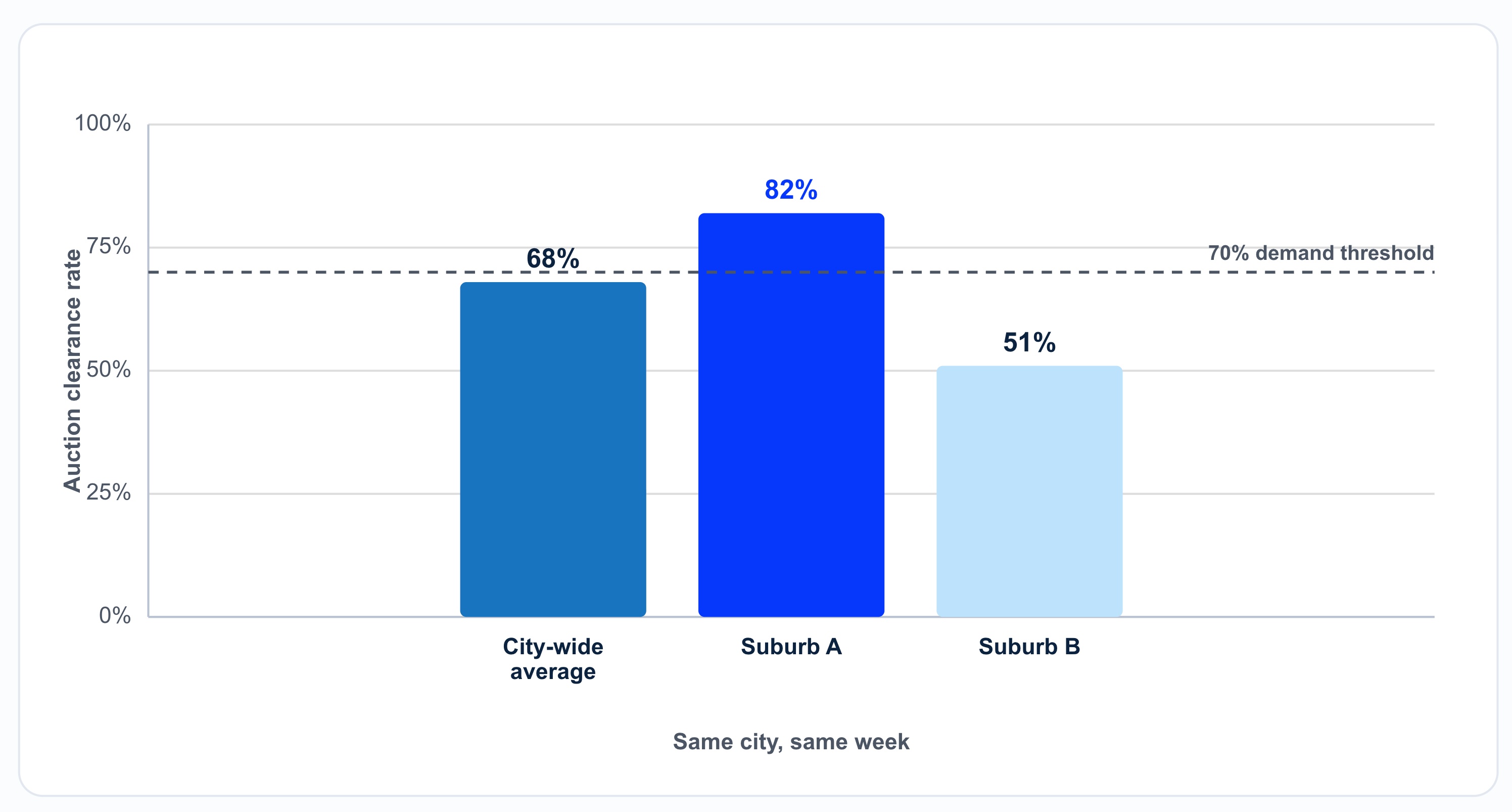
Source: FPW Group analysis; Domain and CoreLogic auction results. Illustrative suburb comparison; not a forecast.
Building Approvals and the Supply Gap
Building approvals data from the ABS is one of the most underused datasets in residential property research. It shows where new supply is coming and, equally importantly, where it is not. Approvals take 18 to 24 months to translate into completed dwellings, which means today’s approval data tells you what the supply situation will look like in 2027 and 2028.
When approvals are low in a market with growing population and employment, the supply gap widens. That widening is a precursor to price pressure. When approvals are running well above historical averages, it is a warning that oversupply risk is building, particularly in unit and apartment markets where project developers often bring large volumes online simultaneously.
Property investment risk that comes from buying into an oversupplied market is among the most preventable forms of portfolio damage, and building approval data is the tool that makes it preventable.
Investors should pay close attention to housing supply signals such as building approvals data.
For example
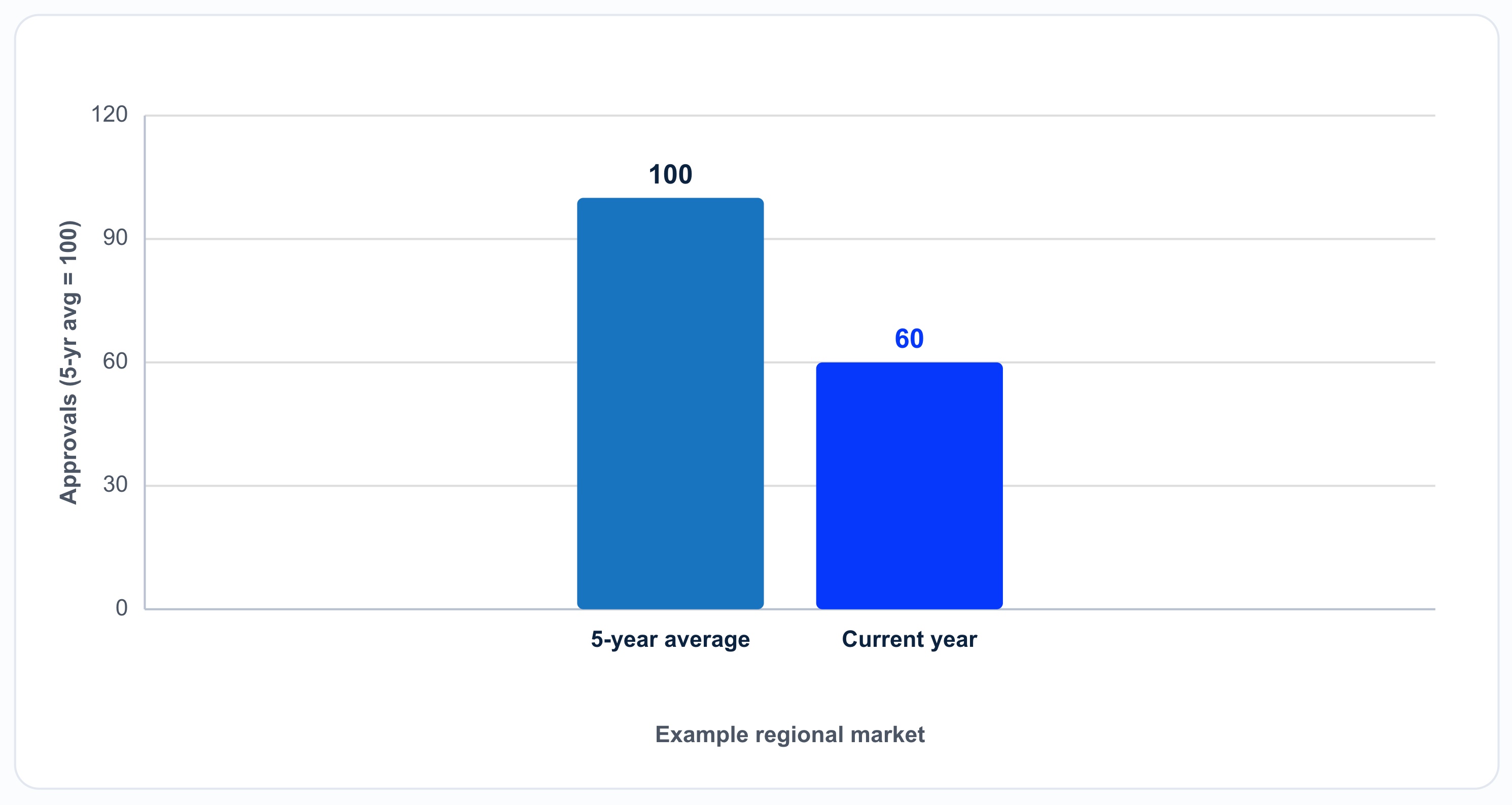
A regional city with a population growing at 2.5% per year and annual building approvals running 40% below the five-year historical average is building a supply deficit. That deficit will not appear in price data immediately. But twelve to eighteen months from now, the combination of growing demand and constrained supply will push rental prices higher, compress vacancy, and eventually translate into capital value growth. An investor who reads the approval data now acts twelve months before the majority of the market.
The Supply Gap: Approvals Below the Five-Year Average
Annual building approvals in the example regional market, indexed against their own five-year average (= 100).
Infrastructure, Population, and Credit: The Macro Signals
Three broader signals round out a leading indicator framework: announced infrastructure investment, net interstate and overseas migration data, and household credit growth.
Infrastructure announcements, particularly major transport projects, create employment during construction and improve liveability outcomes for decades afterward.
Markets within the direct catchment of a major transport upgrade, new hospital, or defence facility expansion tend to see rental demand firm before a single shovel enters the ground. The announcement itself changes the calculus for tenants and buyers who want to be ahead of the development.
Population data from the ABS, particularly net overseas migration figures and interstate flows, tells investors where demand is heading at a state and regional level. South-East Queensland absorbed an extraordinary volume of interstate migration between 2020 and 2023. That population pressure preceded the price growth that followed. It was visible in the data for anyone willing to look.
Credit growth, measured through APRA’s quarterly banking statistics, is a macro signal that filters through to property demand. When RBA rate hikes compress credit growth, demand for property softens. When rates fall and credit loosens, the reverse typically occurs.
Monitoring the credit environment alongside the other indicators creates a more complete picture of where demand is heading.
How to Use Leading Indicators in Practice
The challenge with leading indicators is not finding them. It is building a consistent research process that integrates multiple signals before acquiring decision. One indicator in isolation is useful. Three indicators pointing in the same direction is a genuine thesis.
These are some of the most powerful indicators that influence buying decisions for serious property investors.
A practical framework might look like this: identify a market where vacancy is below 2% and falling. Cross-check building approvals to confirm supply is not materialising to meet that demand. Review population trends to confirm the rental demand is structural rather than cyclical. Check auction clearance rates or days on market to confirm buyer competition is present. If all four signals align, the risk-adjusted case for acquisition is materially stronger than in a market selected on price growth alone.
This is not a system that eliminates risk. Property investment carries genuine risk regardless of how thoroughly a market is researched.
What leading indicators do is improve the timing and information behind the decision. Investors acting on early signals often have more time, greater negotiating power, and less competition from buyers waiting for price data to confirm what the indicators already suggest.
For investors building or expanding a property portfolio in Australia, leading indicator analysis is one of the most accessible ways to develop a genuine research edge over most of the market.
Final Thoughts
Property prices do not move without warning. They move after conditions that produce price pressure have been building for months, sometimes longer. The investors who consistently enter markets before many buyers are not guessing. They are reading a different set of signals at an earlier point in the cycle.
Rental vacancy, auction clearance rates, building approvals, population flows, and credit conditions are all publicly available. They do not require proprietary data or institutional research budgets. What they require is a disciplined research process and the willingness to act on signals that have not yet been validated by headline price growth.
The market rewards that discipline. It has always done so. The investors who buy when a suburb is quiet and the indicators are flashing early are the ones who benefit most when the market catches up with the data.
Want to go deeper? Learn more about investing in Australian property
Frequently Asked Questions
Recommended Reading
Two pages selected based on what readers of this article are most likely to need next.
Watch: RBA rate hikes
In this episode of Smart Property Moves by FPW Group, we unpack one of the biggest questions property investors are asking right now