

Housing Market Slowdown Analysis: Not Every Property Is Bad
Australia's housing market is in a genuine slowdown, and not every property has been insulated from it. But a falling national median is not an investment verdict. It is a prompt to analyse more carefully, because the conditions driving national declines are not uniform across every city, suburb, or property type.
Cotality's data shows home values have now fallen for five consecutive months, taking prices 3.6% below the March 2026 peak. Yet rental yields have simultaneously reached their highest level since 2019, vacancy rates in several capitals remain well below the balanced-market threshold, and one capital city posted growth in August. The data does not tell a single story. Our article on property investment interest rates explains how the rate environment is driving much of this divergence.
What investors need is not a verdict on the market. They need a framework for reading past the headline and into the specific asset, suburb, and financial position that determines whether a property works.
What Is Happening in Australia's Housing Market?
How far has the housing market slowed?
Cotality's August 2026 Home Value Index confirmed the national housing market fell 0.9% for the month, the fifth consecutive decline and the steepest single-month drop since December 2022.
National dwelling values are now 3.6% below the March 2026 peak. The breadth of the decline has widened sharply: Cotality found values fell across 93% of capital city suburbs over winter, more than double the 45.8% recorded in autumn.
Sydney continues to lead the correction, down 1.4% in August and 7.1% below its February peak. Melbourne and Canberra both recorded 1.1% monthly declines, while Brisbane fell 1.0% and Adelaide and Perth each dropped 0.8%. Darwin was the only capital to record growth, rising 0.6% to reach a new peak. Buyer activity has also contracted sharply: national quarterly home sales were 15.5% lower than a year ago and 11.5% below the five-year average, according to Cotality data published in the Your Investment Property Magazine, September 2026.
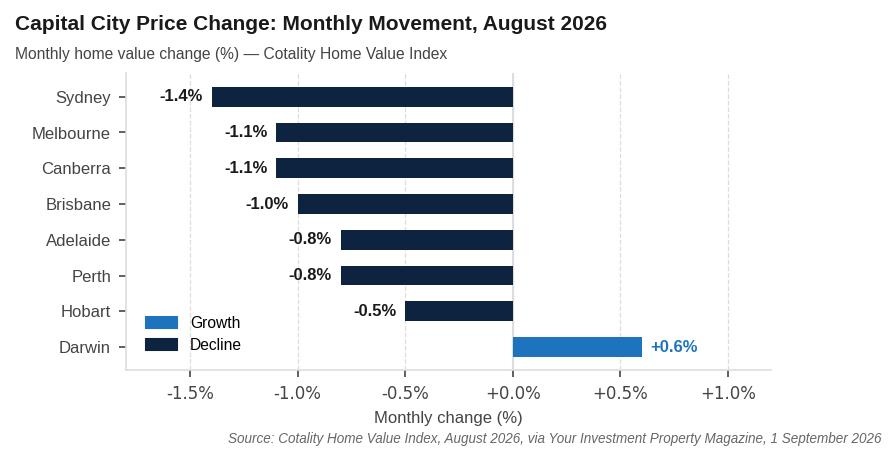
Capital City Price Change: Monthly Movement, August 2026
Source: Cotality Home Value Index, August 2026, via Your Investment Property Magazine, 1 September 2026 | ABC News, 3 August 2026
Why is the market slowing?
Three consecutive RBA rate rises in the first half of 2026 pushed the cash rate to 4.35%, where it was held at the August meeting after headline CPI eased to 3.9% annually but underlying inflation remained above the RBA's 2-3% target range. Lenders now assess borrowers at approximately 9.65% under APRA's 3-percentage-point serviceability buffer, which has compressed what buyers can afford.
The 2026 federal budget legislated changes to negative gearing and CGT arrangements taking effect from 1 July 2027, which Tim Lawless of Cotality noted would likely shift investor focus toward higher-yielding properties. That shift in emphasis, combined with higher holding costs, has softened sentiment in markets where tax-driven investment was most prevalent. Understanding your borrowing capacity in this rate environment is now a prerequisite before evaluating any acquisition.
Does a Housing Market Slowdown Mean Property Is a Bad Investment?
The answer is not automatic in either direction. A market in broad decline can still contain individual properties with durable rental demand, constrained supply, and long-term growth drivers. It can also contain properties that look cheap and are genuinely overpriced relative to their actual income and growth potential.
A falling price can create leverage, or expose a weak decision
With capital city listings running 24% higher than a year ago at the end of August, and homes taking longer to sell, buyers in many markets now have negotiating power that did not exist 12 months ago. Auction clearance rates fell below 50% nationally in August. Vendor discounting has widened. That is a genuine shift in negotiating position for buyers who are financially prepared.
But a lower price only improves an investment if the rental demand and location fundamentals have not deteriorated alongside the price. A property in an outer suburb where vacancy has risen from 1.2% to 3.5% and rents have fallen is not an opportunity because it costs less. The lower price reflects the weaker demand. The investor who buys that property cheaper has reduced their entry cost but not their income risk.
Not every location is moving at the same speed
The most important observation from Cotality's 2026 data is market divergence. Sydney's correction is now deeper than the 2022-23 cycle at an equivalent point. Melbourne follows closely. Brisbane and Adelaide entered the declining phase later and from lower price points. Perth fell 0.8% in August but remains less corrected than the southern capitals. Darwin reached a new peak in August.
Regional markets show further variation. Analysing property investment across Brisbane, Adelaide, and Perth requires suburb-level data, not the national index. A suburb with high population inflow, infrastructure spending, and low listing volumes can be rising while its city's median falls.

What Makes a Property More Resilient During a Slowdown?
Resilience is not immunity. It is about whether the property has underlying characteristics that limit the severity of a price fall and that support income through the correction. Two things stand out in the current data: rental demand and supply constraints.
Rising yields are the unexpected data point
While home values have fallen, rents have continued to rise. Cotality's national rental index rose 0.4% in August, and rents are now 5.7%, or approximately $38 per week, higher than a year ago. Over the past five years, rents have surged 39%, or around $200 per week above 2021 levels. National gross rental yields reached 3.79% in August 2026, the highest level since September 2019.
National Gross Rental Yield vs Home Values: 2023-2026
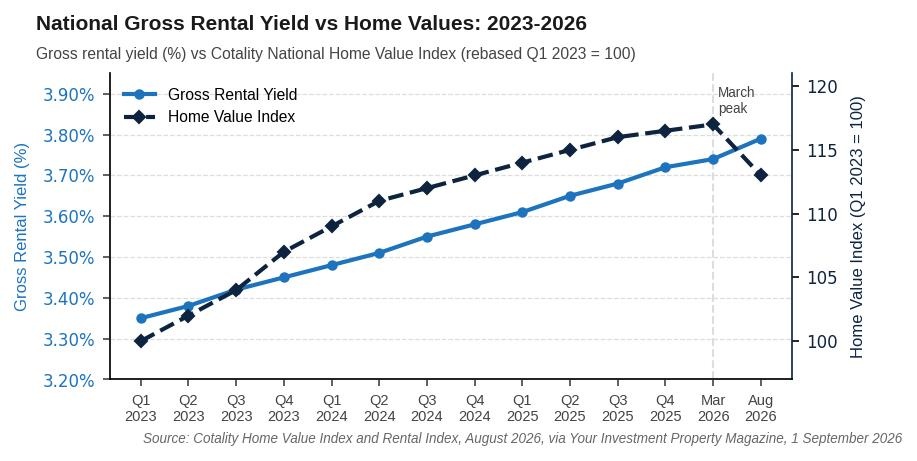
Source: Cotality Home Value Index and Rental Index, August 2026, via Your Investment Property Magazine, 1 September 2026
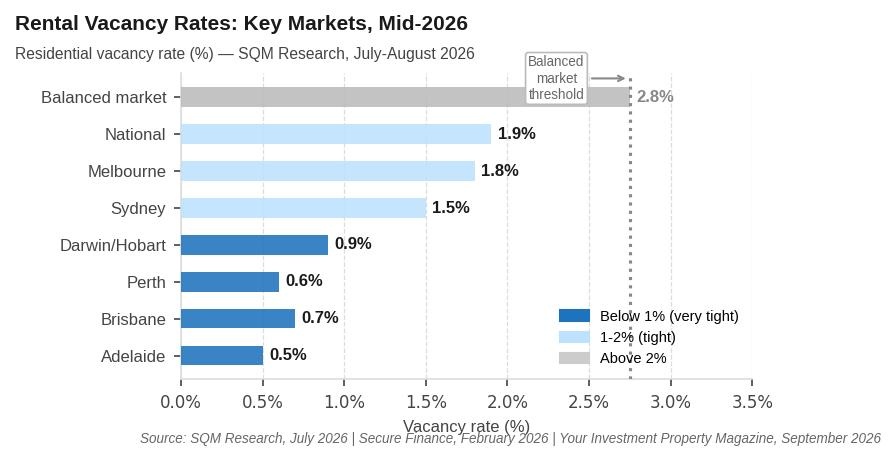
The national vacancy rate edged to 1.9% in August, its highest since January 2025, but still well below the 2.5-3.0% range that indicates a balanced market. As Lawless noted, vacancy has held below 2% nationally for most of the period since early 2022, which represents an exceptional period of rental tightness by historical standards.
Low vacancy protects income when sale prices soften
Brisbane's rental vacancy held at 0.6-0.8% through mid-2026. Perth's vacancy fell to 0.6%, less than half the national figure, with annual rent growth of 8.1%. Adelaide's vacancy was approximately 0.5%, the tightest of any capital. A property in a market with vacancy at that level is generating rent from a tenant who has very few alternatives.
Vacancy rising above 2.5-3.0% is where landlord pricing power begins to erode. Below 2%, landlords retain the ability to maintain or raise rents even when broader market confidence is weak. The rental crisis in Australia is not over. It has simply moderated from peak emergency levels in some markets.
Owner-occupier appeal broadens the exit pool
When investor sentiment weakens, properties with strong owner-occupier appeal hold their resale market. A four-bedroom house in an established school catchment attracts buyers who are making life decisions, not purely financial ones. That broader buyer pool provides a floor when investor demand thins.
Units and apartments in investor-heavy precincts lose this protection. When investor demand falls in those locations, the remaining buyers are predominantly other investors reassessing the same data. The exit pool shrinks at the same time conditions worsen.
What Investors Should Assess When Property Prices Are Falling
Move past the headline median
The national dwelling median is an average across 10 million properties and every capital and regional market in Australia. A suburb can be rising while the national figure falls. What matters is the suburb-level vacancy rate, days on market, listing growth, rental movement, and local employment base.
Knowing how to choose investment-grade suburbs in Australia is a systematic process, not intuition. It begins with the data available at the suburb level, not the national headline.
The eight questions that matter more than the headline price
Stress-test the cash flow at rates higher than today
Investor variable rates are running near 6.65% with lenders assessing serviceability at 9.65%. CommBank has forecast rates to remain on hold through the rest of 2026 and expects two cuts in 2027. A property that works at 6.65% needs to also work at 8.5% to give an investor genuine buffer against the risk of rates staying elevated or rising further.
A practical stress-test allows 4 weeks of vacancy per year, adds 15% to maintenance estimates, and confirms the monthly shortfall can be carried for 12 months without financial strain. How lenders assess borrowing capacity and mortgage stress testing provides a detailed framework for running this.
When a Housing Market Slowdown Is a Reason Not to Invest
Not every market condition creates opportunity, and not every investor can move. Naming the circumstances where not investing is the right decision is as important as identifying when conditions work.
When the cash flow only works under the most optimistic scenario
If a property only pencils out at full occupancy, the current interest rate, and with no maintenance costs modelled, the investment is not viable regardless of suburb fundamentals. The numbers need to work under a stressed scenario before they are considered safe under the base case.
When local fundamentals are deteriorating, not just the national median
Vacancy rising above 3%, declining rents, employers leaving, and listing volumes growing faster than population growth are warning signs that a price decline reflects deterioration rather than a temporary correction. A lower price on a fundamentally weaker asset is not an opportunity.
Lawless noted that 'the risk profile for housing has shifted more firmly to the downside,' citing weak consumer sentiment, real wages declining, and population growth stabilising as factors likely to keep demand subdued through spring 2026. That macro context matters most in markets where fundamentals are already softening.
When borrowing capacity is already stretched
The 2026 rate hikes cut borrowing capacity by roughly 7% from the start of the year. An investor at the edge of their capacity before a potential further move is taking on leverage risk that the current market does not reward. The borrowing capacity formula gives a clear view of how much buffer sits between a current approval and serviceability stress.
A property bought at the limit of capacity in a falling market can become difficult to refinance and difficult to exit without a loss. The price entry point only matters if the holding position is financially sustainable.

The Bottom Line for Property Investors
Australia's housing market is in genuine, broad decline. The August 2026 data confirmed falls across 93% of capital city suburbs, the steepest monthly national drop in nearly four years, and sales volumes running 15% below their five-year average. That is not a minor correction, and investors should not treat it as one.
The housing market slowdown analysis that matters are not whether the national index is negative. It is whether the specific property under consideration has rental demand that holds under weaker conditions, vacancy that gives the landlord pricing power, and cash flow that survives a stress scenario. Those questions have different answers in different suburbs.
The investors who struggle in a slower market are usually those who bought without modelling the downside. The investors who find genuine opportunity are those who use the buyer's leverage created by rising stock levels and lower clearance rates to enter fundamentally sound assets at corrected prices. A slowdown is a reason to be more selective. It is not a reason to stop thinking.
Frequently Asked Questions
Recommended Reading
Two pages selected based on what readers of this article are most likely to need next.
Recommended Video
As rates rise, many people immediately assume it is no longer a good time to invest. But in reality, the opportunity has not disappeared—it has simply shifted. This episode explains why higher interest rates do not automatically remove your ability to invest, but they do change your borrowing power, your cash flow, and the price point that makes sense for you.