

How to Negotiate a Better Price on an Investment Property

To negotiate a better price on an investment property, work out what it is worth and what it can earn before you make an offer, then negotiate toward a walk-away price you set in advance. When you negotiate house price this way, sold prices and rental numbers do the arguing for you, not pressure or guesswork.
Buyers have more room to move in many markets this spring as the housing market slows. But the average discount on offer can still leave an investor paying too much, and the reason sits in three numbers most buyers never line up side by side.
Below, we set those numbers, cover what to say to the selling agent and show when to walk away, using a $750,000 worked example.
What Determines Your Power to Negotiate a House Price?
National figures set the mood, but negotiating power is decided street by street, by the local market and the seller's situation.
Supply, demand and time on market
Selling conditions have softened. Cotality reports the median home now takes 39 days to sell, up from 28 a year ago, and listings are 18.1% higher than a year earlier.
Vendors are adjusting too. The median capital city discount off the first asking price reached 4.2%, the highest since January 2023, and auction clearance rates have stayed below 50% since early June.
Still, a well-located home in a tightly held pocket can draw several buyers in a soft market. Check the suburb itself, using our best places to invest in property in Australia and how to read a suburb profile guides.
How long the property has been listed
A listing that has sat for eight weeks tells you more than one that went live on Saturday. Price drops, a change of sale method or a relisting with a new agent all suggest the seller's expectations are being tested.
The seller's motivation
A seller who has bought elsewhere, is relocating or is handling a deceased estate often values certainty over the last few thousand dollars. A vacant property can signal the same, since the owner pays holding costs with no rent.
Know What the Investment Property Is Worth Before You Make an Offer
Use recent comparable sales, not asking prices
The asking price tells you what the seller hopes to get. Recent sold prices for similar properties tell you what buyers have been willing to pay, and that is the evidence a negotiation should rest on.
Use sales from the same suburb in the last three to six months, with similar land, bedrooms and condition. Adjust for real differences, such as a new kitchen or a busy road.
Asking Price vs Comparable Sales in Our Worked Example
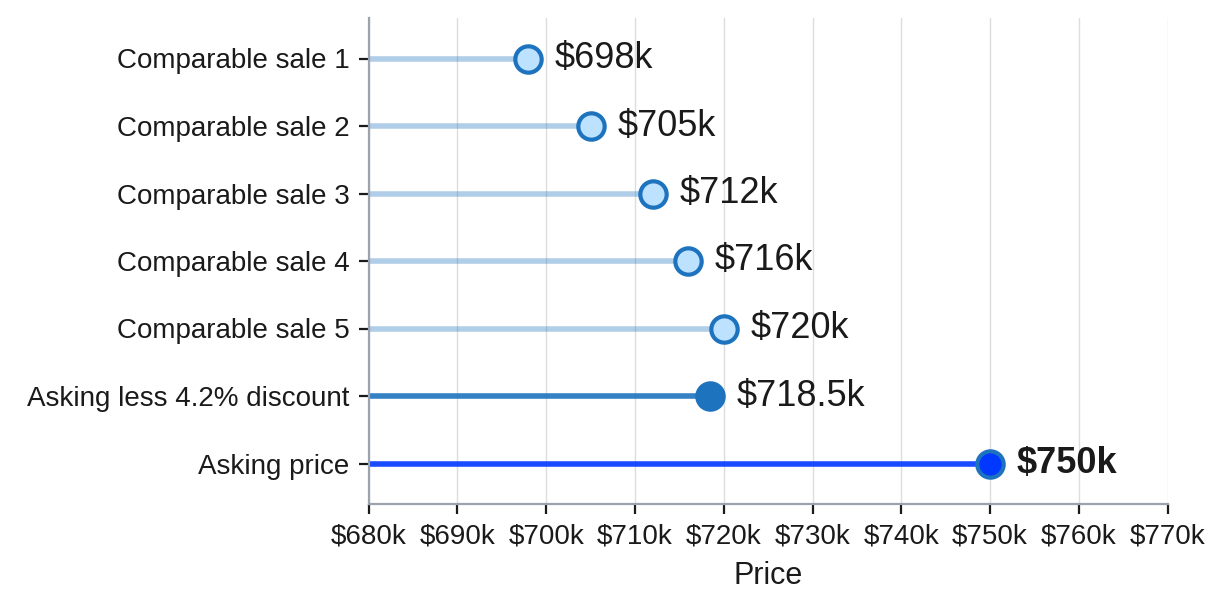
Source: FPW Group worked example; Cotality Housing Chart Pack, September 2026
Factor in condition and future costs
Repairs, strata levies, insurance and vacancy all come out of your return. A property needing $15,000 of work is worth less to an investor, and spotting the red flags when buying an investment property early protects your price.
Run the investment numbers at the asking price
An investor must ask whether the rent covers enough of the holding costs at the price being discussed. That links to the borrowing capacity formula and what makes a good investment property.
Yields are thin in most capitals, which is why every dollar of price matters. Cotality puts the national gross rental yield at 3.79% in August 2026, the highest since September 2019, but Sydney sits at just 3.3%.
Gross Rental Yields by Capital City, August 2026
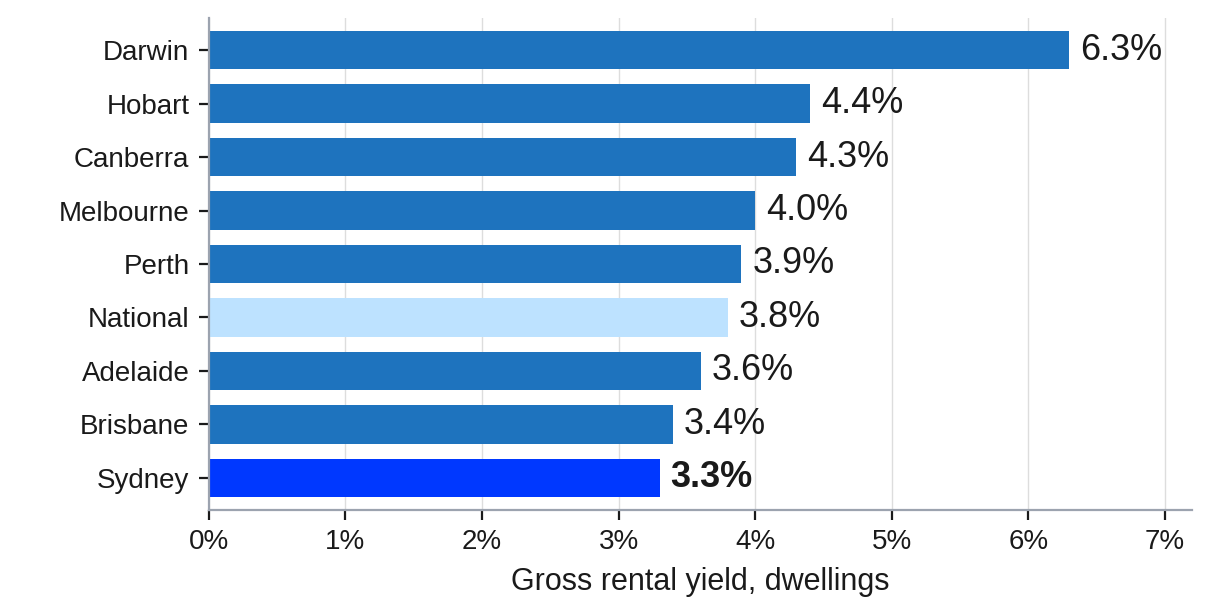
Source: Cotality Home Value Index, September 2026 (dwellings, to 31 August 2026)
Tax changes raise the stakes. The ATO confirms negative gearing will be limited to new builds from 1 July 2027 for established homes bought after Budget night, as our negative gearing rules guide explains.
How Much Below Asking Price Should You Offer?
There is no universal percentage
There is no safe rule such as ten percent below asking. The right offer depends on the gap to sold evidence, the property's condition, time on market and competing buyers.
Average discounts are context, not a target. A discount off an inflated asking price is not the same as buying below market value, and in our example the average discount still overpays.
Set your walk-away price first
Your walk-away price is the lower of two numbers: what the evidence says the property is worth, and the highest price at which the investment still meets your cash flow limit. Then take off any repair costs your inspections uncover.
Our example property rents for $650 a week, with $11,074 a year in holding costs and an 80% loan at 6.8% interest. The investor can accept a pre-tax shortfall of up to $320 a week.
Weekly Cash Flow at Different Purchase Prices
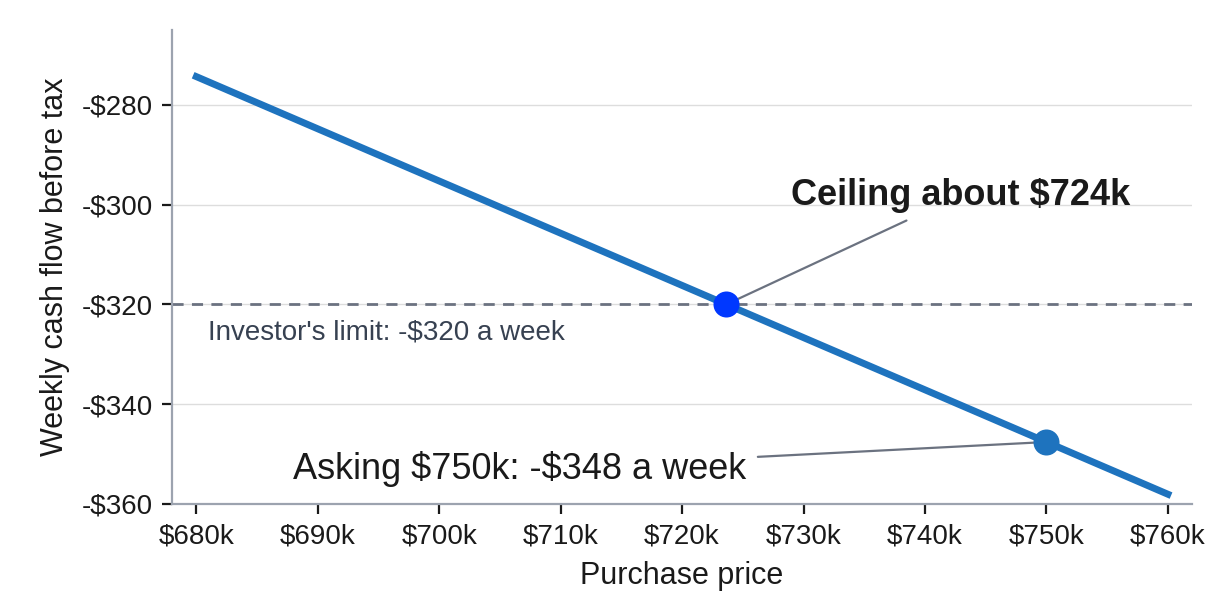
Source: FPW Group calculations, September 2026, via the Moneysmart mortgage calculator
If the numbers only work at a price no seller will accept, move on. Our guide to choosing investment-grade suburbs shows where the numbers are more likely to stack up.
Make an evidence-backed opening offer
Open below your walk-away price, but close enough to the evidence that the agent takes it seriously. A lowball offer with no reasoning often ends the conversation.
From Asking Price to Opening Offer
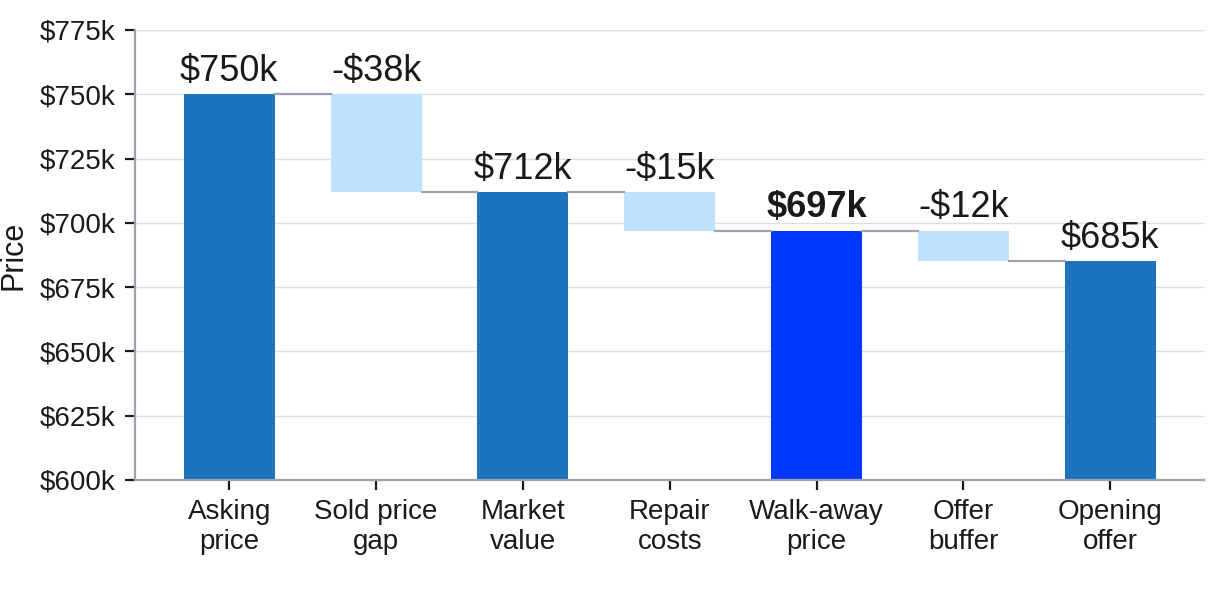
Source: FPW Group worked example, September 2026, following Moneysmart offer guidance

How to Negotiate House Price with the Selling Agent
The selling agent works for the vendor, so anything you say can be passed on. Your job is to gather information before you give any away.
Ask questions before you reveal a number
How long has the property been on the market, and has the price changed?
Have there been other offers, and were any turned down?
What settlement date would suit the vendor?
Is the vendor buying elsewhere or working to a deadline?
Use sold prices to justify your offer
"I think it's overpriced" invites an argument. "Three similar homes sold between $705,000 and $720,000 in the last four months, and this one needs roof work" gives the agent something to take back to the vendor.
Do not negotiate against yourself
If you raise your offer and hear nothing new back, you have paid more for no information. Only move when the seller moves or tells you something new.
This is where a buyer’s agent earns their fee, handling the back and forth and keeping emotion out of the numbers.
Negotiate More Than Just the Purchase Price
A better deal is not always the lowest price. Some terms are worth thousands to one side and cost the other little.
Be careful with finance conditions, because what you can borrow is set by the lender, not by the price you negotiate. Check your borrowing capacity in Australia before you shorten a finance clause to make an offer look stronger.
Negotiating After Inspections, at Auction and by Private Treaty
Use inspection findings and valuations
Moneysmart notes that conditional offers can depend on finance, valuation or inspections, and most states have a short cooling-off period for private sales. Use that window to turn a building and pest report into a fair price adjustment.
Ask for a reduction that matches the quoted repair cost, not a round number. If the bank valuation comes in low, share it, because other lenders are likely to agree.

Auction vs private treaty
At auction there is no cooling-off period, and the sale is not subject to finance or inspections, so complete your checks and finance before the day. With auction clearance rates below 50%, many properties are passing in and moving to private negotiation afterwards.
A pre-auction offer only works if it is strong enough to cancel the auction. If competition is heavy on the day, your walk-away price is your only protection.
When Should an Investor Walk Away?
The price needed to secure the property is above your walk-away price.
The asking price sits well above sold evidence, and the seller will not move.
An inspection, valuation or strata report changes the investment case.
Another property offers better fundamentals for the same money.
Walking away is the process working, not failing. Successful property investment in Australia is built as much on the deals you skip as the ones you sign.

A seven-step framework for negotiating an investment property
Final Thoughts
Negotiating a better price on an investment property starts well before the first offer. Sold prices tell you what the property is worth, your rent and loan numbers tell you what it is worth to you, and the lower of the two sets your line.
Softer conditions this spring give buyers more room. But an average discount off an optimistic asking price can still be an overpayment, and an investor lives with that price for years.
Know your numbers, negotiate with evidence and be ready to walk away. The discipline costs nothing and can save tens of thousands. That is how to negotiate house price as an investor.
Frequently Asked Questions

Recommended Reading
Two pages selected based on what readers of this article are most likely to need next.
Recommended Video
These are not dramatic mistakes or rare worst-case scenarios. They’re the pressure points that often show up after purchase—when the property is already settled, the loan is in place, and the reality of ownership starts to unfold. From growing cashflow pressure and tenant risk to interest rate changes, rising ownership costs, overpaying at the start, and making structural decisions too late, this episode explains why even good properties can start to feel heavy when these issues aren’t understood early.