

Auction Clearance Rates Are Falling. Is That Bad for Investors?
Australia property auction clearance rates have been falling through 2026, but a lower clearance rate is not automatic proof that prices are about to drop. It is a signal about competition on a single Saturday, not a forecast of where a property's value is heading.
The national preliminary rate sat at 46.1% for the week ending 5 September 2026, well under the 74.4% recorded in the same week of 2025. What that number can and cannot tell an investor, and what else needs checking before it changes a buying decision, is the real question worth answering, more useful than reading the wider market slowdown from one weekly figure alone.
What Australia's Auction Clearance Rate Is Actually Showing Right Now?
Australia property auction clearance rates have fallen through most of 2026, and the trend has kept moving in one direction since winter. The national preliminary clearance rate was 46.1% for the week ending 5 September 2026, down from 47.3% the week before and well under the 74.4% recorded in the same week of 2025, according to Cotality
A rate above 60% is generally seen as a balanced market. Every major capital has spent recent months below that mark, and some weeks have landed well below it, including a preliminary reading of 49.2% in late June that Cotality expected to fall closer to 40% once final results were counted.
National Auction Clearance Rate, 2026 vs a Year Earlier
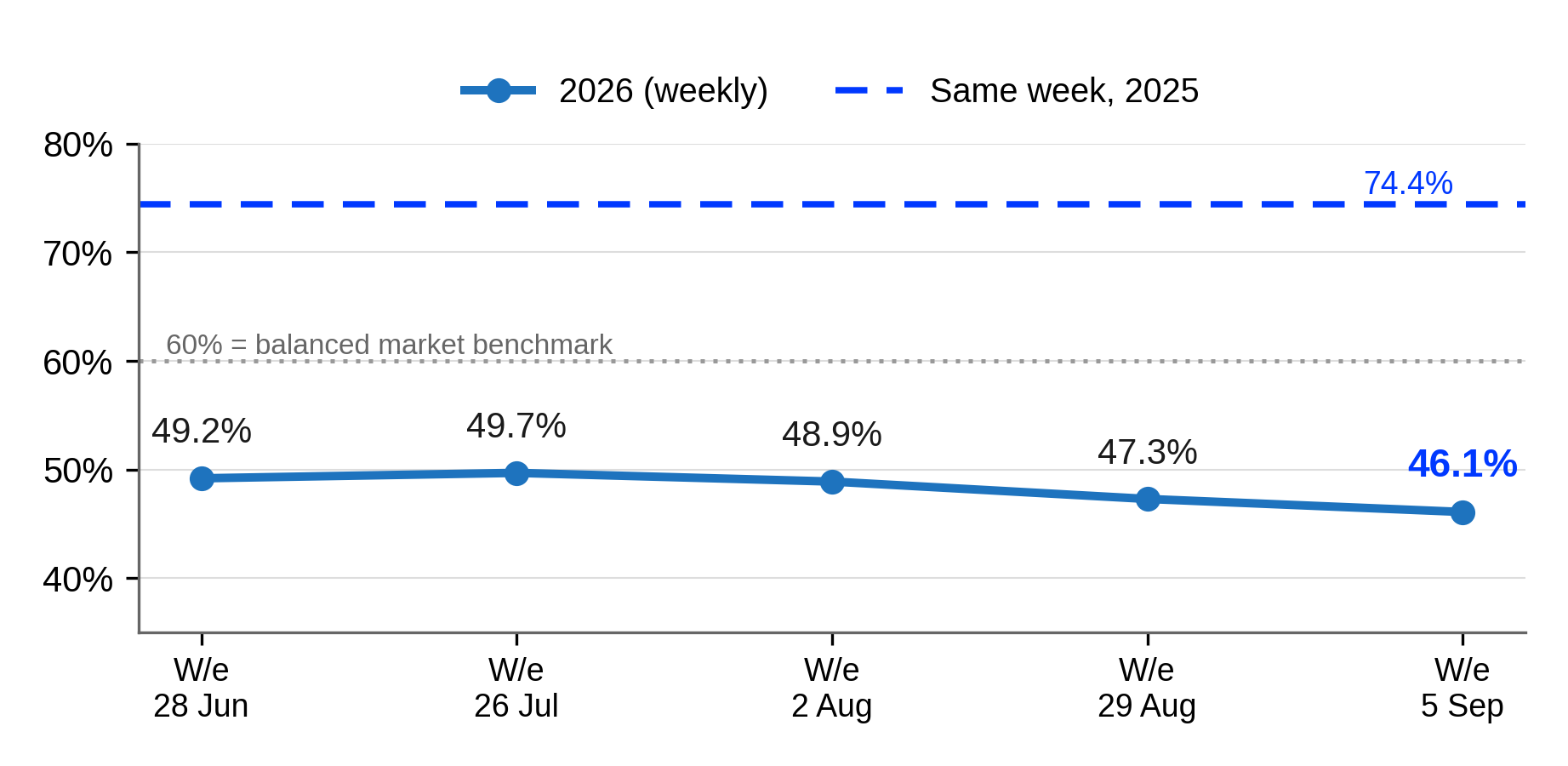
Source: Cotality, weekly auction results, 2026
Is a Falling Clearance Rate a Warning Sign or Just a Signal?
A clearance rate is a signal, not a forecast. It measures how many properties found a buyer at auction that week, which reflects competition and confidence on the day, not the value of any property twelve months from now.
Forecasters disagree sharply on what comes next. HTAG Analytics puts the city's 2026 growth range at anywhere from minus 7 percent to plus 18 percent, reflecting a market sitting at the peak of its own cycle. SQM Research is more bullish, forecasting 7 to 11 percent dwelling price growth for the year, while bank and PropTrack-aligned estimates sit closer to 4 to 7 percent.
Gold Coast 2026 Growth Forecasts: How Far Analysts Disagree
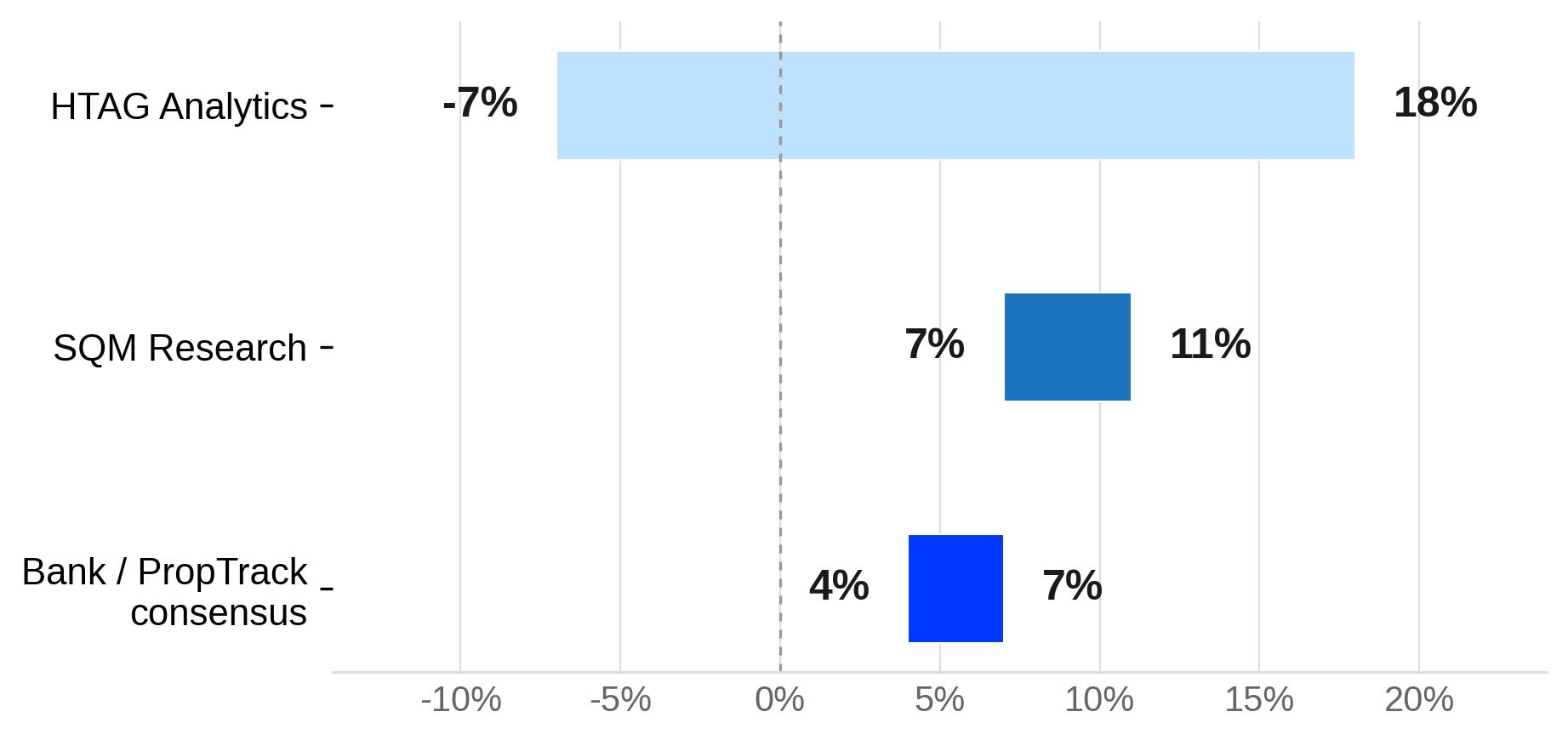
Source: HTAG Analytics, PropTrack and SQM Research, 2026.
What's Driving Demand Across the Gold Coast?
Three forces are keeping demand ahead of supply on the coast: population growth, a shrinking pipeline of new apartments, and infrastructure that is reshaping which suburbs are easy to reach.
Queensland has been the top destination for interstate migrants for four straight years, with net inflows averaging more than 31,000 people annually since 2022, according to Australian Bureau of Statistics regional migration data.
The Gold Coast has added roughly 68,000 residents over five years, and the council estimates the region needs 185,000 new homes over the next two decades. The housing shortage across Australian cities is particularly visible here, and it shows up directly in the rental market, where vacancy in the strongest pockets sits near multi-year lows, keeping upward pressure on rents even as buyer demand cools.
New apartment supply is falling at exactly the wrong time. The Property Council of Australia expects completions to drop from around 1,900 units in 2025 to roughly 1,400 in 2026, with only about 50 apartments considered firmly locked in for 2027.
Gold Coast Apartment Completions Are Falling Fast
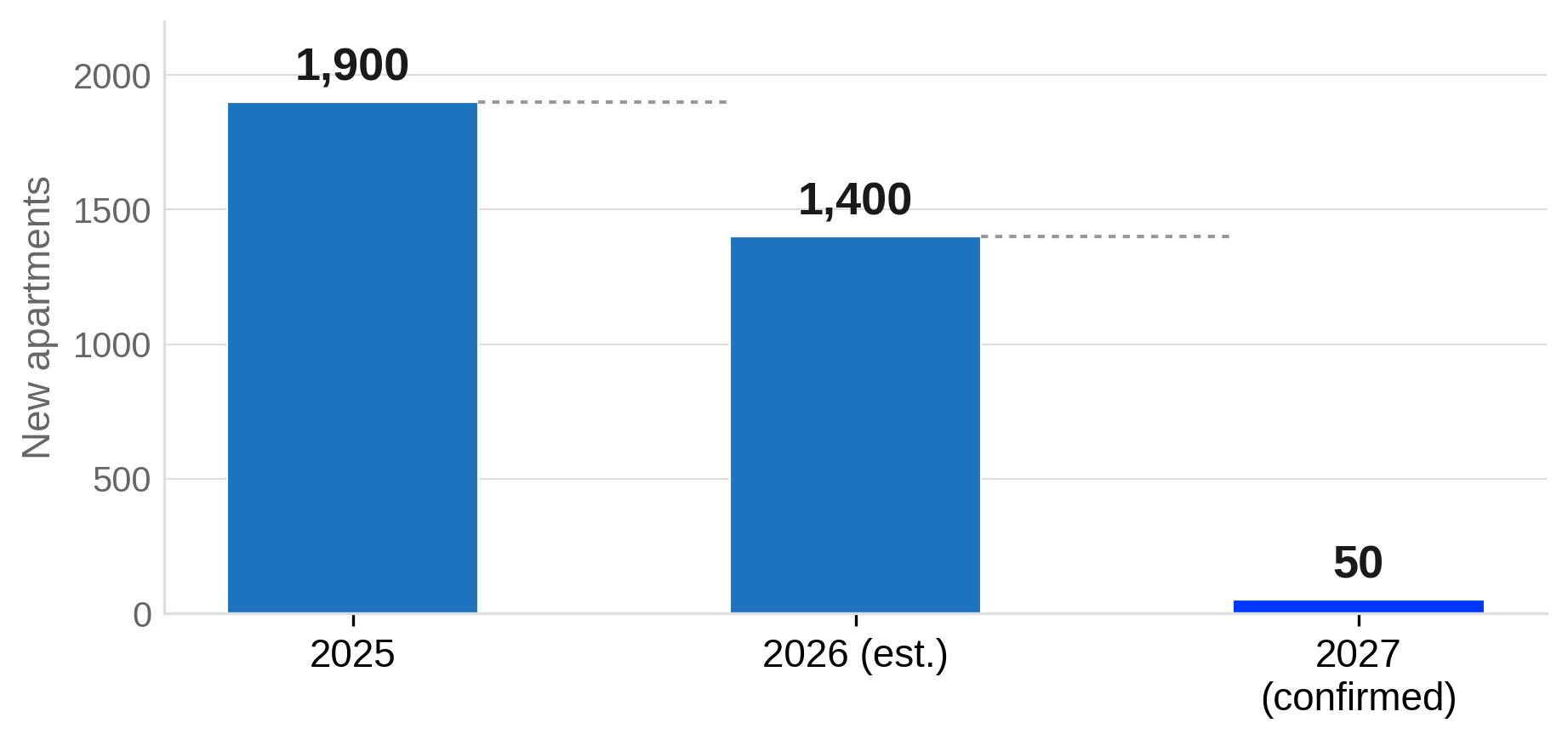
Source: Property Council of Australia, 2026.
Infrastructure is reshaping demand corridor by corridor, but it is not guaranteed to arrive as planned. Gold Coast Light Rail Stage 3 is due to open in mid-2026, extending the network from Broadbeach South to Burleigh Heads at a cost of $1.549 billion. Stage 4, which would have pushed the line on to Coolangatta via the airport, was cancelled in September 2025.
Interstate migration is reshaping demand across the entire east coast, and the Gold Coast remains one of its biggest beneficiaries.
Which Gold Coast Suburbs Still Have an Investment Case?
Rather than naming five “best” suburbs, it is more useful to group them by what they actually offer an investor. A suburb can be a great place to live and a mediocre place to buy at today's price.
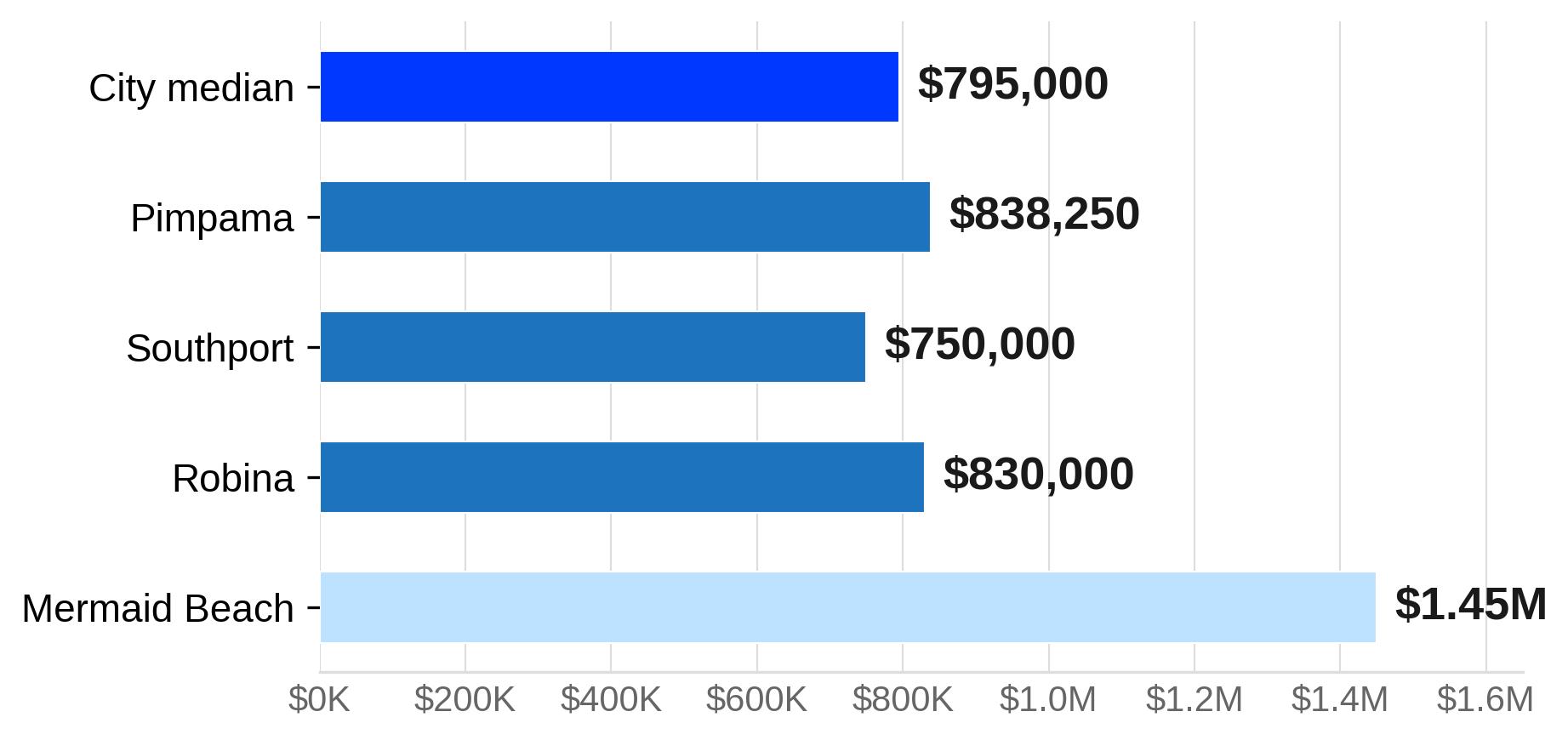
Median Unit Prices Across Gold Coast Suburbs vs the City Median
Source: CoreLogic and PropTrack suburb data, 2026.
Northern corridor: affordability with a growth story
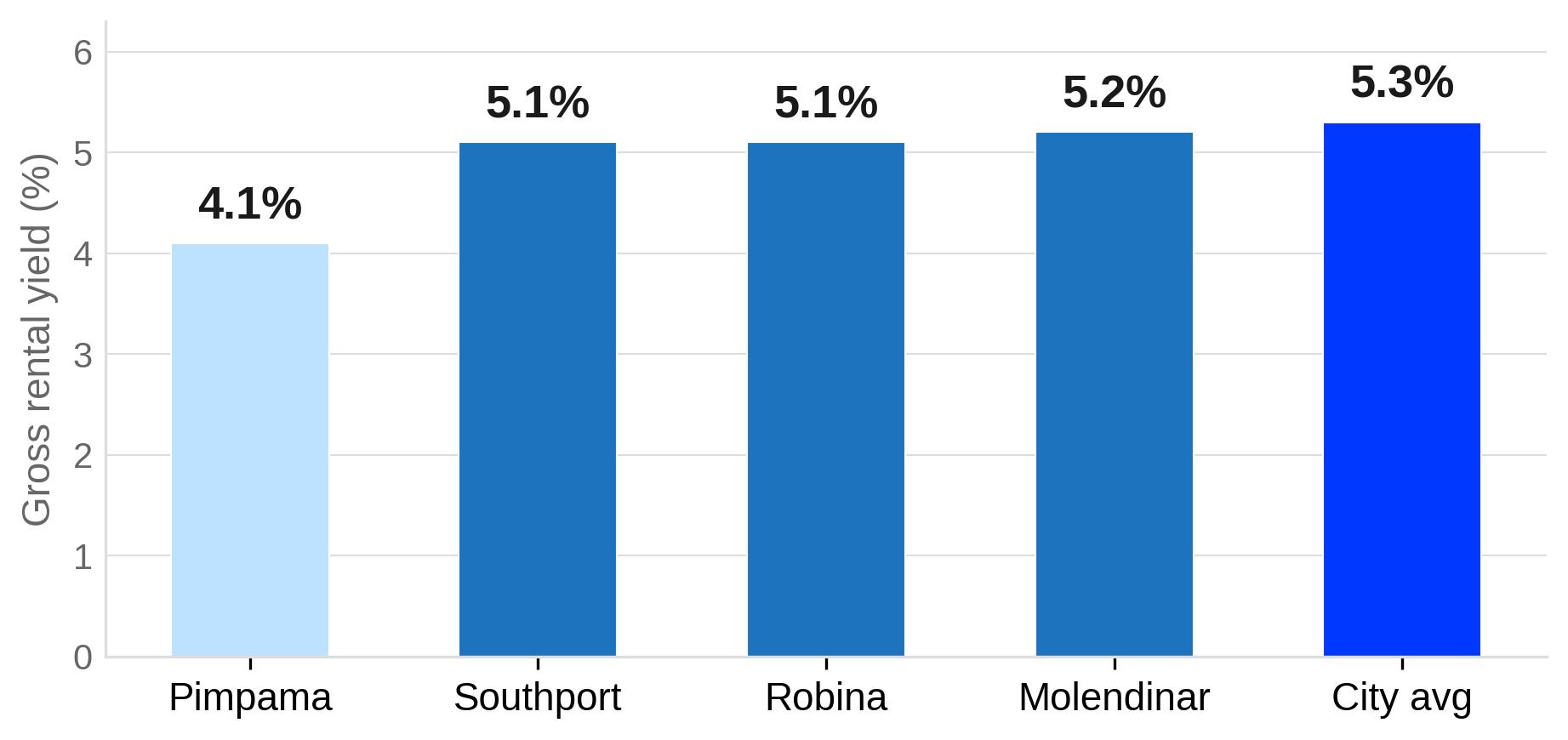
Pimpama and Upper Coomera continue to attract buyers priced out of suburbs closer to the coast. Pimpama's median unit price reached $838,250 in the past year, up 19.8 percent, while Upper Coomera posted 19.5 percent annual growth. The trade-off is yield: Pimpama's gross rental yield sits around 4.1 percent, the lowest of the northern pockets, so the case leans on continued price growth rather than income.
Established hubs: where the yield sits
Robina, Southport and Molendinar have become the coast's strongest yield plays, each returning a little over 5 percent gross on units, with Robina's median rent near $795 a week.
Gross Rental Yield by Gold Coast Suburb
Source: CoreLogic, 2026.
Premium coastal suburbs: scarcity, but check the entry price
Burleigh Waters has delivered close to 99 percent growth over five years on lifestyle demand and genuine land scarcity, while Mermaid Beach commands the coast's highest prices. These suburbs are unlikely to run short of buyers. The open question is whether five years of growth is already priced into what a buyer pays today.
How to Tell If a Gold Coast Suburb Is Actually Investment Grade
Past capital growth tells you what already happened, not what is likely to happen next. A stronger test is comparing that growth against rental yield, because a suburb showing high growth and low yield is being priced for future gains that may or may not arrive.
Balancing yield against growth is one of the more consistently overlooked steps in suburb selection, and it applies directly to the Gold Coast's current split between the northern corridor and the established rental hubs.
Supply pipeline matters just as much as demand. A suburb with strong buyer interest but a wall of new apartments due within eighteen months is a different proposition to one where approvals have stalled. How to choose an investment-grade suburb covers this test in more depth, including how to check a local development pipeline before making an offer.
Finally, the property's price matters more than the suburb's reputation. A good suburb can still contain an overpriced property, particularly where vendor expectations have been shaped by three years of growth.

Entry price also interacts with what a lender will approve. A suburb near the top of your budget leaves no room if borrowing capacity is reassessed at a higher rate buffer, worth checking before making an offer.
Gold Coast Property Investment Risks Investors Should Watch
Most Gold Coast suburb guides read like a highlight reel. The risks are just as real as the upside, and they explain why suburb selection matters more now than it did three years ago.
Paying too much after a strong run is the most common mistake, particularly in premium coastal suburbs where five years of growth have already reset buyer expectations. Property investment mistakes made by first-time investors often trace back to exactly this pattern: buying the story rather than checking the number.
Hotspot suburbs that never deliver the promised boom usually share the same pattern: heavy promotion, heavy new supply, and a buyer pool that cannot absorb both. Oversupply risk is real in specific apartment pockets even while the broader market stays tight.
Rising holding costs are the quieter risk. Higher entry prices mean higher loan balances, and a serviceability buffer at a higher rate can leave less room than buyers expect. Checking debt-to-income settings and how lenders assess risk before committing to a suburb avoids a surprise at approval stage.
Final Thoughts: Is Gold Coast Property Investment Still Worth It in 2026?
The Gold Coast still has strong structural drivers behind it: population growth well above the national average, a genuine housing shortage, and infrastructure investment reshaping entire corridors. What has changed is how much of that story is already reflected in the price you are asked to pay.
The suburbs still worth watching in 2026 are not necessarily the ones getting the most attention. They are the ones where growth, yield, supply and entry price still line up in the buyer's favour. Suburb and property selection now matter more than timing the broader market, because the broader market has already made its move.
Frequently Asked Questions

Recommended Reading
Two pages selected based on what readers of this article are most likely to need next.
Recommended Video
Most investors are still positioned in capital cities — but in 2026, that allocation gap is creating real opportunity cost. In a market where timing, positioning, and yield profiles compound into long-term outcomes, that disconnect matters more than most people realize.