

Perth Property Market: Has Growth Gone Too Far?
Introduction
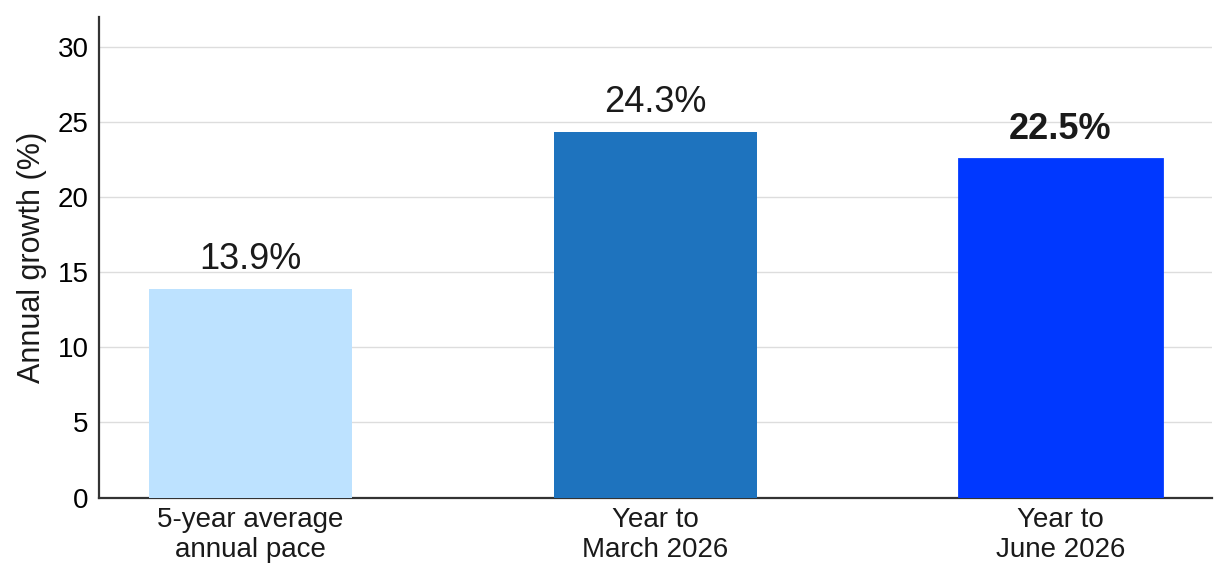
Perth house prices have not stopped rising, but the pace of that rise is changing. Growth peaked well above 20 percent a year through 2025 and into early 2026, and the latest data shows that rate easing for the first time in over a year.
That does not settle the question of whether Perth is now overvalued. It depends on whether the forces that pushed prices up, a chronic housing shortfall, fast population growth and record low listings, are still strong enough to support prices at this new level. The answer changes depending on whether you look at houses or units, and whether you trust the more cautious bank forecasts or REIWA's own bullish outlook for the rest of 2026.
Perth property investment decisions now hinge on a set of figures that most headlines skip entirely.
How High Have Perth Property Prices Actually Climbed?
Perth's median dwelling value reached $1,017,698 in March 2026, according to Cotality's Home Value Index. That is a rise of 24.3% over the year and 7.3% in the March quarter alone.
Zoom out further and the scale becomes clearer. Dwelling values in Perth have climbed more than 91% since March 2021, the fastest five year run of any Australian capital.
Not every data source agrees on the exact number, and that is worth understanding rather than skipping over. REIWA's transacted median, based on actual settled sales, put Perth's median house price at $845,000 in its 20 April 2026 release, a more conservative figure than Cotality's stock wide valuation index. REIWA measures what has already sold. Cotality models the value of every dwelling in the city, sold or not. Both point the same direction. Only the size of the number changes.
Perth's Growth Rate Is Slowing From an Exceptional Peak
Source: Cotality Home Value Index, 2026
What Is Still Driving Perth Prices Higher?
Perth's population grew 2.4% in the 2024/25 financial year, reaching 2,452,765 people. That is a faster growth rate than every other Australian capital.
Supply has not kept pace. Western Australia is currently short more than 10,000 dwellings a year, and that gap shows no sign of closing quickly, a pattern consistent with the broader housing shortage across Australia.
Construction costs, labour shortages and a limited pipeline of new land are compounding the problem. At the end of December 2025, only 250 residential lots remained on the market across greater Perth, against a five year average of 1,180.
Listings overall are down roughly a third compared to a year ago, according to REIWA. That scarcity is doing as much to support prices as buyer demand itself.
Is Perth's Growth Actually Slowing Down?
Yes, on the most recent numbers. Domain's June 2026 data shows Perth house prices up 22.5% annually, but quarterly growth has eased to its weakest pace in 15 months.
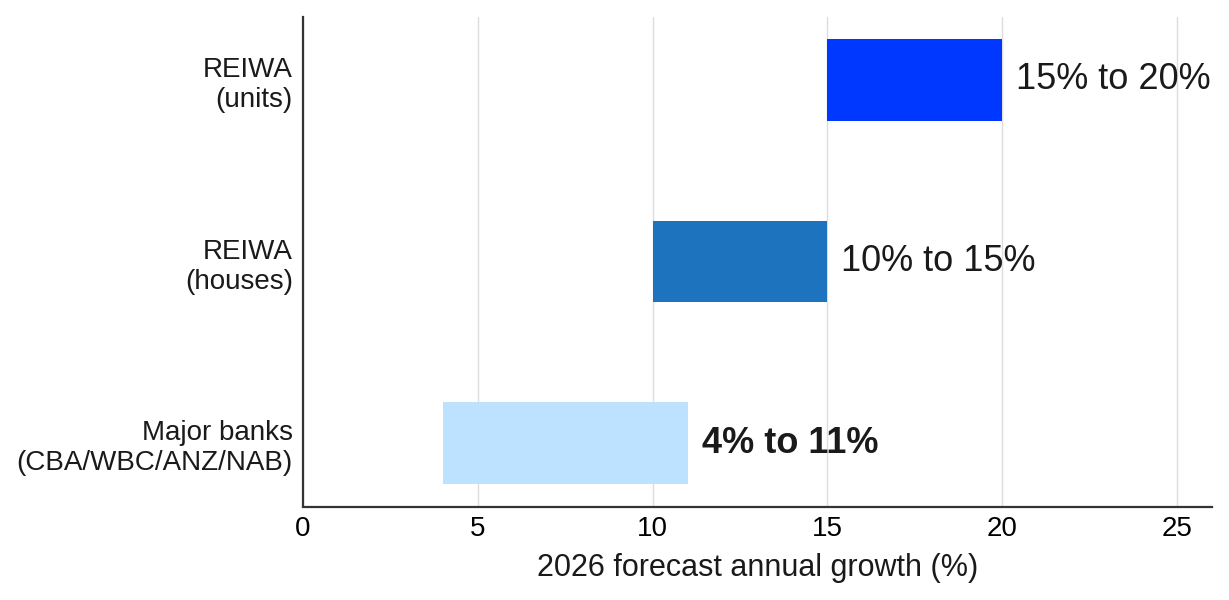
The banks are split on what happens next. CBA, Westpac and ANZ expect the cash rate to hold around 3.85% through 2026, while NAB expects one more increase. Combined with tightening affordability, the four majors' 2026 growth forecasts for Perth span a wide range, a divergence closely tied to how property investment interest rates are read by each bank's own economics team.
REIWA's own forecast sits well above that range, calling for 10% or more on houses and 15% to 20% on units. The gap between REIWA and the banks comes down to how much of the supply shortage and migration story is already priced into the market.
The 2026 Forecast Gap Between Banks and REIWA
Source: Major bank economics teams and REIWA, 2026
KPMG's August 2026 analysis takes the middle ground. It flags affordability as a growing constraint while still describing Perth as one of the strongest housing markets in the country.
Are Perth Prices Becoming Unaffordable?
Every dollar added to the median price changes what a buyer needs to qualify for a loan. A larger purchase price means a larger deposit and a larger loan, one that a lender will test at a rate higher than you will actually pay, the same buffer mechanism covered in our debt to income ratio breakdown.
That serviceability buffer is the real constraint behind Perth's growth ceiling, not the headline cash rate. As prices rise faster than incomes, fewer buyers clear that bar without adjusting their deposit, their loan term or their target suburb. Some respond by looking at how to increase borrowing capacity before they shop for a property, rather than after.

Houses vs Units: Is the Market Moving as One?
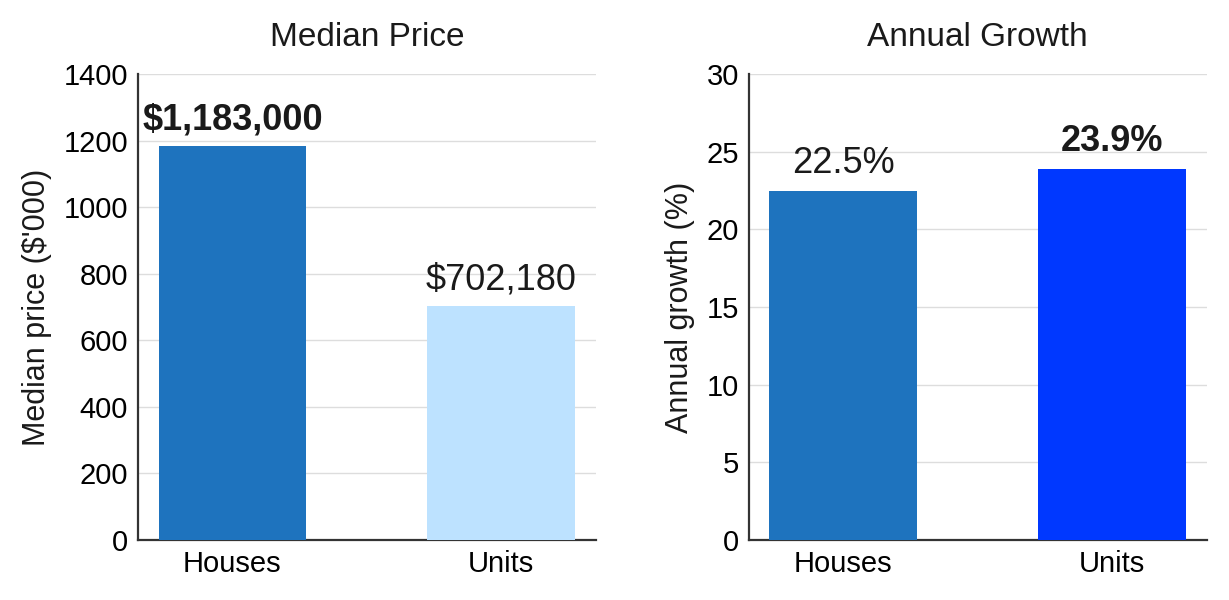
Not quite. Domain's June 2026 data shows Perth units growing 23.9% annually, edging past the 22.5% recorded for houses, even though houses still carry the higher price tag at $1.183 million against $702,180 for units.
That gap matters for strategy, not just for headline reporting. Units are becoming the more affordable entry point into a market where house deposits have moved out of reach for a growing share of buyers, which reopens the yield versus growth question for anyone building a portfolio rather than buying a single property.
Houses and Units Are Now Growing at Similar Rates
Source: Domain Research, June 2026
Rental data tells a similarly split story, and the split itself is instructive. REIWA's own release put Perth's citywide vacancy rate at 2.2% in March 2026, just outside the 2.5% to 3.5% band it considers balanced. SQM Research, which surveys online rental listings rather than member rent rolls, put a comparable reading closer to 0.5% in April 2026. The two methods disagree on the exact figure, but both describe a rental market still firmly in landlords' favour.
suburb selection still matters more than the citywide averages, a point our guide to choosing investment grade suburbs covers in more depth.
Final Thoughts: Has Perth Growth Gone Too Far?
The evidence does not support calling Perth's growth run finished. Population growth, a genuine supply shortfall and record low listings are all still in place, and none of them reverse quickly.
What has changed is the margin for error. Quarterly growth is slowing, affordability is tightening, and the banks themselves cannot agree on how much room remains before why borrowing capacity drops when interest rates rise starts to bind on the marginal buyer.
For investors weighing a Perth purchase now, four figures are worth tracking every quarter: the vacancy rate, days on market, dwelling approvals and the gap between REIWA's forecast and the major banks. A widening gap in any of those is the earliest sign that the current cycle is entering its next phase.
Frequently Asked Questions

Recommended Reading
Two pages selected based on what readers of this article are most likely to need next.
Recommended Video
Australia's record migration surge — peaking at over 528,000 people in a single year — created unprecedented housing demand almost overnight. We explain why the government used population growth as a deliberate tool to avoid recession, how that decision flows directly into property prices Australia-wide, and why rents have surged to record highs as a result.