Fifth RBA Rate Hike: Are Investors Underestimating the Real Cost?
Property investment returns come from rent and capital growth, minus everything it costs to hold the property, and the fifth RBA rate hike has just made the biggest of those costs larger. For many geared investors, the return is now lower than the one they modelled when they bought, even if the property's value has held up.
The RBA lifted the cash rate to 4.85% on 3 November 2026, its fifth rise this year. This is interest rate risk at work, and it is not only a repayment problem, because it changes how much growth a property now needs just to break even.
The numbers below show where that shift happens, and how to check whether your own property still does the job you bought it for.
What Really Makes Up Property Investment Returns?
TInvestment property returns come from two places: rental income while you own the property and capital growth when you sell. The total return is those two together, after vacancy, holding costs, loan interest and tax.
Rental income is only one part of the return
Gross rental yield is the yearly rent divided by the price. A $750,000 home renting for $560 a week has a gross rental yield of 3.9%, in line with the national average for dwellings in Cotality's October 2026 data.
Net rental yield takes off vacancy and running costs such as management, insurance, council rates and maintenance. In our example, that brings the yield down to about 2.5%, before a single dollar of interest is paid.
Capital growth can change the picture
Growth is usually the larger part of the return, but it is also the least certain. It is not paid to you each year, it cannot cover a cash shortfall until you sell or refinance, and it can stall for years. Weighing the two is the heart of any rental yield vs capital growth decision.
How the Fifth RBA Rate Hike Changes the Return Calculation
The 3 November decision took the cash rate from 4.60% to 4.85%, its highest level in 18 years, with three of nine board members voting to hold (ABC News). The cash rate started 2026 at 3.60%, so it is now 1.25 percentage points higher
RBA Cash Rate Through 2026
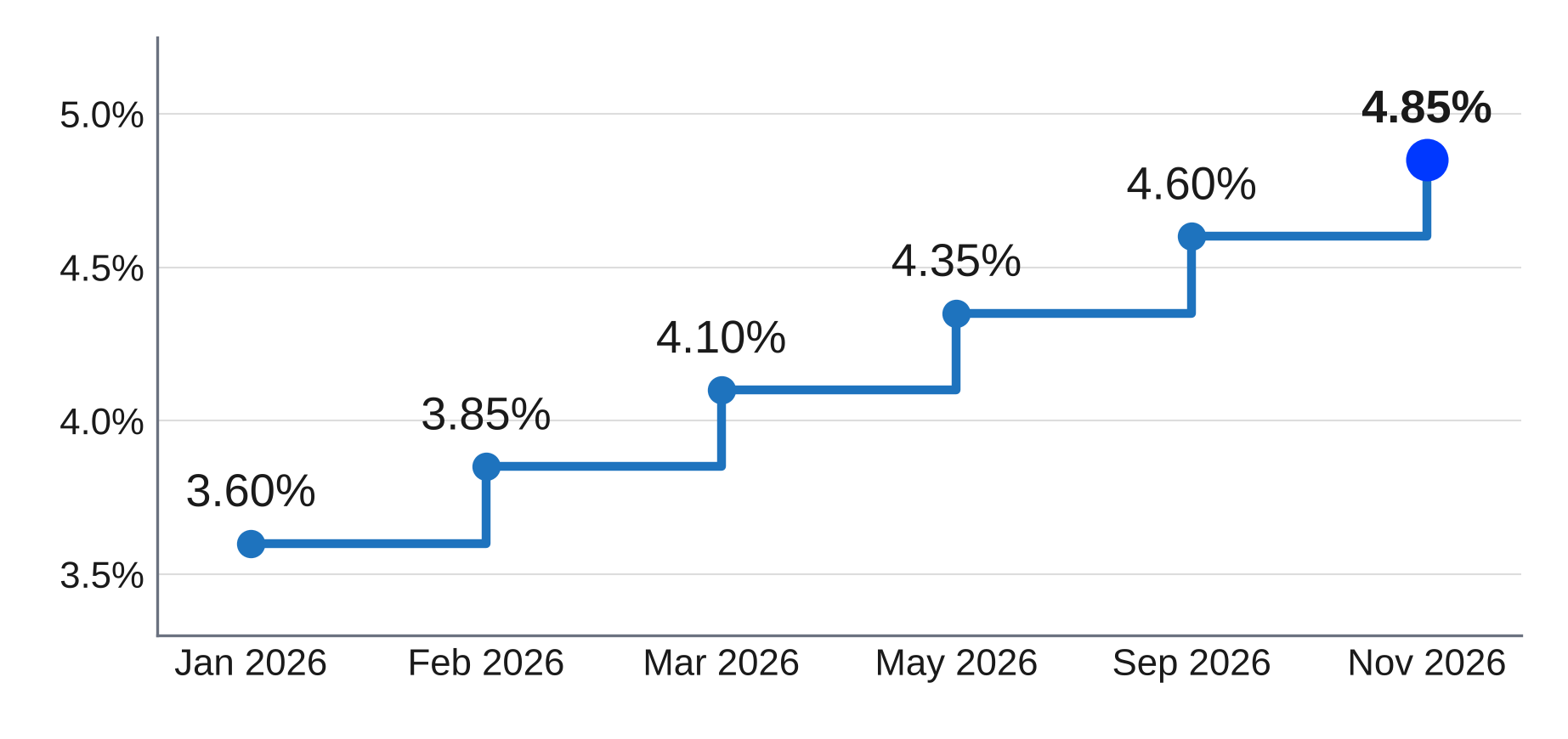
Source: CommBank, September 2026 (100 basis points of rises to 4.60%); ABC News, 3 November 2026 (rise to 4.85%).
Higher borrowing costs cut into the income side
Canstar put the average investor interest-only variable rate at 7.14% on 2 October 2026, before the latest rise. That is above the gross rental yield in every capital city.
Even Darwin, the highest-yielding capital at 6.4%, earns less in gross rent than an average interest-only investor pays in interest on the same amount. Sydney sits at just 3.5%
Gross Rental Yields by Capital City Against the Average Investor Rate
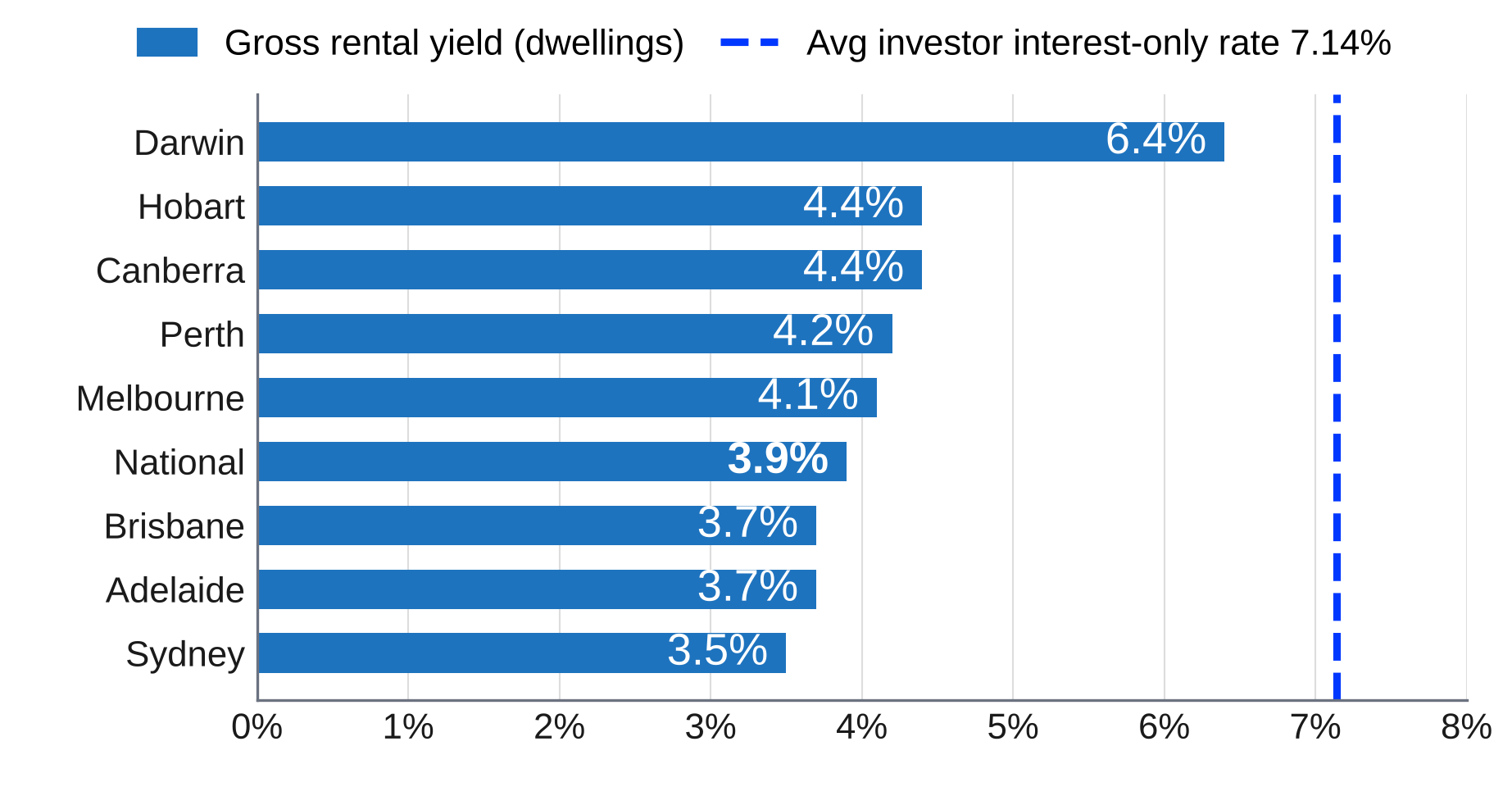
Source: Cotality Home Value Index, yields as at 31 October 2026; Canstar, average rates as at 2 October 2026.
The difference between gross yield and what investors actually keep
Higher rates also shrink how much a lender will let you borrow, which affects your next purchase as well as this one. Our guide to borrowing capacity covers that side, and our article on property investment interest rates explains how rate moves flow through the market.
For this property, the path from rent to property investment cash flow looks like this at today's estimated rate.
From Rent to Cash Flow on a $750,000 Investment Property
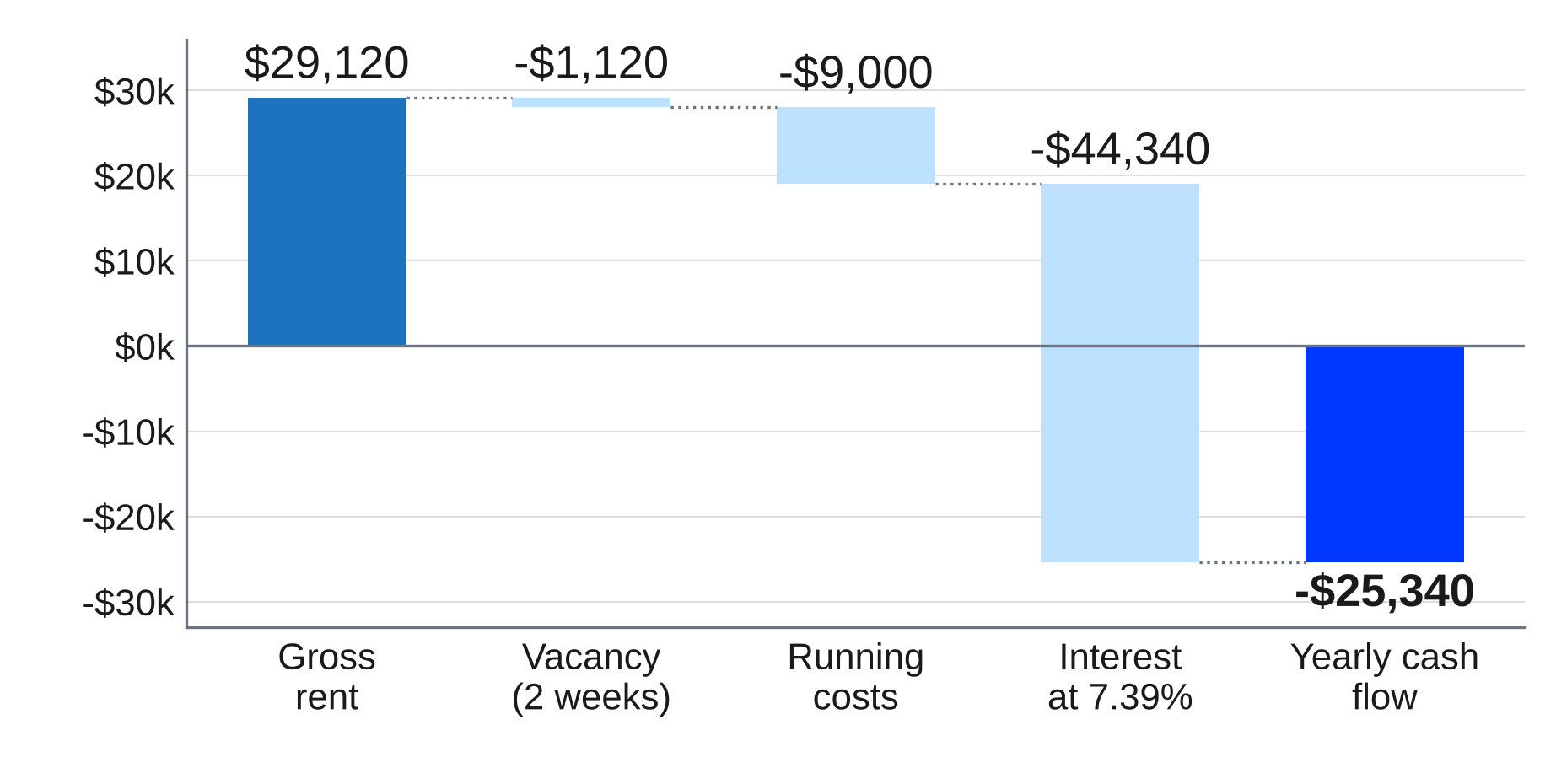
Source: FPW Group illustrative calculation. Assumes rent of $560 a week, $9,000 in yearly running costs and a $600,000 interest-only loan at Canstar's 7.14% average plus the November rise, before tax.
Why a property can rise in value while its return gets worse
None of this means prices must fall. A property can keep growing in value while the return on your cash shrinks, because the cost of holding it has risen faster than the rent.
Investors on fixed rates have not felt this year's rises yet. When the fixed term ends, the full increase can arrive in a single step, so it pays to run the numbers now.

Are Investors Underestimating What Higher Rates Cost Their Returns?
Many return calculations were done when money was cheaper. Three assumptions tend to carry the most weight, and each deserves a fresh look.
The assumption that rent will close the gap
Rents are still rising, with Cotality's data showing Brisbane house rents up 6.7% over the year to October. But a 6.7% rise on $29,120 is about $1,950, which covers only about a quarter of the extra $7,500 in interest from this year's rises.
The assumption that growth will fix negative cash flow
Growth is real but uneven, and Cotality's index shows values fell in six of eight capitals in October 2026. Treating future growth as certain is how a manageable shortfall turns into selling at the worst possible time.
The investment property holding costs that quietly reduce returns
• Loan interest
• Property management and letting fees
• Landlord and building insurance
• Maintenance and repairs
• Council rates and water charges
• Strata levies for units and townhouses
• Vacancy between tenants
• Land tax above state thresholds
Underestimating holding costs is one of the most common reasons a property looks better on paper than in the bank account. Allow for rental vacancy too, even in a tight market.
Tax can soften the shortfall through property investment tax deductions, but the negative gearing rules are changing. From 1 July 2027, negative gearing for residential property is limited to new builds, with properties held at 7:30pm on 12 May 2026 exempt (ATO).
Tax deductions soften the hit but do not remove it. For an investor paying 30% tax plus the 2% Medicare levy, deductions could cut the $25,340 shortfall to about $17,200 a year, before depreciation.
What Does a Property Investment Return Need to Look Like Now?
There is no single good number. A better test is whether the property still makes sense at today's costs, with growth treated as uncertain.
Test the property under a higher-cost scenario
Run the numbers at your current rate, then again at a rate 1 percentage point higher. If the shortfall at the higher rate would strain your budget, the return relies on conditions you do not control.
Compare income, growth and holding costs together
What This Year's Rate Rises Did to One Investment Property
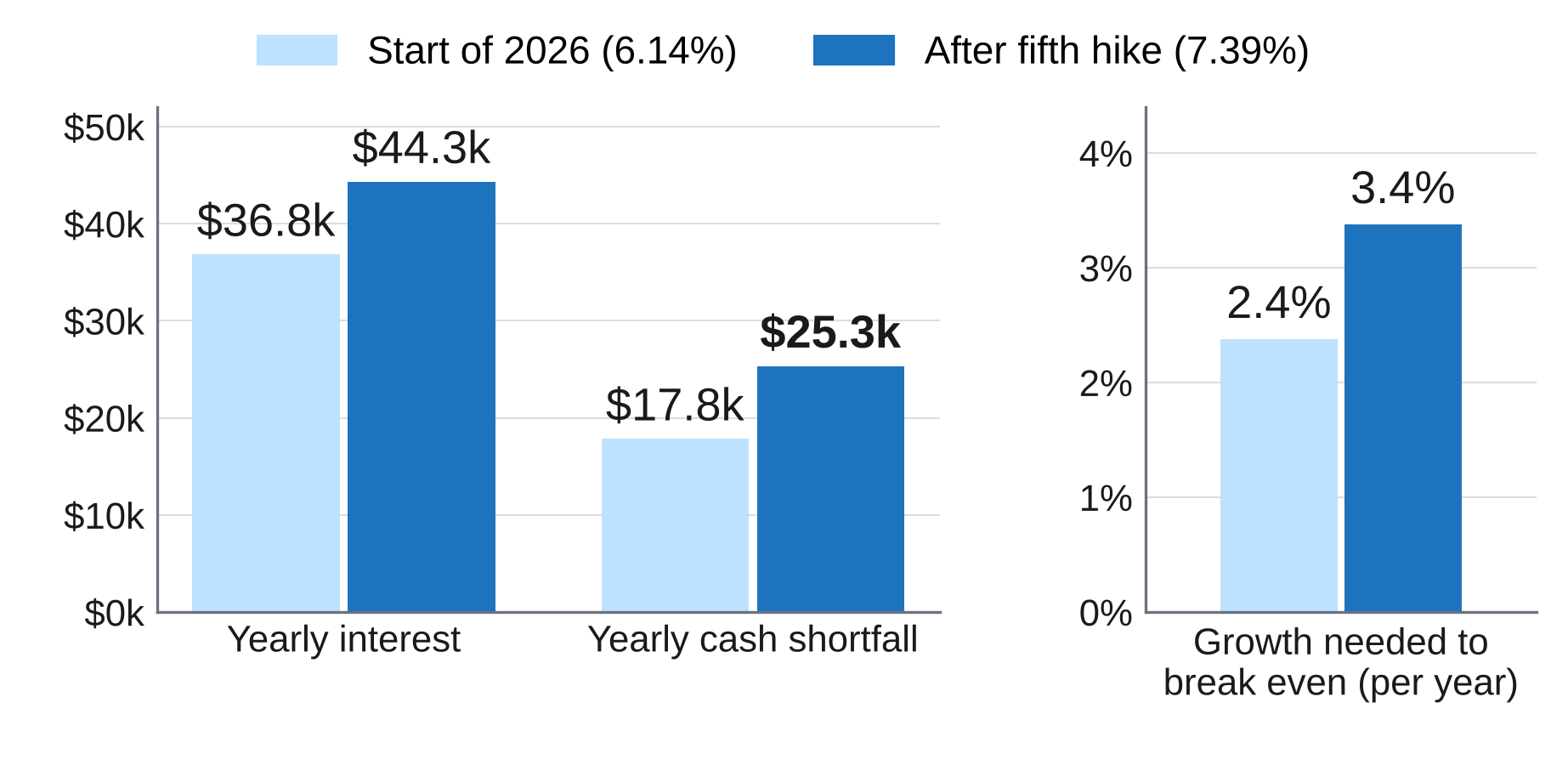
Source: FPW Group illustrative calculation. The start-of-2026 rate assumes the four earlier rises were passed on in full.
Test the property under a higher-cost scenario
A 6.7% pre-tax return depends on 5% growth arriving year after year. Compare that with what the same cash could earn elsewhere, including in super, as our property vs super analysis shows, and decide whether the gap is worth it.
If the loan is a big part of the problem, a mortgage broker can check whether your rate and loan structure still suit the investment.
Final Thoughts
Property investment returns are not one number. They are rent and growth minus the full cost of holding, and the fifth RBA rate hike has made that cost bigger for almost every geared investor.
In our example, the 2026 rises added $7,500 a year in interest and lifted the growth needed to break even from 2.4% to 3.4%. The property did not change. The cost of money did.
Recalculate before you assume your return is unchanged, using today's rate, real holding costs and a cautious growth figure.

Frequently Asked Questions
Recommended Reading
Two pages selected based on what readers of this article are most likely to need next.
Recommended Video
Australia's record migration surge — peaking at over 528,000 people in a single year — created unprecedented housing demand almost overnight. We explain why the government used population growth as a deliberate tool to avoid recession, how that decision flows directly into property prices Australia-wide, and why rents have surged to record highs as a result.