
Commercial Property Investment in Australia: Returns vs Risks
Commercial property investment can pay more income than residential property, but that higher yield is payment for risks most home investors never face. Whether the returns are worth it depends less on the advertised yield and more on the tenant, the lease, the loan and how long the property could sit empty.
That is the part many first-time commercial buyers underestimate. A headline yield can look strong on a listing and still leave very little cash once a few real costs come out.
Investor money is flowing back into the sector, but not evenly, and the gap between the best and worst assets is wide. This article looks at where commercial returns come from, what can wipe them out, and how to test a deal before you commit.
It sits within our wider guide to property investment in Australia. property investment in Australia.
Why Are Investors Looking at Commercial Property Investment?
Money has returned to the sector. Ray White Commercial research recorded $87.82 billion in Australian commercial property transactions in the 2025/26 financial year, up 25.7% on the year before.
The appeal is simple: higher yields, leases that often run for years, and tenants who pay most running costs.
Tax settings add to the interest. From 1 July 2027, negative gearing is limited to new builds for residential property bought after Budget night, a change that does not apply to commercial property (see our new negative gearing rules guide).
The Tenant Is a Business, Not a Household
A household rents a home because it needs somewhere to live. A business rents space only while it can trade profitably, so when it fails or moves, the income can stop completely.
How Does Commercial Property Investment Generate Returns?
Rental Income and Who Pays the Outgoings
Most commercial leases are net leases. The tenant pays the rent plus most outgoings, such as council rates, insurance and routine maintenance.
Rent rises through set reviews: fixed increases, CPI-linked increases or a reset to market rent
Capital Growth Depends on Rent and Yields
Commercial property is mostly valued on its income. If the market yield rises from 6.0% to 6.5% on a property earning $100,000, its value falls from about $1.67 million to $1.54 million, even though the rent has not changed.
Knight Frank reports Melbourne prime CBD office yields softened to an average of 7.02% in the June 2026 quarter, their highest level since 2013.
Why the Advertised Yield Is Not Your Return
A listing shows the yield before your loan. Interest is usually the largest cost, and commercial lending can affect your borrowing capacity quite differently to a home loan.
How a 6.5% Commercial Yield Can Shrink to Almost No Cash
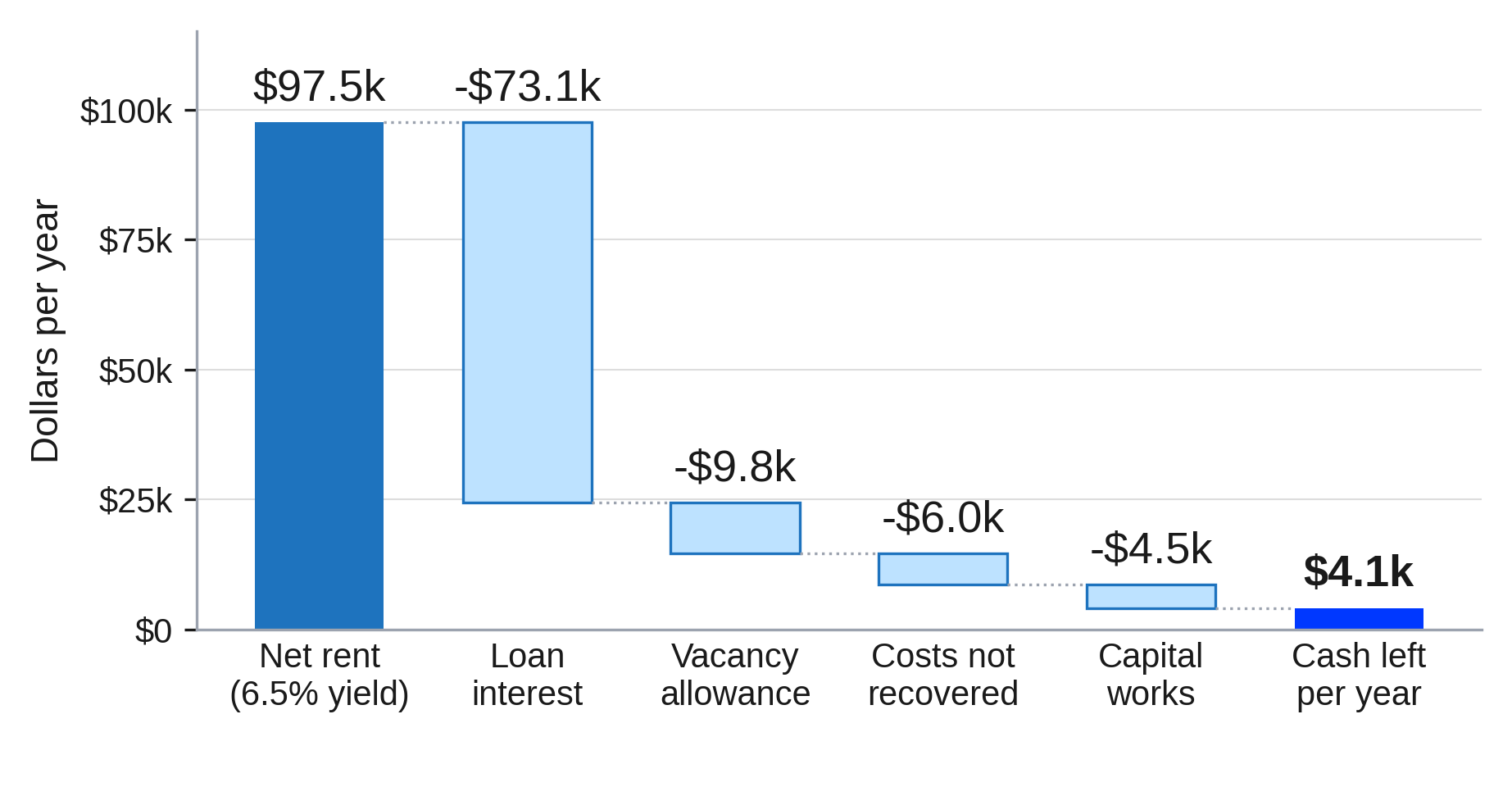
Source: FPW Group illustrative calculation, October 2026. Assumes a 65% interest-only loan at 7.5%.
Commercial Property Yields vs Residential Property: Is Higher Better?
On the surface, the gap is large. Cotality puts the national gross rental yield on homes at 3.85% in September 2026, while prime commercial yields sit well above that.
Colliers reports a national prime industrial yield of 5.70% in the March 2026 quarter, and CBRE puts the average prime CBD office yield at 6.67%
Commercial Property Yields Sit Well Above Residential Yields
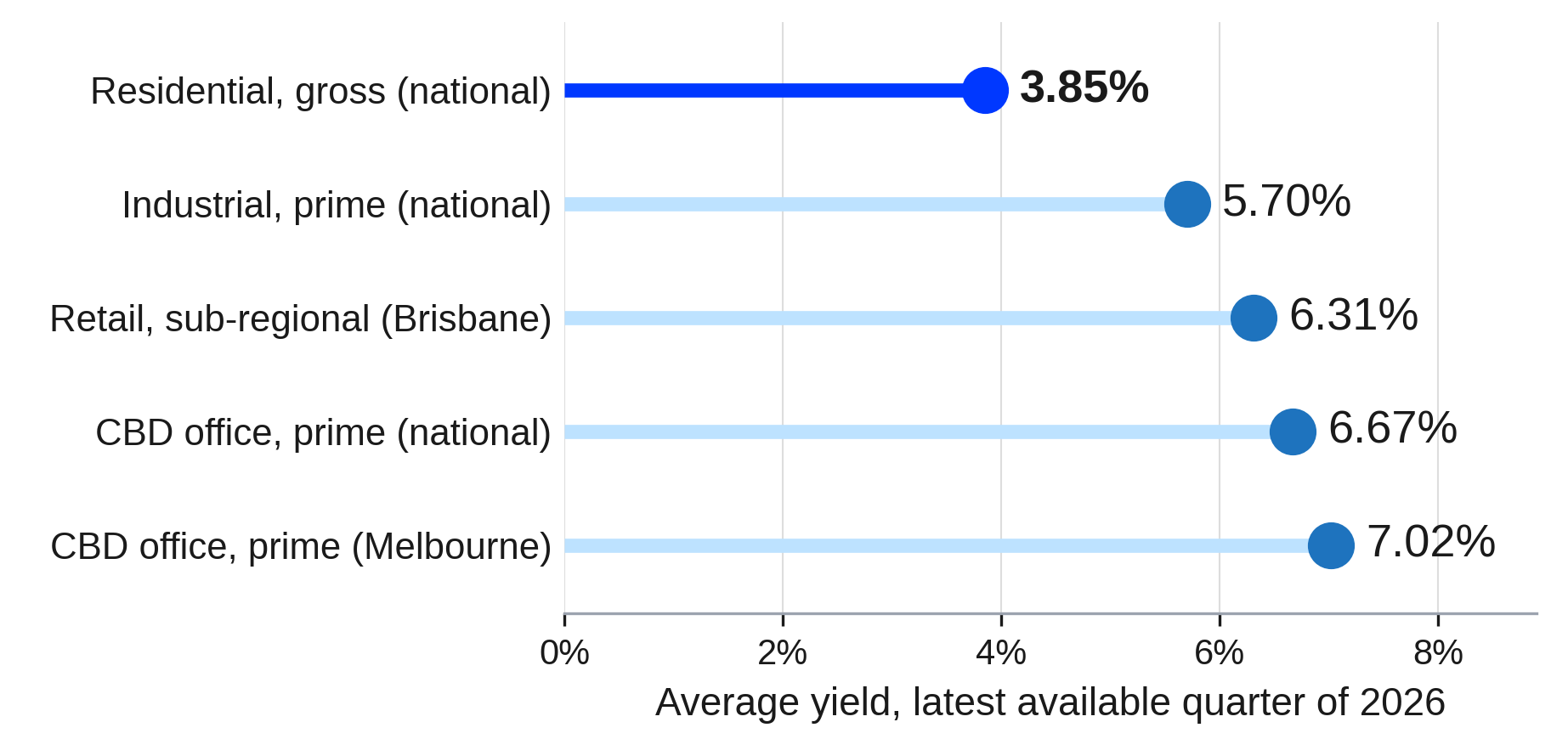
Source: Cotality, September 2026; Colliers, Q1 2026; CBRE, Q1 and Q2 2026; Knight Frank, Q2 2026
What Investors Give Up for the Higher Yield
Higher yields exist because buyers want paying for extra risk.
Does a Higher Yield Mean a Better Investment?
Not on its own. A 7% yield on a hard-to-lease secondary office can be worse than 5.7% on a well-leased warehouse, the same yield versus growth balance residential investors weigh up, with sharper edges.

What Are the Biggest Risks Behind Commercial Property Returns?
Vacancy Can Stop Income Completely
Office vacancy remains high. The Property Council reported national CBD office vacancy of 14.9% in July 2026, although Brisbane fell to 10.2%, the lowest of any CBD.
Industrial is much tighter. CBRE put national industrial vacancy at 3.2% in the first half of 2026, below the 4% level it treats as balanced.
Tenant Strength and Lease Expiry
Tenant covenant means how financially strong the tenant is: a national chain on a long lease beats a new small business on a two-year term.
Investors also check the WALE, or weighted average lease expiry, which shows how long income is locked in.
Incentives and Re-Leasing Costs
To win tenants, landlords often offer rent-free periods or pay for fit-outs. Knight Frank puts average incentives for Melbourne prime CBD offices at 48.1%, so close to half the face rent over a lease can be given back.
Commercial Property Can Be Harder to Sell
Fewer buyers mean slower sales. Ray White reports quarterly volumes fell from more than $27 billion in the December 2025 quarter to $15 billion to $18 billion in early 2026, as due diligence took longer.
Our guide to property sales and liquidity explains why that matters.
Which Commercial Property Sectors Carry Different Risks?
Commercial property is not one market. Each sector has its own tenants, demand drivers and weak points.
Industrial Leads Commercial Property Investment by Sector
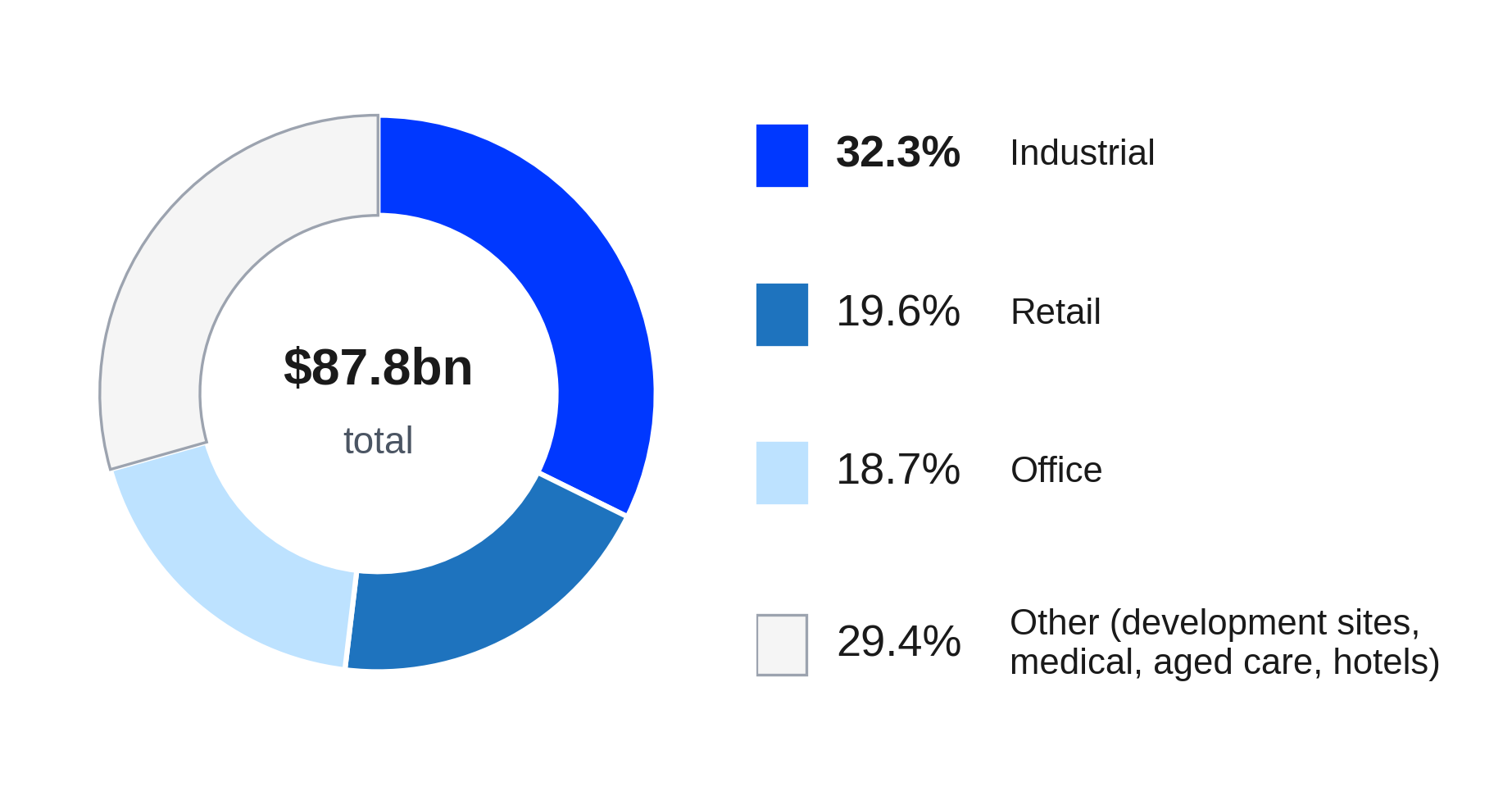
Source: Ray White Commercial, preliminary 2025/26 data, July 2026
Industrial. $28.34 billion traded. Units under $5 million draw private investors, but tight yields leave little room for error.
Retail. $17.19 billion traded. CBRE says neighbourhood centres returned 9.4% a year over a decade, but income depends on shoppers.
Office. $16.44 billion traded. Premium buildings win tenants while secondary stock struggles.
Medical, childcare and aged care. $7.23 billion, up 72.5%. Long leases, but a narrow pool of tenants and buyers.
What Does Australian Commercial Property Data Tell Investors?
Where Commercial Investment Activity Is Growing
New South Wales still leads with $34.49 billion, or 39.3% of national activity. Queensland is the standout, lifting its share from 16.9% in 2018/19 to 25.4%
Queensland Is Now the Second-Largest Commercial Property Market
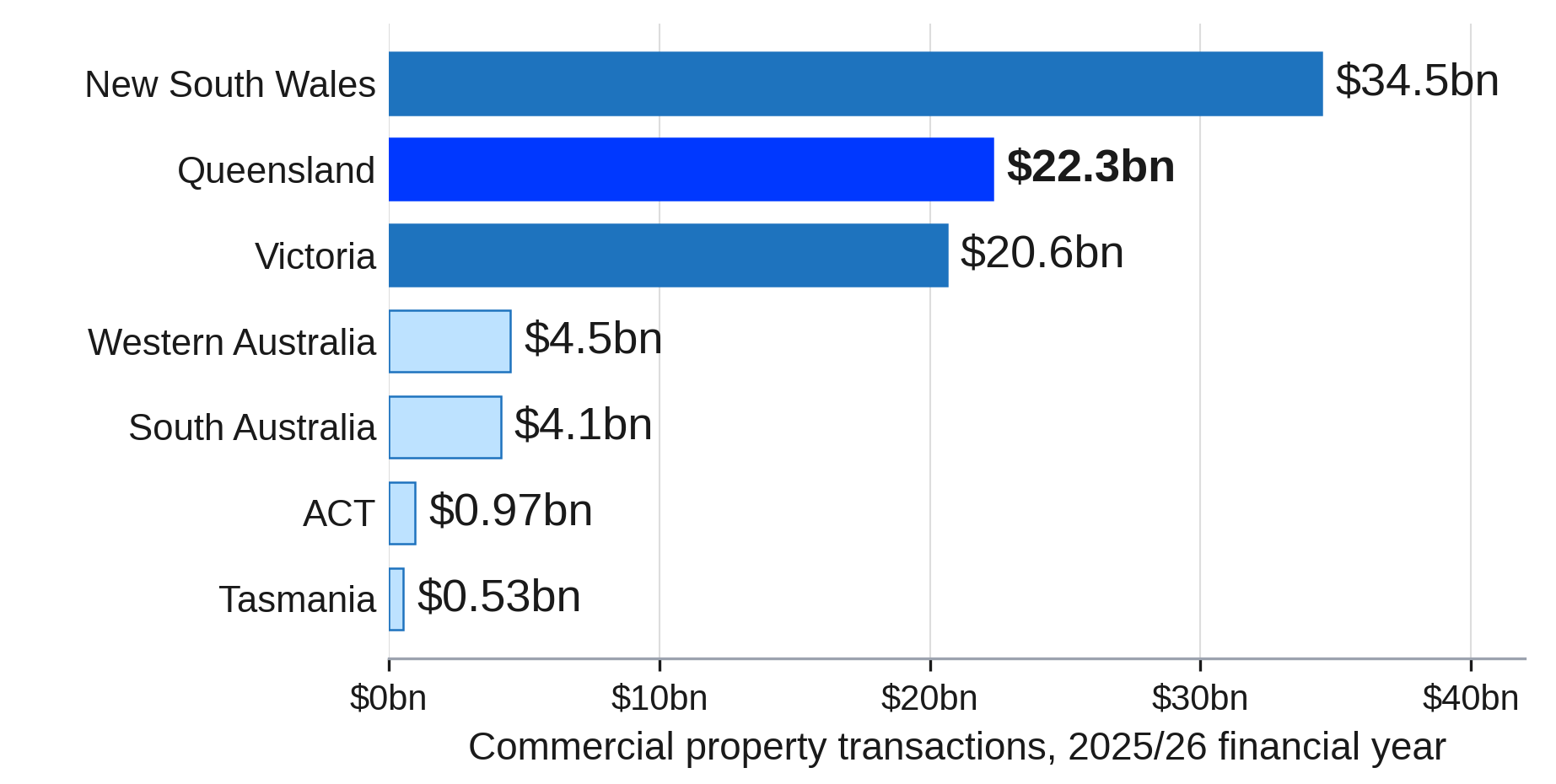
Source: Ray White Commercial, preliminary 2025/26 data, July 2026
Brisbane's 2032 Olympic investment corridors are part of that story.
Momentum Has Cooled Since Late 2025
Rate cuts in late 2025 brought buyers back. Since then, the Reserve Bank has lifted the cash rate four times in 2026, to 4.60% in September, which puts pressure on investment returns and borrowing costs.
Why National Averages Hide Local Differences
CBRE reports Perth industrial vacancy at 1.0% against 3.5% in Sydney. In office, Brisbane CBD vacancy sits almost five points below the national rate.
Location research matters as much here as it does when choosing residential investment locations.
How Much Does It Cost to Invest in Commercial Property?
The entry cost is much higher than most home investments. In practice, many lenders cap commercial loans at around 65% to 70% of the property's value, so a deposit of 30% or more is common.
Lenders also check that rent covers repayments with a buffer, as our guide to investment property loan criteria explains.
Then come stamp duty, legal and valuation fees, building reports and GST questions for your accountant. Land tax also varies widely, as our land tax by state guide shows.
If you planned to buy through super, check the 2026 changes to SMSF borrowing first. On a $1.5 million purchase, more than $500,000 of your own money can be tied to one asset and one tenant.
How to Assess Whether a Commercial Property Is Worth the Risk
Run every deal through the same five checks.
Start with net income. Work from the rent after outgoings, not the advertised yield.
Read the lease. Check tenant strength, lease length, WALE, reviews, options and outgoings.
Stress-test vacancy. Ask how you would cope with no rent for 6, 12 or 18 months.
Test the exit. Think about who would buy the property and how long a sale might take.
Compare the return with the risk. Does the extra yield cover what you are taking on?
What Vacancy Does to Cash Flow Over Three Years
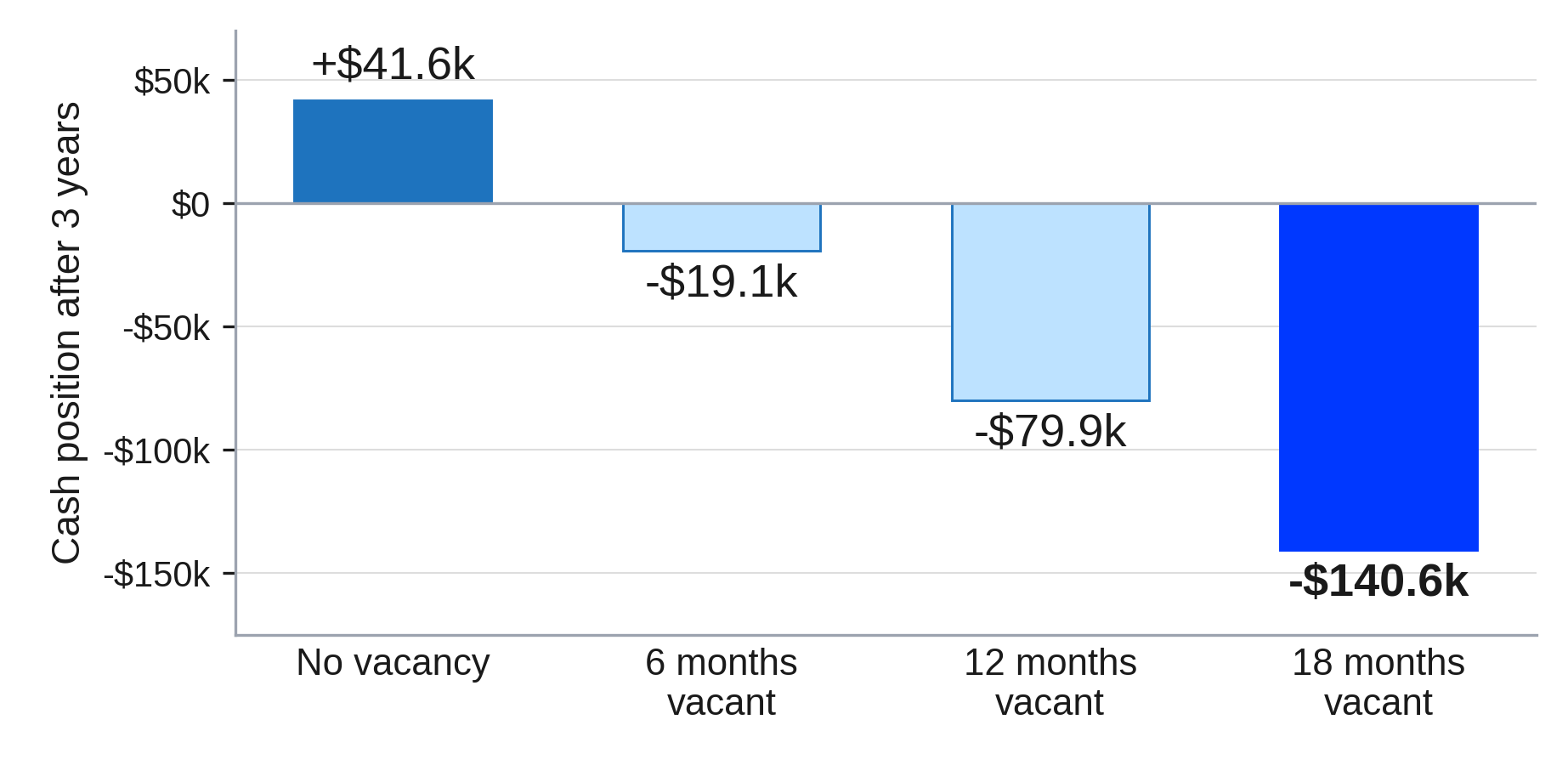
Source: FPW Group illustrative calculation, October 2026, using the earlier example and assuming the owner pays $30,000 a year in outgoings while vacant.
Our guide to investment property red flags covers more warning signs. For a second opinion on your numbers, start with an investment property strategy session.
So, Is Commercial Property a Good Investment in Australia?
When the Returns May Justify the Risks
A strong tenant on a long lease with fixed or CPI-linked reviews.
A sector and location with low vacancy.
A price that still works after interest, vacancy and costs.
Enough spare cash to cover a long vacancy
When the Yield May Not Be Enough
A high yield on a property that has been hard to lease.
A short lease, or one ending soon after you buy.
Large incentives needed to attract tenants.
A deal that only works with no vacancy at all.
Final Thoughts: The Numbers Matter More Than the Headline Yield
Commercial property investment can pay more than residential property, and current data shows money returning to the sector. Industrial assets and Queensland are drawing the strongest interest, while office remains split between strong and weak buildings.
But the higher yield is not a bonus. It is payment for longer vacancies, business tenants, incentives, larger deposits and slower sales.
Investors who do well with commercial property start with net cash flow, read the lease before the listing, and test what happens if the tenant leaves. If a property still works under those tests, the returns may justify the risks. If it only works when everything goes right, the headline yield is doing too much of the work.

Frequently Asked Questions
Recommended Reading
Two pages selected based on what readers of this article are most likely to need next.
Recommended Video
Australia's record migration surge — peaking at over 528,000 people in a single year — created unprecedented housing demand almost overnight. We explain why the government used population growth as a deliberate tool to avoid recession, how that decision flows directly into property prices Australia-wide, and why rents have surged to record highs as a result.