

Are Older Owners Missing Tax Deductions?
Many owners of older investment properties are missing tax deductions, but the property's age alone does not decide it. An investment property depreciation schedule tends to pay for itself when the original build, or work a later owner added, still sits inside the ATO's claim window.
That window has firm start dates and a firm end date. A rule change in 2017 also removed a large part of what older homes used to claim, so two houses built in the same year can produce very different results.
Below, we test three property histories against current ATO rules and 2026-27 tax rates, then show where the report fee breaks even. If you are building a wider plan for property investment in Australia, this is one of the smaller decisions that adds up over time.
Is an Investment Property Depreciation Schedule Worth It for an Older Home?
A depreciation schedule is a quantity surveyor's report showing what you can claim on the building and its fittings each year. The ATO accepts it as evidence of construction costs when no receipts exist, which is normal with an older home
Why the report fee is only part of the calculation
The fee is the easy number. The harder one is the tax saved each year, which depends on your marginal tax rate, how many years of claims are left, and how long you hold.
Timing matters too: under the 2026 Budget changes, established homes bought after 7:30pm on 12 May 2026 can no longer use rental losses against wages from 1 July 2027, according to the ATO. For those buyers, a loss boosted by depreciation is carried forward instead.
When a schedule may be less valuable
A schedule finds deductions, but it cannot create them. If the home was built before 18 July 1985, has had no major work since, and you bought it after May 2017, there may be very little for a report to find.
Depreciation also sits alongside your other property investment tax deductions, such as interest, council rates and agent fees. If those already create a loss, extra deductions mostly change when you benefit.
What Depreciation Deductions Can Older Rental Properties Still Claim?
Deductions fall into two groups, and older homes are treated differently in each. For the wider list of claims, our guide to investment property tax write-offs covers the rest.
Capital works deductions (Division 43) on the building
Capital works deductions cover the structure itself: walls, roofs, built-in kitchens, bathrooms and other fixed work. Under the ATO's capital works rules, the rate for residential buildings depends on when construction started.
The claim stays with the building when it sells, so you pick up whatever is left of the 40 years. The purchase price or an insurance value cannot be used as the construction cost, so a quantity surveyor's estimate is often needed.
Years of Capital Works Claims Left by Year of Construction
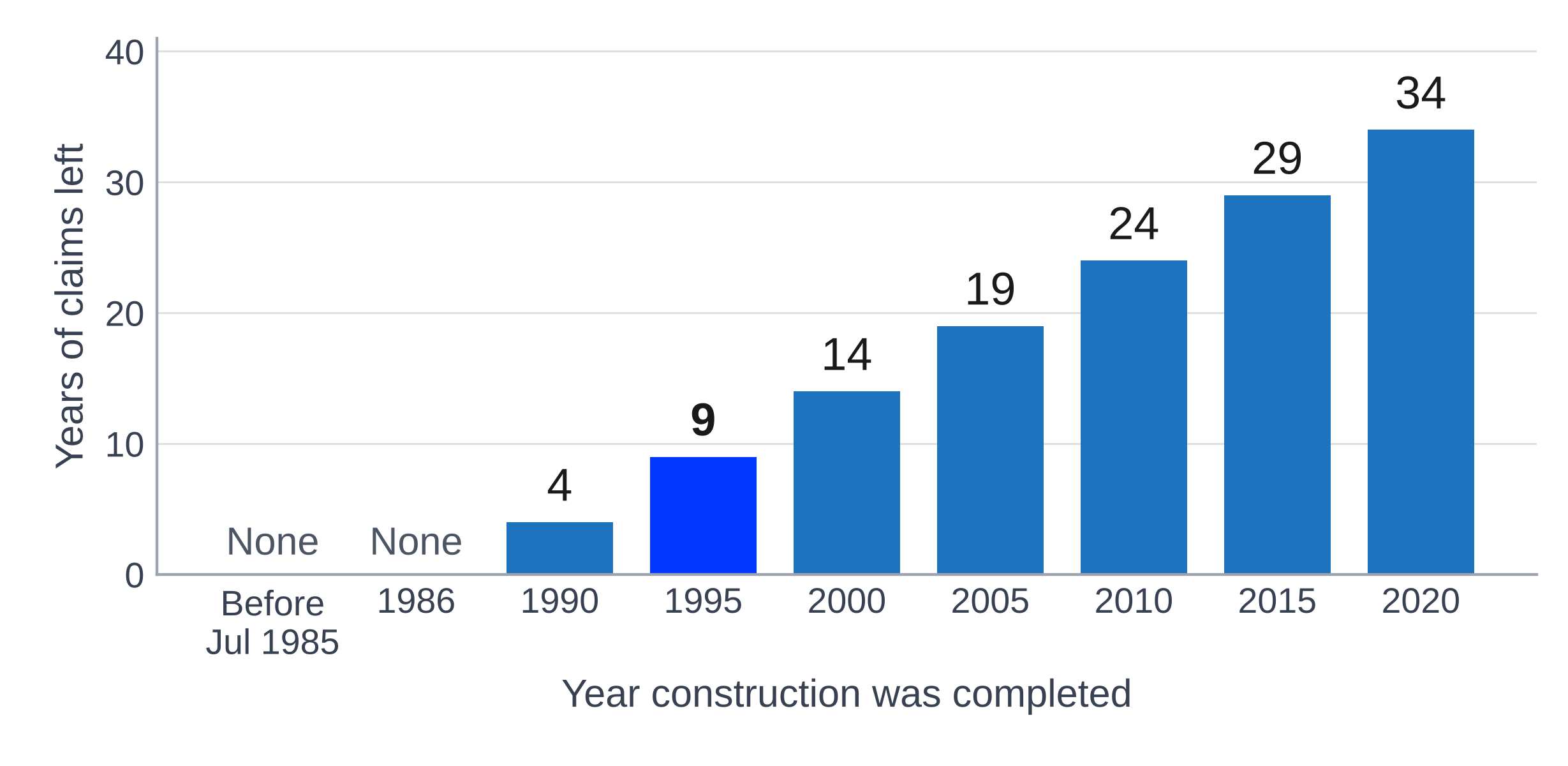
Source: ATO, Work out your capital works deductions, 2026. Assumes completion on 1 July.
Plant and equipment (Division 40): why the 2017 rule matters
Plant and equipment means removable items like carpets, blinds and split systems. Since 1 July 2017, most individual investors cannot claim second-hand depreciating assets that were already in the property when they bought it.
The rule applies if you bought after 7:30pm on 9 May 2017, or turned your own home into a rental on or after 1 July 2017. New items you install yourself can still be claimed, which is why new build versus established investment property deductions now differ so much.
Plant and equipment (Division 40): why the 2017 rule matters
This is the part many older owners miss. Renovations, extensions and alterations started after 15 September 1987 can be claimed at 2.5% a year, and so can structural improvements such as driveways, fences and retaining walls built after 26 February 1992.
That applies even when a previous owner paid for the work. If you are renovating an investment property yourself, the new work starts its own 40-year claim once it is finished.
Three Older Property Histories Tested Against the Depreciation Rules
We tested three illustrative properties. Each owner earns a taxable income of $120,000, which means a 32% marginal rate in 2026-27 once the 2% Medicare levy is added, based on ATO resident tax rates.
Scenario A: a pre-1985 house with no known improvements
Built in 1980, bought in 2020, with the original kitchen and bathroom. The structure sits outside the capital works rules, and the fittings fall under the second-hand rule.
Unless a report uncovers work the owner did not know about, the yearly deduction is close to zero. A full schedule is hard to justify here without checking the history first.
Scenario B: a 1980 house renovated by a previous owner
Also built in 1980, but a previous owner spent an estimated $60,000 on a new kitchen, bathroom and rear deck in 2010. That work stays inside its own 40-year window until 2050
Scenario C: a 1995 unit with new fittings added by the owner
Built in 1995 and bought in 2021. A quantity surveyor estimates the original construction cost at $180,000, and the owner spends $9,000 on new carpet, blinds and a split system at the start of 2026-27.
That gives $4,500 a year in capital works until about 2035, plus around $2,000 for the new fittings in year one, falling after that. The year-one total is about $6,500, or roughly $2,080 in tax saved.
Year-One Deductions and Tax Saved in Each Scenario
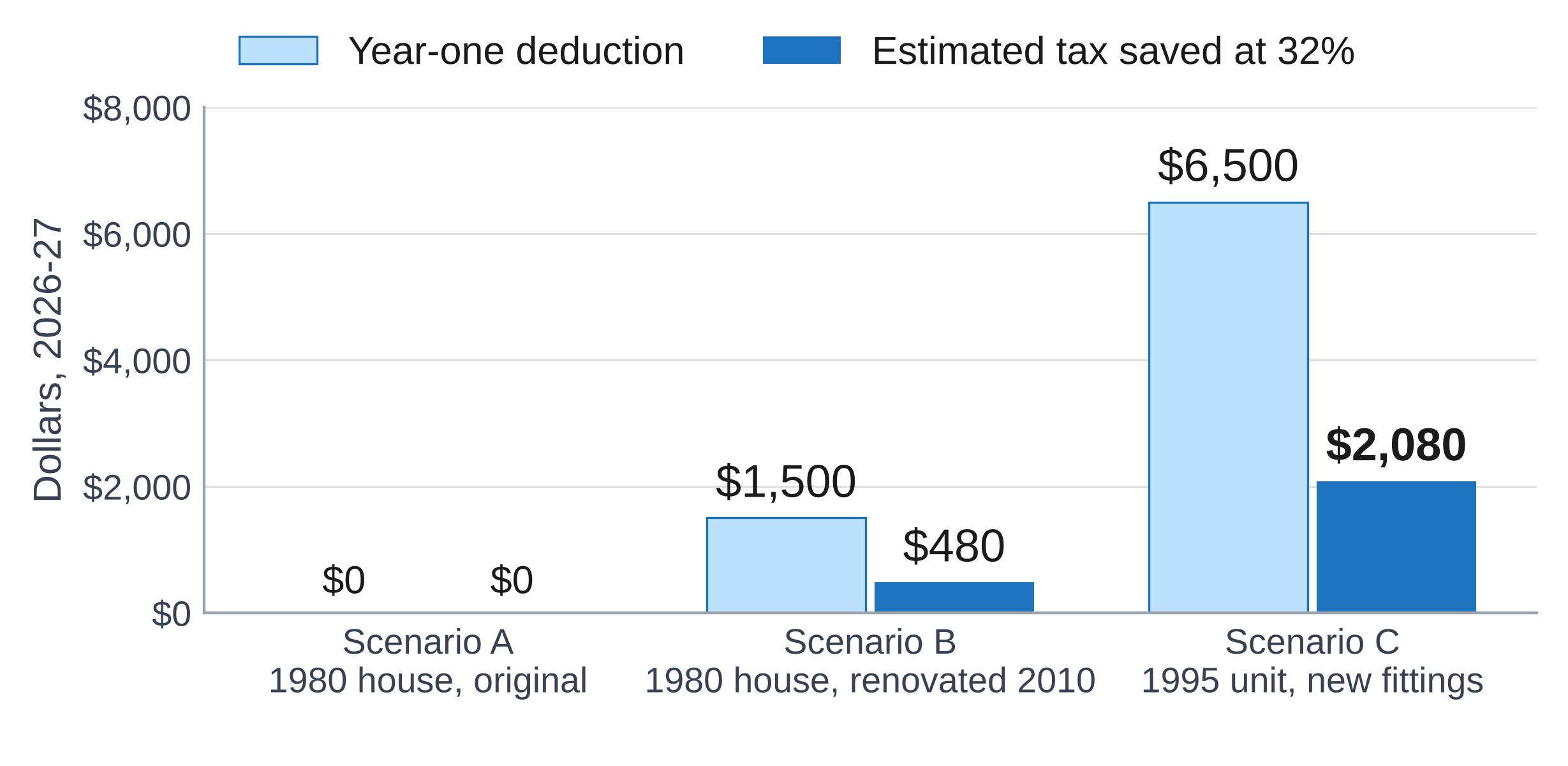
Source: FPW Group illustrative scenarios using ATO rules and 2026-27 resident tax rates, 2026
Does the Tax Benefit Justify the Cost of a Depreciation Schedule?
The test is simple. Compare the after-tax cost of the report with the tax it saves, then see how long it takes to break even.
Working out the after-tax cost of the report
For this example, assume a schedule costs $700. The ATO lets you claim the cost of getting construction cost information in the year you pay for it, so at 32% the real cost falls to about $476.
Scenario C clears that hurdle in year one with about $1,600 to spare. Scenario B only just breaks even, then pulls ahead slowly. Scenario A stays $476 behind unless the report finds hidden work.
Net Benefit Over Ten Years After Paying for the Report
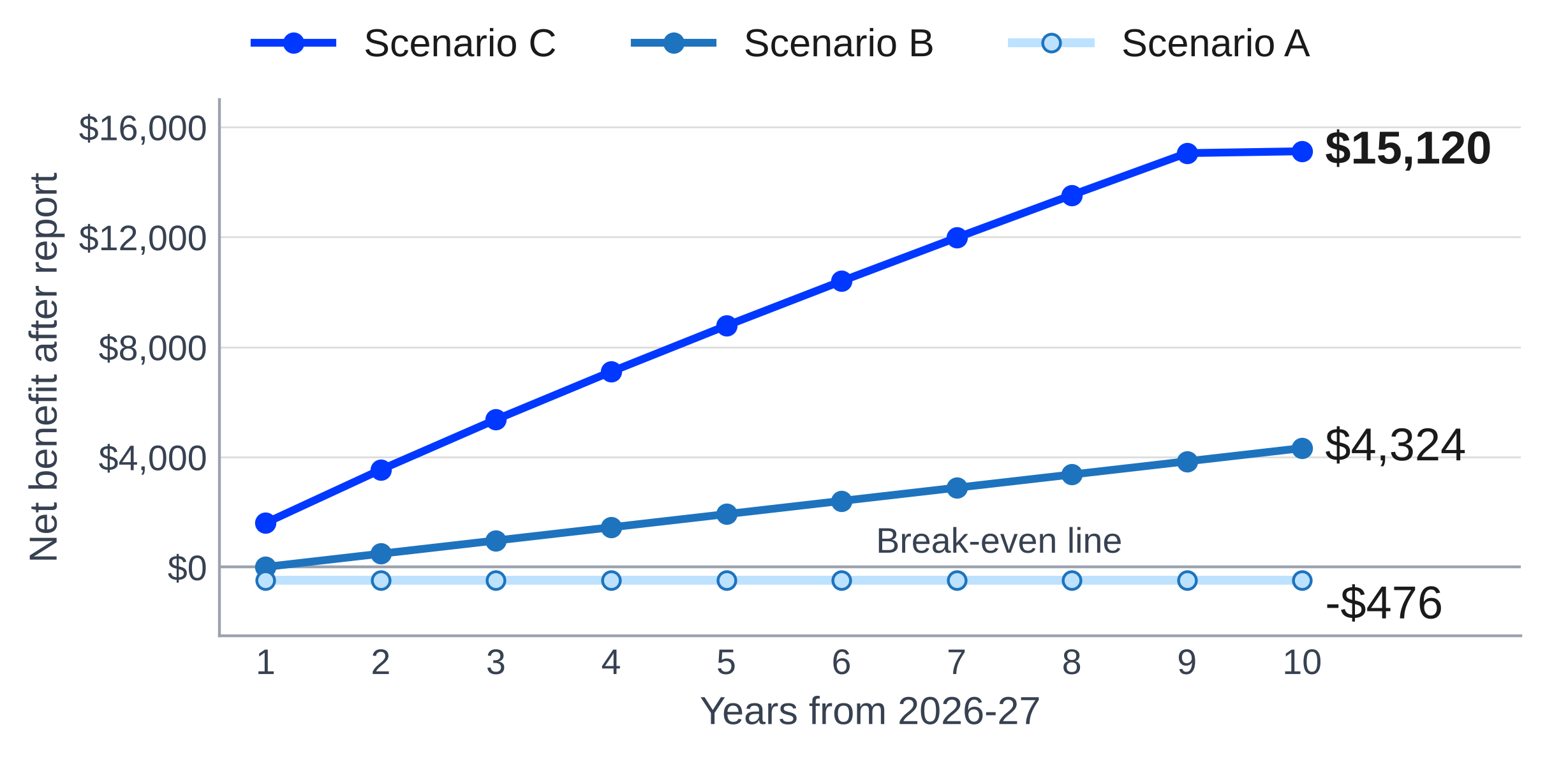
Source: FPW Group illustrative scenarios using ATO capital works rules, 2026.
Which variables change the result most?
Build and renovation dates. These decide whether a claim exists, and for how long.
Your marginal tax rate. The same $1,500 deduction saves about $480 at 32%, $585 at 39% and $705 at 47%, including the Medicare levy.
How long you hold. Claims stop when you sell, and capital works deductions you have claimed generally reduce the cost base, which can increase your capital gain. Knowing when to sell an investment property is part of the maths.
Your purchase date and cash flow. For established homes bought after Budget night, losses are carried forward from 1 July 2027, as covered in our look at negative gearing on new builds versus established property.
That point about cash flow affects a lot of people. ATO data for 2023-24 shows 1,266,454 of the 2,335,540 individuals with a rental property reported a net rental loss, up from 1,117,175 the year before.
Share of Rental Investors Reporting a Net Rental Loss
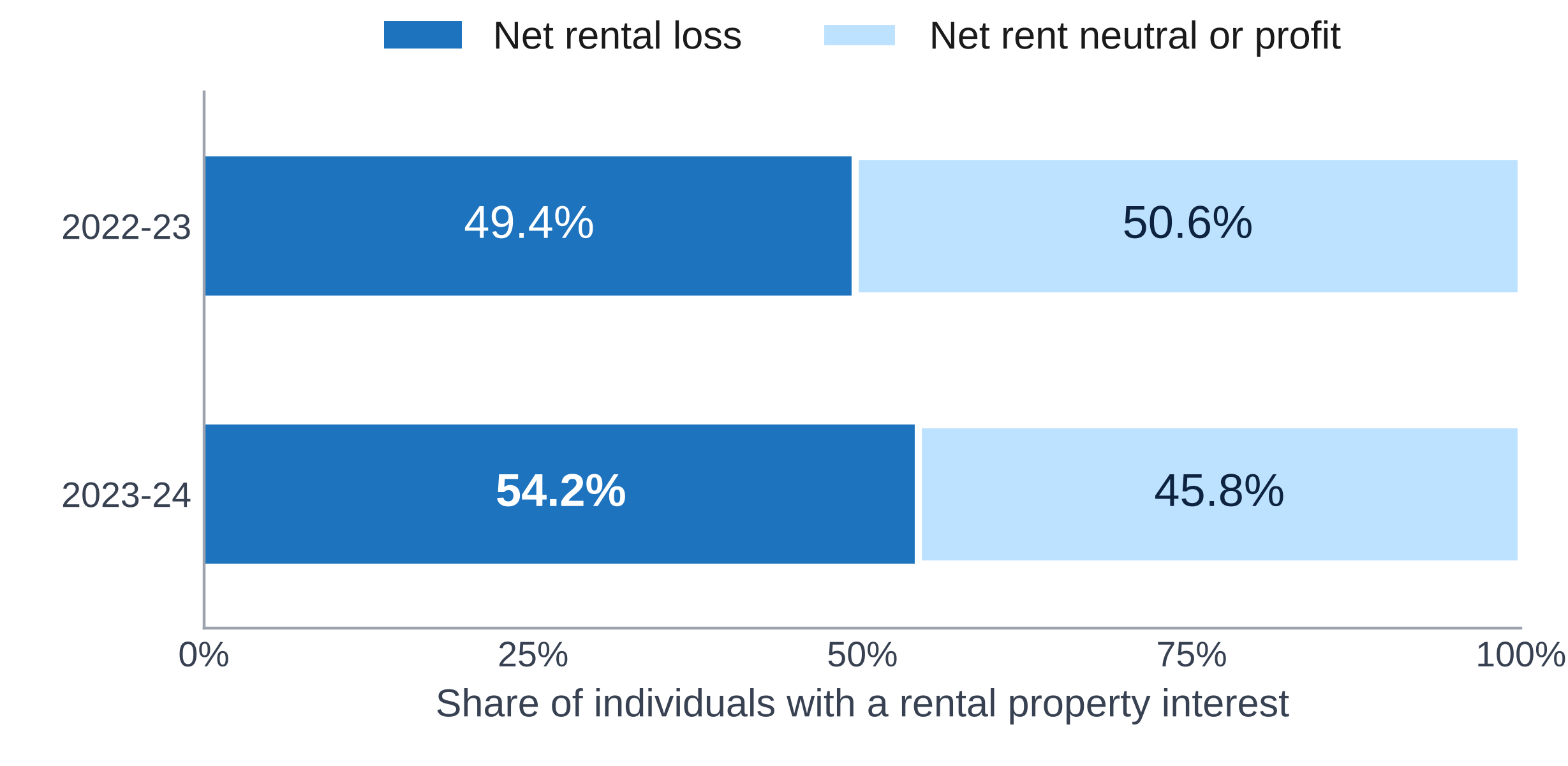
Source: ATO, Taxation statistics 2023-24, Individuals Table 8, 2026.
This is also where depreciation fits into balancing yield and capital growth. A schedule cannot turn a weak cash flow property into a strong one, but it can narrow the gap each year.

What Should You Check Before Ordering a Depreciation Schedule?
A little homework before you call a quantity surveyor can save the fee, or make the report more accurate.
Records to gather first
Council approvals or building certificates that show construction and renovation dates
The contract of sale and any capital works notice from the previous owner
Invoices for anything you have added since you bought
Questions to ask your accountant
The quantity surveyor estimates the numbers. Your registered tax agent decides how they apply to your returns.
Which past returns can still be fixed? The ATO's amendment time limits give most individuals two years from their notice of assessment.
How will capital works claims affect my capital gain when I sell, given the CGT grandfathering rules for existing investment properties?
Does the second-hand rule apply to the way I own this property?
If this review is part of a bigger plan, an investment property strategy session can put these numbers next to your borrowing and growth goals.
Final Thoughts
Older investment properties are not automatically low on deductions, and they are not automatically rich in them either. The build date sets the starting point, later work can reopen claims the original structure lost, and the 2017 rule decides whether existing fittings count at all.
For most owners, an investment property depreciation schedule is worth ordering when the property was built after 1987 or renovated since, and when the tax saved clearly beats the after-tax fee.
Scenario C showed that can happen in year one. Scenario A showed it may never happen.
Gather the dates first, ask for an initial assessment, and let your accountant confirm how it applies to you. The answer is usually in the paperwork, not in how old the house looks.

Frequently Asked Questions
Recommended Reading
Two pages selected based on what readers of this article are most likely to need next.
Recommended Video
Australia's record migration surge — peaking at over 528,000 people in a single year — created unprecedented housing demand almost overnight. We explain why the government used population growth as a deliberate tool to avoid recession, how that decision flows directly into property prices Australia-wide, and why rents have surged to record highs as a result.