

Melbourne Property Market: Should You Invest Now or Wait?
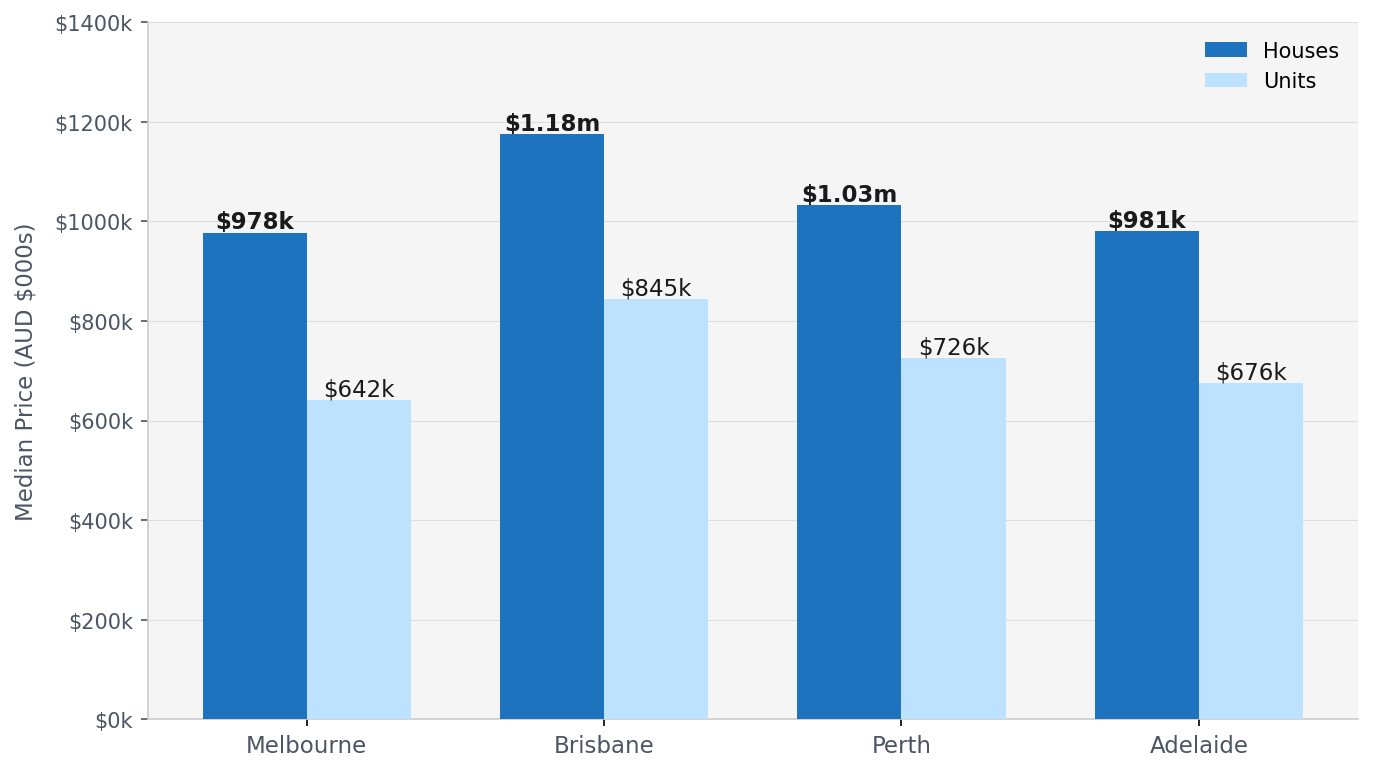
Melbourne is undervalued relative to every other major Australian capital city right now, and that gap is one of the clearest investment signals in the country. At a median dwelling value of $812,621, it sits below Brisbane ($1.17 million for houses), Perth ($1.03 million), and Adelaide ($980,000), making it the most affordable large city in the country.
That does not mean the path is risk-free. Short-term price pressure remains, and the ongoing housing shortage in Australia is failing to convert into price recovery quickly enough to satisfy sentiment-driven investors. What the data does show is that Melbourne's long-term structural case is intact, even while confidence has weakened.
What the Melbourne Property Market Looks Like Right Now
Melbourne's median dwelling value sits at $812,621 as of May 2026, down 0.8% for the month and 2.3% over the quarter (Cotality, May 2026). Annual growth is barely positive at 0.5%, making it one of the weakest capital city performers nationally.
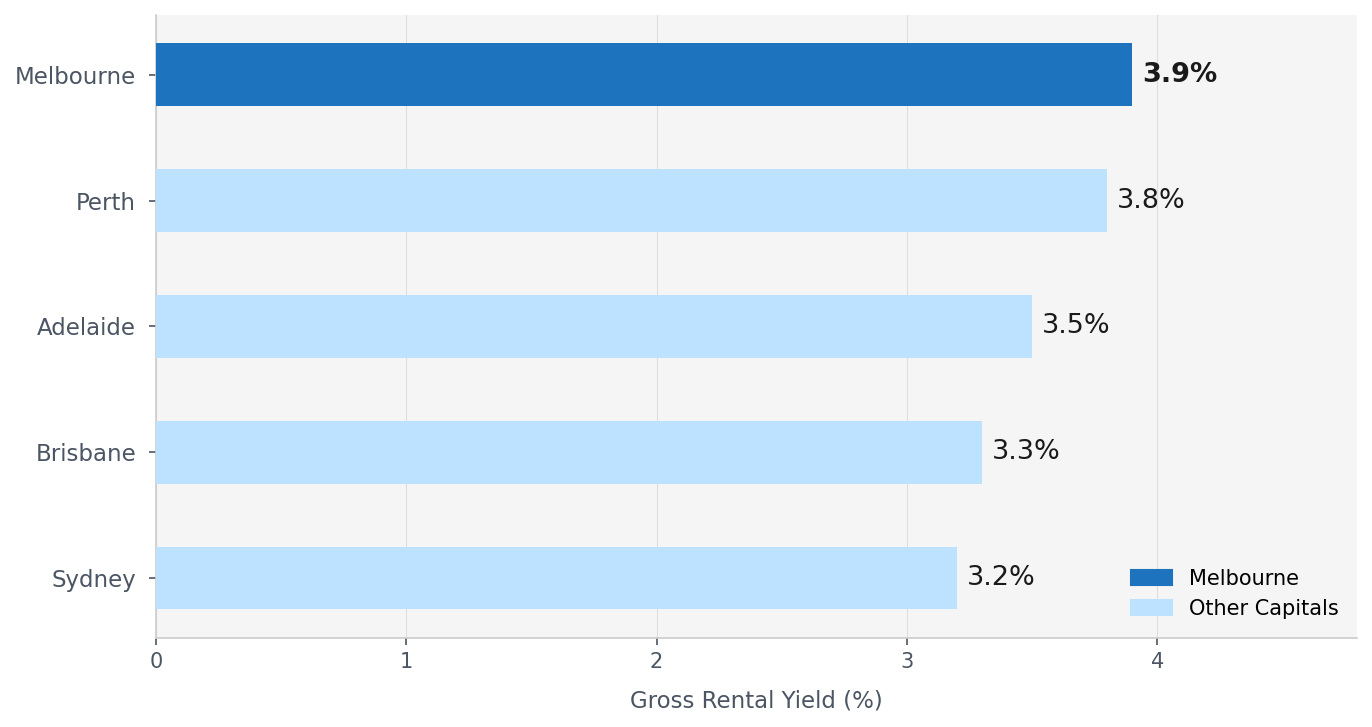
The split between houses and units matters here. The median house price is $977,579, while units sit at $642,431, and units have held up slightly better in recent months. Gross rental yield across both segments stands at 3.9%, the highest of any major capital city.
Why Melbourne Has Underperformed and What That Means for Investors
Several factors have pushed Melbourne prices lower over the past three years. Victoria's land tax increases, introduced as part of the state's COVID debt recovery, made investor holding costs significantly higher. Many landlords sold, which tightened the rental market but also dampened buyer demand.
The structural drivers pulling in the opposite direction are substantial. Melbourne's population reached 5.8 million in 2024 and is projected to reach 6.2 million by 2030, the fastest growth of any Australian capital city. The state has committed over $88 billion to transport, health, and education infrastructure, including the Suburban Rail Loop and West Gate Tunnel, both in active construction.
The range of forecasts reflects genuine uncertainty. KPMG's January 2026 Residential Property Market Outlook projects house prices up 6.8% and units up 7.3% in 2026. ANZ Research takes a more cautious view at a 1.7% decline. None of it changes the underlying math: population is growing faster than housing supply can accommodate.
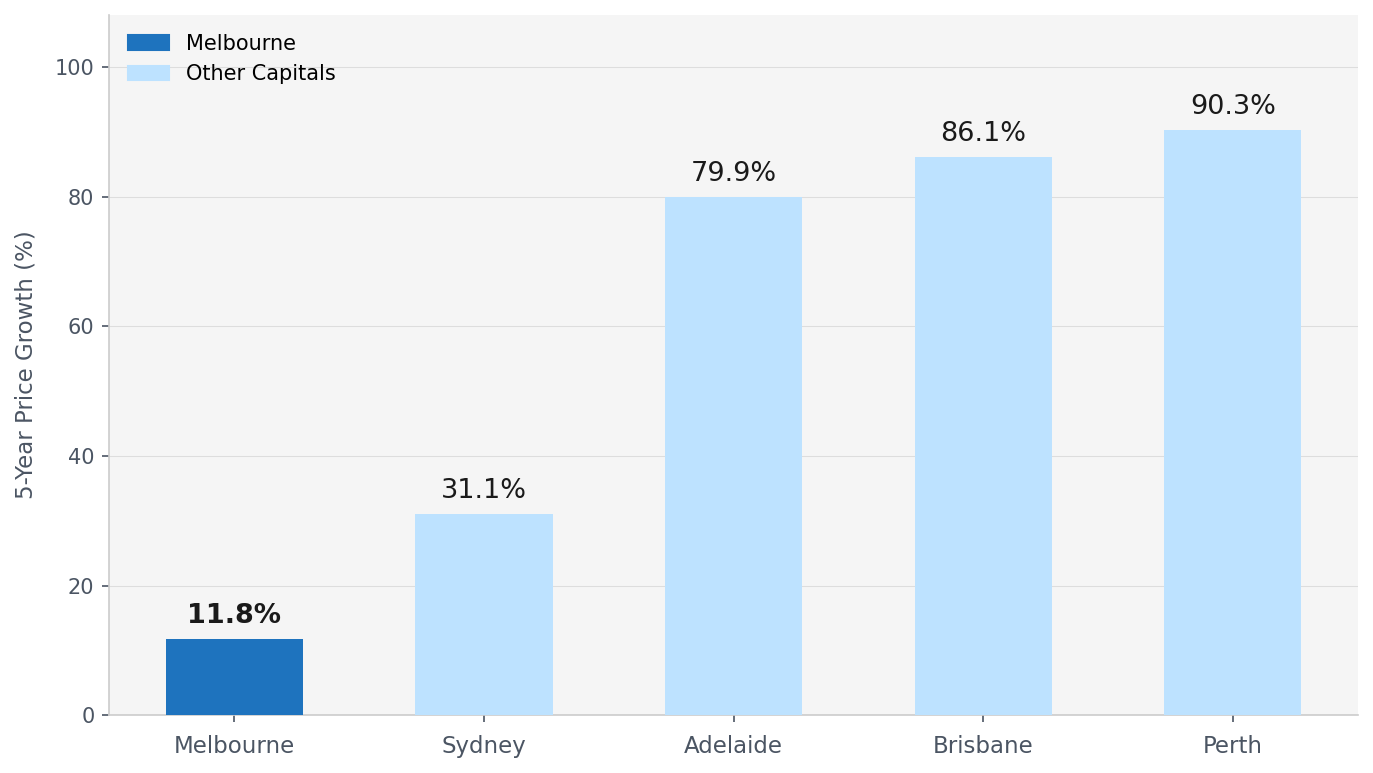
5-Year Dwelling Price Growth by Capital City
Source: Cotality Home Value Index, March 2026
How Melbourne Compares to Brisbane, Perth, and Adelaide
The comparison numbers tell the story plainly. Over five years, Brisbane dwelling values rose 86.1%, Perth 90.3%, and Adelaide 79.9%. Melbourne's equivalent figure is 11.8%. Buyers who moved early into those mid-sized capitals made exceptional gains via the interstate investing momentum that defined 2021 to 2024. The question now is what comes next.
In each of those cities, monthly growth is already slowing. Perth gained 2.3% in February 2026 but is beginning to moderate. Brisbane posted 1.6%, Adelaide 1.3%. Both are still growing, but the acceleration phase is behind them. Buyers entering those markets today are paying at or near peak prices.
Understanding your borrowing capacity formula becomes particularly relevant when comparing markets at different price points. Melbourne buyers currently need approximately $70,000 less in annual household income to service a mortgage than Sydney buyers (Cotality, May 2026). That income efficiency is a real factor in investment planning.
Gross Rental Yield by Capital City (May 2026)
Source: Cotality Home Value Index, May 2026 | NAB Melbourne Property Market Insights, May 2026
Melbourne Rental Market: What the Numbers Show
Vacancy across Melbourne sits at 1.6% (SQM Research, May 2026), down from 1.7% a year earlier. That is below the 3% level considered a balanced market. Annual rent growth is 4.7% for houses and 4.9% for units. The rental crisis pressures affecting tenants nationally are acute in Melbourne despite it being the loosest of the major capitals by vacancy rate.
The income side of Melbourne investment is performing well. Units in the middle ring are returning 4.7% gross yield or more. For investors studying yield versus growth to build a balanced property portfolio, Melbourne's current position offers something rare: a city with yield running above the national average and prices that have not yet fully recovered.
FOR EXAMPLE
An investor purchasing a $640,000 Melbourne unit returning 4.7% gross yield would generate approximately $30,080 in annual rental income. At a vacancy rate of 1.6%, sustained occupancy is highly probable. Compare that to a $1.03 million Perth house at 3.8% yield, which returns $39,140 gross but requires a significantly larger deposit and carries higher debt exposure relative to income.
Should You Invest Now or Wait?
The short-term data points toward further softness. Cotality's June 2026 data shows Melbourne dwelling values down 0.8% for the month, and sales volumes are down 14.2% year-on-year.
Listings have increased, giving buyers more negotiating power. The impact of property investment interest rates on sentiment remains real. If you need certainty of short-term capital gains, Melbourne is not offering that right now.
The case for investing now is built on a different logic. Melbourne has underperformed the national average for three consecutive years. Prices are below where population growth and income levels would normally put them. Yields are the highest of any major capital. Infrastructure is in active delivery. And for property investment, the evidence consistently shows that time in market outperforms attempts to time the bottom precisely.
Rate cuts from early 2025 have progressively improved borrowing capacity, and each further reduction adds meaningful purchasing power. Buyers who wait for rates to fall further may find that prices have already responded.
Median Dwelling Values: Melbourne vs Other Capitals (March 2026)
Source: Cotality Home Value Index, March 2026
Best Melbourne Suburbs for Investment in 2026
Suburb selection matters more in a selective market than in a rising tide. A strong foundation in property investment in Australia provides the broader context, but within Melbourne, performance varies widely across the geographic spread.
For capital growth, Frankston, Brimbank, and Sunbury have led Melbourne's recent suburb-level performance, with 12-month price gains of 12.9%, 10.3%, and 8.5% respectively (Cotality, March 2026). For rental yield, Meadow Heights, Pakenham, and Broadmeadows are delivering above 4.5% gross yield with strong tenant demand from essential workers and families, all accessible under $700,000.
For investors wanting a balance of both, low-rise boutique apartments and townhouses in middle-ring, transport-connected suburbs offer the strongest projected total returns over five years. Understanding how to choose investment-grade suburbs in Australia is the critical skill that separates sustainable property investment from speculative risk.
Final Thoughts
Melbourne's current position is uncomfortable reading if you already own. It is genuinely interesting reading if you are looking to enter. The city offers the highest rental yield of any major capital, an entry price below Brisbane, Perth, and Adelaide, and structural drivers of population growth and infrastructure investment that are among the strongest in Australia.
The uncertainty is real: forecasters disagree on timing, short-term prices continue to drift lower, and Victoria's tax settings add genuine holding cost pressure. But for investors with a five-to-ten-year view and the financial position to hold through the short-term noise, Melbourne's fundamentals are making the strongest case they have made in years.
Frequently Asked Questions
Recommended Reading
Two pages selected based on what readers of this article are most likely to need next.
Recommended Video
8,000 completed apartments sitting unsold. Vacancy creeping up in the CBD. Rents softening in Southbank. The headlines make it sound like the entire city is in trouble. But when you dig into where that oversupply actually sits, how it got there, and who it competes with, the picture looks completely different.