

Sea Change Property: Coastal Locations to Retire and Invest

The best sea change property locations are not simply the towns with the nicest beach. They are the coastal markets where rental demand, population growth and price fundamentals sit underneath the lifestyle appeal, not the other way around.
Australians have been moving from the capitals to the coast at a pace that has reshaped housing demand in several regional markets, and that shift matters to investors as much as retirees chasing a change of scenery. Some of the country's most searched sea change destinations carry rental yield and vacancy numbers that tell a very different story depending on whether you plan to live in the property or hold it as an investment. Working out which story applies to you starts with a handful of measurable criteria most lifestyle guides skip entirely.
Why Australians Are Chasing a Sea Change Right Now
Regional Australia added 94,700 people in the 2024-25 financial year, a growth rate of 1.1 percent, while capital cities recorded a net internal migration loss of 29,800 people over the same period, according to the Australian Bureau of Statistics. That outflow has eased slightly from the 34,600 net loss recorded the year before, but it has not reversed.
Affordability is doing most of the work. More than half of the people leaving Sydney in early 2026 cited housing costs as the primary driver, and the same pattern is visible, at a smaller scale, in Melbourne and Brisbane. Retirees are a growing share of this movement too, selling higher priced family homes in the capitals and buying smaller coastal properties outright, often without needing to borrow at all.
None of this means every coastal town is capturing the same demand. The migration data shows a genuine and persistent shift towards the coast, but the shift has moderated slightly rather than accelerated, which is a more honest description than most headlines allow.
Regional vs Capital City Population Growth, FY2023-24 to FY2024-25
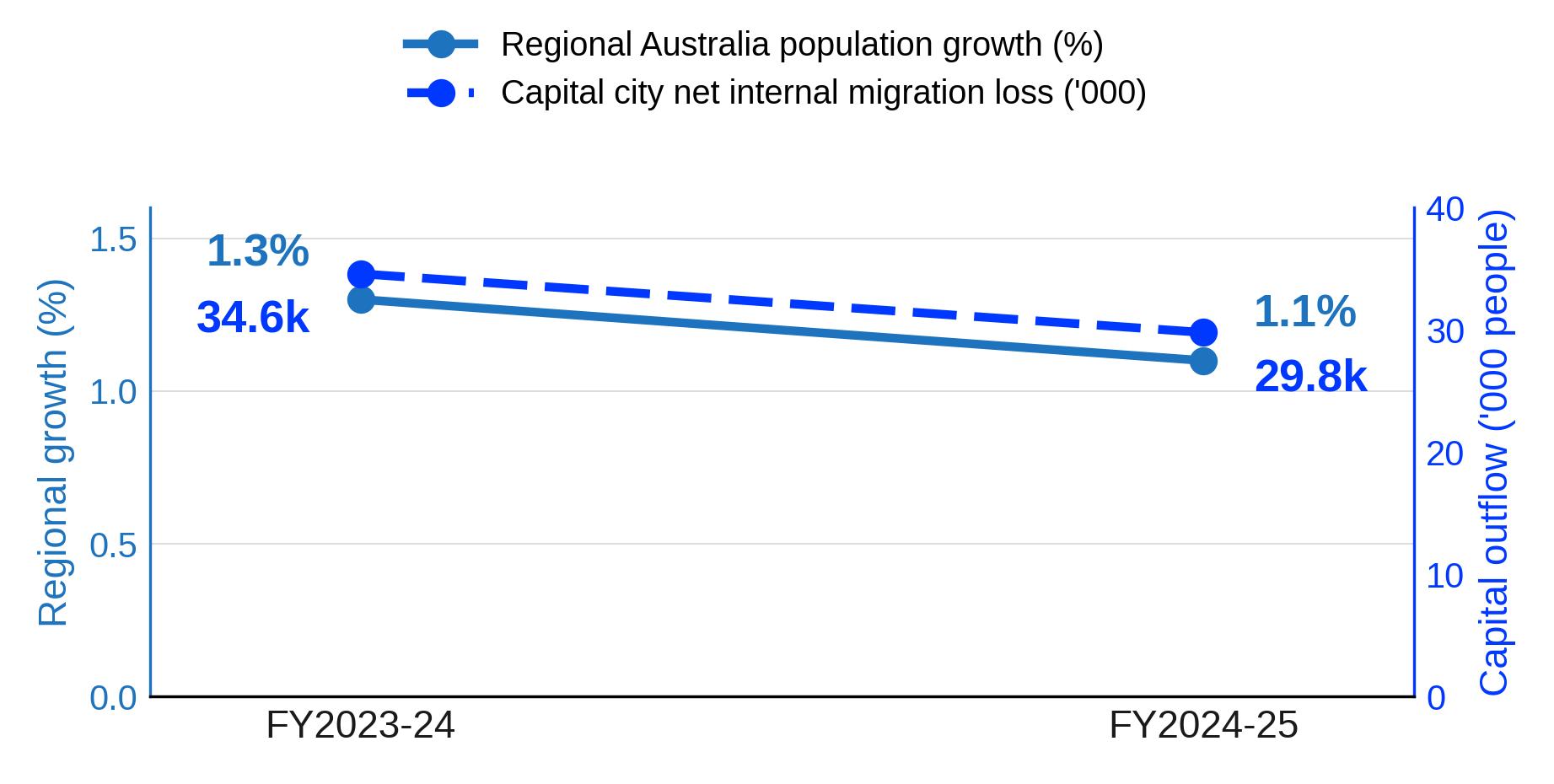
Source: Australian Bureau of Statistics, Regional Population, 2025
What Actually Makes a Sea Change Location a Good Investment?
A good sea change investment location needs five things working together: affordable entry relative to income, genuine rental demand, a supply pipeline that is not about to flood the market, population growth that is broad based rather than one demographic, and a realistic path to long term capital growth. Missing two or three of these is common, and it is usually where lifestyle content stops looking closely.
This is the same framework FPW applies across investment property research more broadly, because a coastline does not change the underlying mechanics of what makes a property perform. Balancing yield against long term growth matters just as much on the coast as it does in a capital city suburb, and coastal markets often ask investors to lean further towards one side of that trade off than they expect.
Supply is the criterion lifestyle content is quietest about. A coastal town with a large apartment pipeline still under construction can absorb years of population growth before rents or prices respond, which is exactly the gap between a suburb that looks popular and one that is genuinely undersupplied. Checking approved but unbuilt development against current population trends takes ten minutes and prevents most of the worst sea change purchases.
Where the Numbers Actually Stack Up
The affordable coastal alternative narrative does not hold up evenly across the country. The Gold Coast's typical house price reached 1.74 million dollars in the year to June 2026, which has now overtaken Brisbane's median by a wide margin. Geelong and Wollongong tell a different story, both still trading at a genuine discount to Melbourne and Sydney respectively.
Rental yields across the most searched sea change markets sit below the 3 percent threshold that many investors use as a rough benchmark, with Greater Geelong the strongest of the group at just under 3 percent. That compression reflects strong owner occupier demand competing directly with investors for the same stock, which is common in lifestyle markets and worth factoring into any borrowing capacity calculation before you commit to a higher entry price.
Median House Price, Sea Change Location vs Nearest Capital City
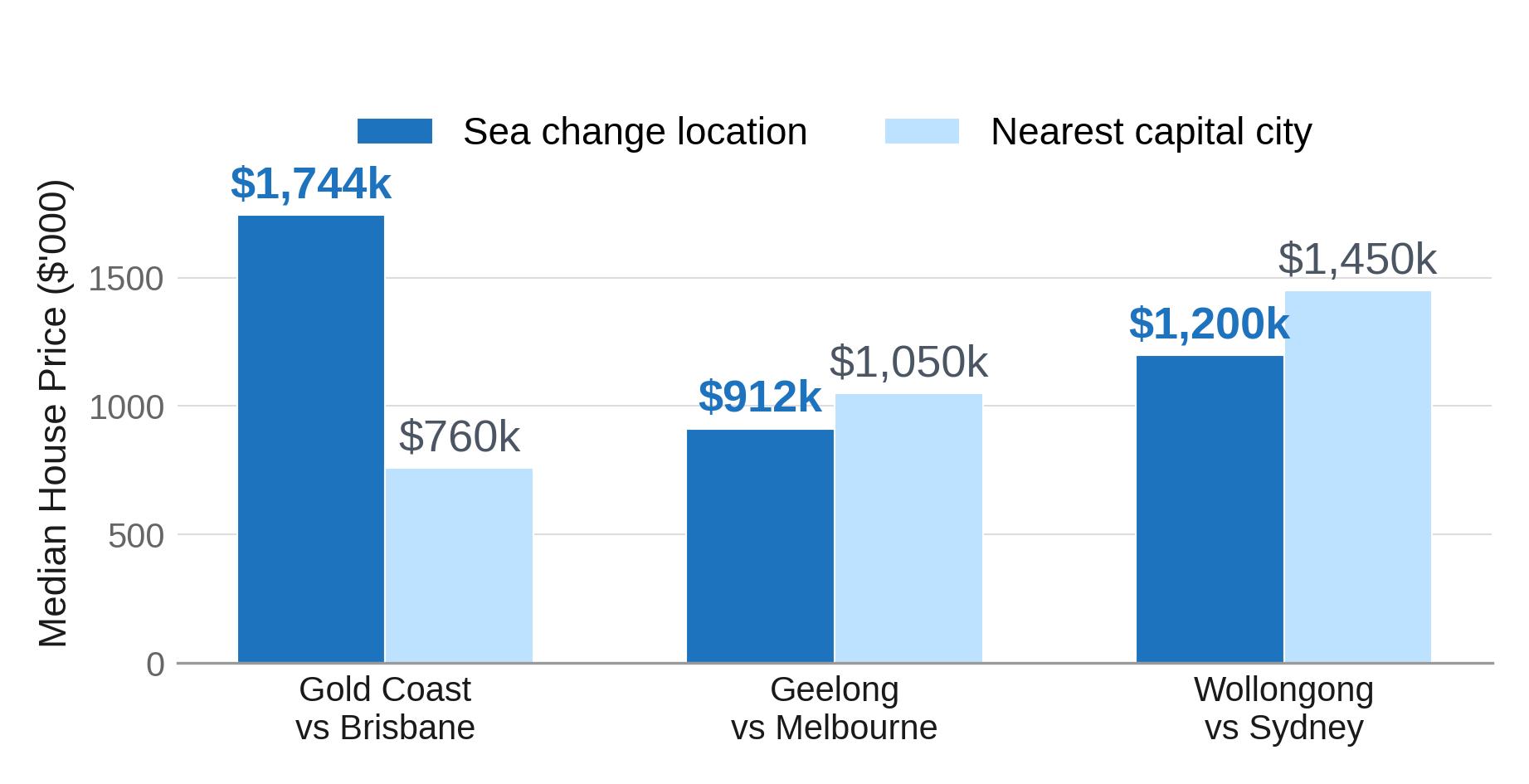
Source: CoreLogic, 2026
Gross Rental Yield by Sea Change Location
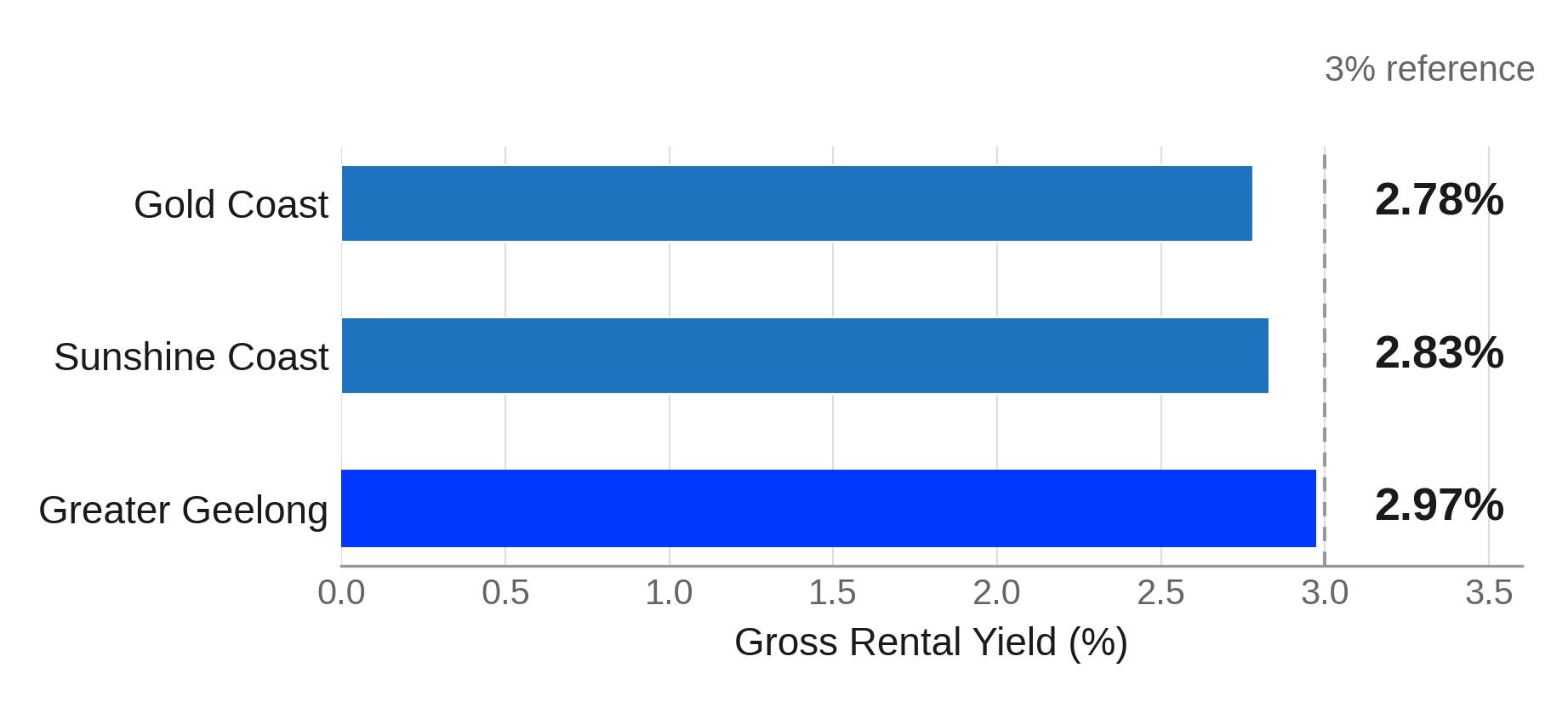
Source: CoreLogic, 2026
Investors weighing a coastal purchase against interstate markets like Brisbane, Adelaide and Perth will find the same yield and growth trade-offs apply, just under a different postcode.

Can One Property Deliver Lifestyle, Investment and Retirement at Once?
Sometimes, but rarely all three at full strength. The scorecard below rates four popular sea change markets against lifestyle appeal, investment fundamentals and retirement suitability separately, because collapsing them into a single score hides exactly the trade off an investor needs to see.
Lifestyle Appeal, Investment Fundamentals and Retirement Suitability by Location
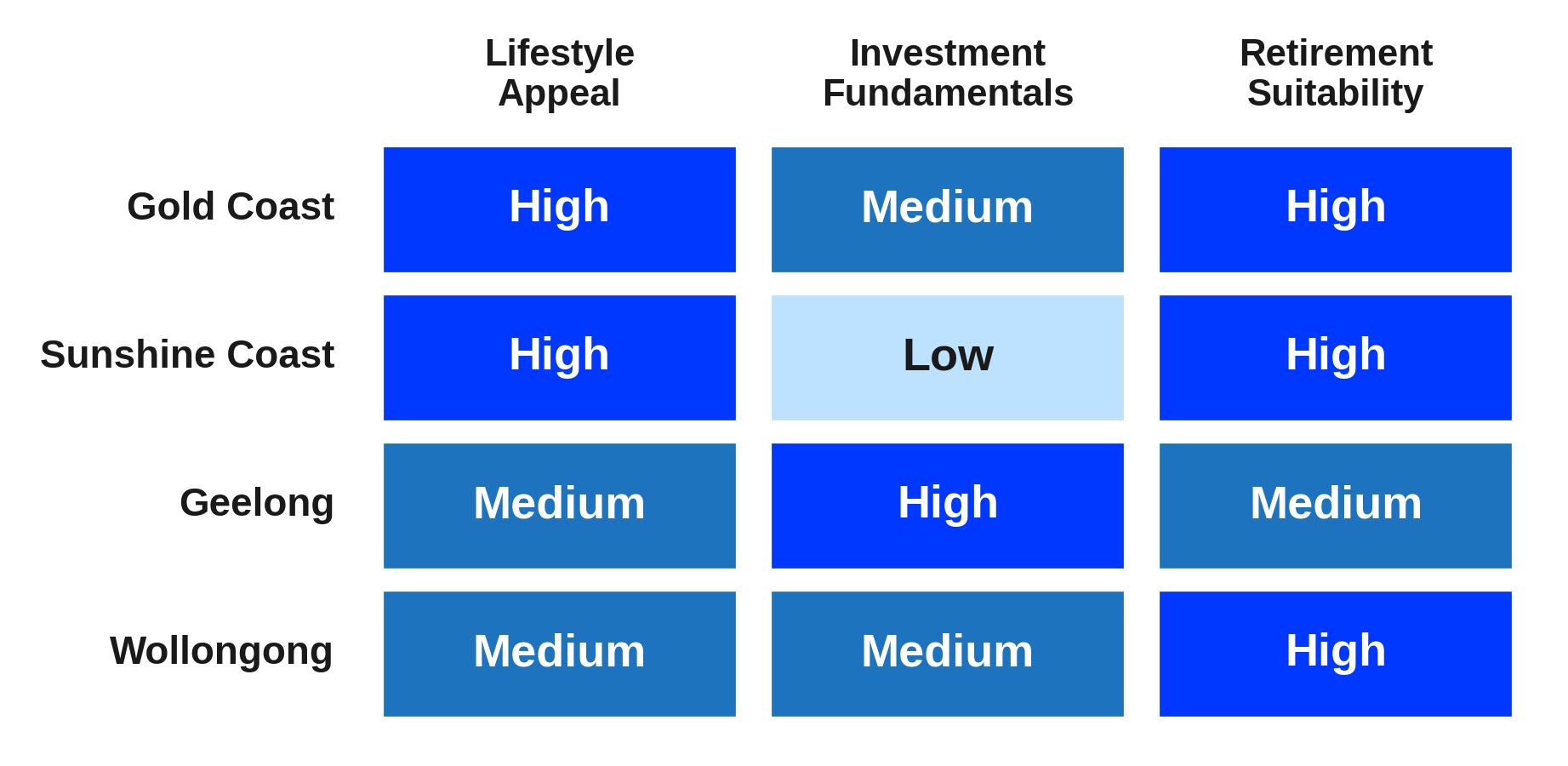
Source: FPW Group analysis based on CoreLogic and ABS data, 2026
Retirees who plan to keep an existing property and rent it out after moving to the coast can unexpectedly become landlords for the first time, a group that is growing faster than most investors realise and often needs different advice to a deliberate investor.
What Buying Near the Coast Does Not Guarantee
Coastal property carries risks that rarely make it into a listing description. Insurance costs in flood and storm exposed postcodes have risen well beyond national averages over the past few years, and some coastal properties are becoming harder to insure at all as risk models are updated. That cost needs to sit inside your cash flow modelling, not outside it.
Smaller coastal towns also carry thinner employment bases and more seasonal rental demand than their population figures suggest, which can mean longer vacancy periods outside peak season. Apartment heavy pockets of some sea change markets have faced oversupply before, and buying near the beach does not automatically create an investment grade property if the fundamentals underneath it are weak.
This is also where avoidable first time investor errors tend to surface, because the emotional pull of a coastal purchase can crowd out the due diligence a landlocked suburb would automatically get.

How to Decide If a Sea Change Property Belongs in Your Portfolio
Start by separating your own lifestyle goal from your investment goal, even if you eventually want the same property to satisfy both. Score your shortlist against affordability, yield, vacancy, population growth and supply the way the earlier scorecard does, rather than relying on how a suburb feels on an inspection day.
Then stress test the numbers the way a lender would. Understanding how lenders actually assess borrowing capacity before you fall in love with a coastal listing avoids the common mistake of shortlisting properties you cannot comfortably finance once real interest rate buffers are applied.
If the property clears both tests, a buyer's agent with genuine knowledge of that specific coastal market can help separate a strong shortlisted suburb from a strong sounding one, which is a harder distinction to make from a capital city than it looks.
Finally, decide how long you can genuinely hold the asset. Coastal markets with thinner buyer pools can take longer to sell in a soft cycle than an equivalent capital city property, so a five-year investment horizon needs more conservative assumptions on a smaller coastal market than it would on a suburb inside a major city.
Final Thoughts
A sea change property can be a genuinely good investment, a genuinely good retirement purchase, or both, but rarely by accident. The locations getting the most search attention are not always the ones with the strongest fundamentals underneath them, and price growth in one coastal market does not guarantee the same result in the next town along the coast.
Treat lifestyle appeal and investment fundamentals as two separate questions with two separate answers, then decide how much weight each one deserves in your specific situation. That approach will serve you better than chasing whichever coastal suburb is trending this year.
Frequently Asked Questions

Recommended Reading
Two pages selected based on what readers of this article are most likely to need next.
Recommended Video
Most investors are still positioned in capital cities — but in 2026, that allocation gap is creating real opportunity cost. In a market where timing, positioning, and yield profiles compound into long-term outcomes, that disconnect matters more than most people realize.