

Property Investment Tips: What Would Warren Buffett Do?
Warren Buffett would work out what a property earns and what it is really worth before thinking about what it might sell for. That one habit is the most useful of all the property investment tips his record offers. His own property deals were few and simple, and he bought them for their income rather than a quick rise in price.
That order sounds obvious, yet many Australian buyers still start with the suburb story and check the rent and holding costs last. Buffett's two small property investments show the opposite approach, and the one number he used to judge both is far above what Australian capitals pay today.
The gap between those numbers says a lot about how to approach property investment in Australia in 2026. It also shows where his thinking stops working here.
What Property Did Warren Buffett Actually Buy?
For one of the world's richest investors, Buffett's personal property record is short. He bought his Omaha home in 1958 for $31,500 and still lives there, and Fortune reports he bought a Laguna Beach holiday house for $150,000 in the 1970s and sold it for about $7.5 million in 2018.
He has also warned that a home can become a burden when the buyer stretches beyond what they can afford.
The two deals worth studying are his investment properties. He explained both in his 2013 letter to Berkshire Hathaway shareholders. The reasoning matters more than the results.
The Nebraska farm, 1986
After a farm price bubble burst in the Midwest, Buffett bought a 400-acre farm about 50 miles north of Omaha from the FDIC for $280,000. That was well below what a failed bank had lent against the same farm a few years earlier.
He estimated the farm's normal yearly earnings and worked out a return of about 10% on the price. By the time he wrote the 2013 letter, those earnings had tripled and the farm was worth five times or more what he paid.

How Buffett's Nebraska Farm Performed Over 28 Years
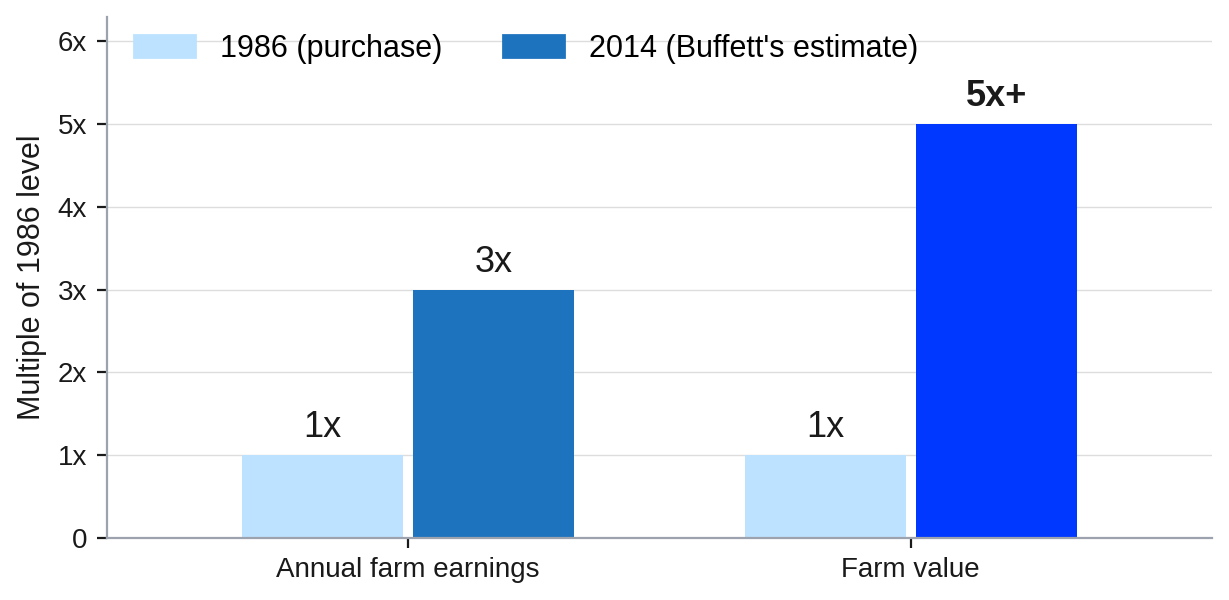
Source: Berkshire Hathaway, 2013 Shareholder Letter, published 2014.
The New York retail building, 1993
In 1993 he joined a small group that bought a retail building next to New York University from the Resolution Trust Corporation, a US agency selling assets from failed savings banks. Its unleveraged yield was also about 10%, and several empty shops meant the income could rise once they were leased.
His view on location was simple: "NYU wasn't going anywhere." CNBC reported that Buffett had received more than $1.5 million in special payouts by 2013 on top of regular income, and he had never even visited the building.
What Buffett's Property Deals Reveal About His Investment Principles
The same four ideas run through both deals. None of them depend on forecasting the market.
Value comes from earnings. Buffett estimated what each property would earn in a normal year and paid a price that made sense on that alone. He noted in the letter that he had never seen a price quote for either property, and never needed one.
Stay within what you understand. He admitted he knew nothing about farming, so he relied on his son Howard, who did. An experienced property partner managed the New York building, so the real skill was knowing where his own knowledge ended.
Keep a margin of safety. Buying the farm for less than a bank had once lent against it gave him room for error. The yields he quoted were also unleveraged, meaning the deals made sense without depending on a loan.
Expect steady, not spectacular, results. He wrote that income from both would probably rise for decades, but that the gains would not be dramatic.
These ideas line up closely with what makes a good investment property here, even though a Nebraska farm looks nothing like a Brisbane townhouse.

What Would Warren Buffett Do in Australia's Market?
Turning Buffett's ideas into Australian decisions means asking harder questions before you sign a contract. Four questions matter most.
Start with the income, not the growth story
Buffett's starting point was a return of about 10%. Australian investors start somewhere very different: Cotality's national gross rental yield was 3.79% in August 2026, the highest since September 2019, while Sydney sat at 3.3%.
Gross yield is rent before costs, so the real return is lower. Cotality's research director noted that yields would need to rise a long way before rent covers holding costs while interest rates stay high.
Australian Rental Yields Compared With Buffett's Starting Yields
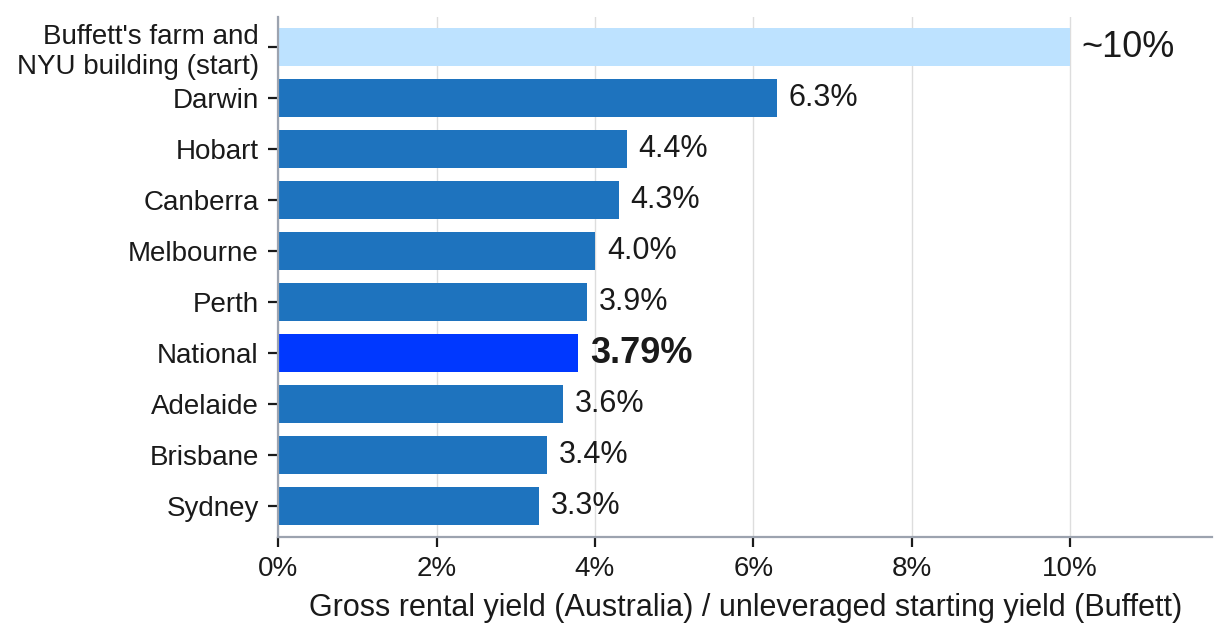
Source: Cotality Home Value Index, September 2026, results to 31 August 2026; Berkshire Hathaway, 2013 Shareholder Letter.
Price is not the same as value
A property becoming more expensive does not make it a better investment. Buffett bought when prices had dropped and sellers were under pressure, which has some echoes in Australia right now.
Cotality data shows home values fell across 93% of capital city suburbs over winter 2026, with Sydney 7.1% below its February peak. Buying below market value does not automatically create instant equity, but a softer market does give patient buyers more room to negotiate.
Build a margin of safety into your finance
Lenders test your loan at a higher rate than you pay, but that buffer protects the bank, not you. It helps to understand how banks calculate borrowing power, then treat the top figure as a limit rather than a target.
Whether maximum borrowing capacity builds wealth or risk depends on your buffers. The RBA cash rate was 4.35% in late September 2026 after three increases earlier in the year, and markets expected another rise at the 29 September meeting.
Higher property investment interest rates hit a highly geared property first, as the example below shows.
Worked Example: Annual Cash Flow on an $800,000 Investment Property
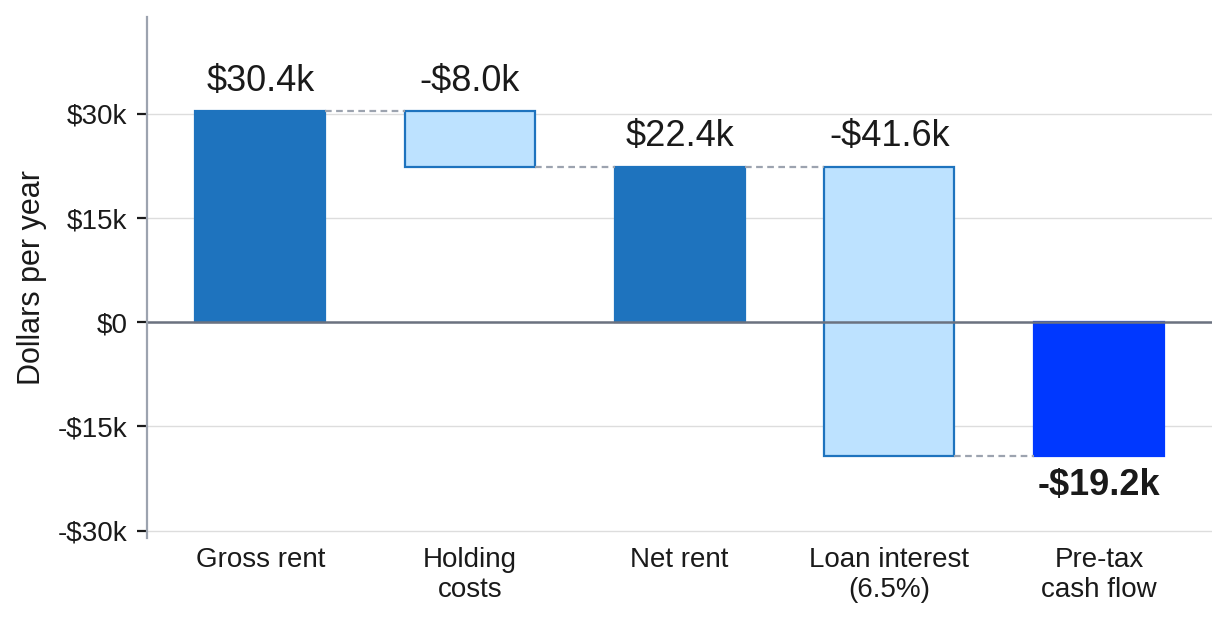
Source: FPW Group illustrative example using the national gross yield from the Cotality Home Value Index, September 2026. Costs and interest rate are assumptions.
Know what will keep demand steady where you buy
Buffett trusted demand that would outlast any news cycle: people would always need crops, and a major university would always need space nearby. The Australian version is asking what supports rental demand in a suburb, such as local jobs, transport, schools and limited new supply.
Learning how to read a suburb profile helps separate lasting demand from a short burst of attention. It also shows why so many property hotspots never boom the way buyers expect.
Where Buffett's Approach Has Limits for Australian Property Investors
Buffett's lessons are useful, but they are not an Australian residential property strategy. He bought a farm and a commercial building in the United States, at yields that local housing rarely offers.
Even Berkshire's current housing exposure looks different. It owns homebuilders rather than rental homes, and in July 2026 it completed its US$8.5 billion purchase of Taylor Morrison, adding to its existing Clayton building businesses.
Several local factors change the maths for Australian investors:
Debt. Most investors borrow a large share of the price, so rate rises matter far more than they do in an unleveraged deal.
Entry and holding costs. Stamp duty adds a large upfront cost, and land tax varies by state as an ongoing expense.
Tax changes. From 1 July 2027, negative gearing losses on established properties bought after 12 May 2026 can no longer reduce wage income, as covered in our guide to the 2026 federal budget for property investors.
Management. Residential property means tenants, repairs and vacancy. Buffett handed those jobs to partners who knew the asset.
Scale. A $280,000 farm was a small bet for Buffett. For most Australians, one property is a large share of everything they own.
A Buffett-Style Property Investment Checklist Before You Buy
Before you commit to an investment property, work through these questions in order.
If you cannot answer most of these with confidence, that is useful information too. Buffett leaned on people who knew farming and New York property, and a strategy session on your investment property can test a specific deal against the same questions.
Final Thoughts
The most useful property investment tips from Warren Buffett are less about what to buy and more about the order of the questions. He looked at what a property earned, paid a price that made sense on that income, and let growth arrive in its own time.
Australian investors face lower yields, more debt and higher costs, so his approach cannot be copied line by line. What does carry over is the discipline: check the income, keep a margin of safety, stay within what you understand, and plan to hold.
A property that only works if prices keep rising is a bet. A property that works on today's numbers, with growth as a bonus, is an investment in the way Buffett meant it.
Frequently Asked Questions

Recommended Reading
Two pages selected based on what readers of this article are most likely to need next.
Recommended Video
Most buyers think success comes from timing the market, but the real difference between people who build wealth and people who get stuck comes from buying the right asset with the right strategy, structure and support.