

Perth Property Investment 2026: Market Outlook, Best Suburbs and Rental Yields
Perth grew nearly 16 percent in 2025. That number now appears in every property summary, every investment podcast, every weekend financial supplement. Which means the easy part of the trade is already priced in. Investors weighing up property investment in Australia are right to ask how much runway is left.
This is not a bearish argument. Perth's structural case remains real. But entering a market that has already re-rated demands more precision than entering one that hasn't moved yet.
Understanding your borrowing capacity before you shortlist a suburb isn't optional here. Perth's median has moved significantly. Entry price bands that worked in 2022 no longer apply.
Perth Property Market Outlook 2026
Where Perth Sits in the Cycle Right Now
Perth's recovery from its post-mining-boom flatlines took nearly a decade. The market turned hard in 2021 and hasn't stopped. By late 2025, it had re-rated to the point where calling it an 'undervalued' market requires more qualification than it used to.
Most cycle analysts now place Perth in mid-to-late expansion. That's not the same as saying it's about to be corrected. It means the tailwind that made almost any suburb work in 2022 no longer exists. You're now buying into a market that has already repriced the macro thesis.
That distinction matters. A lot.
Annual Dwelling Growth: Perth vs Every Other Capital
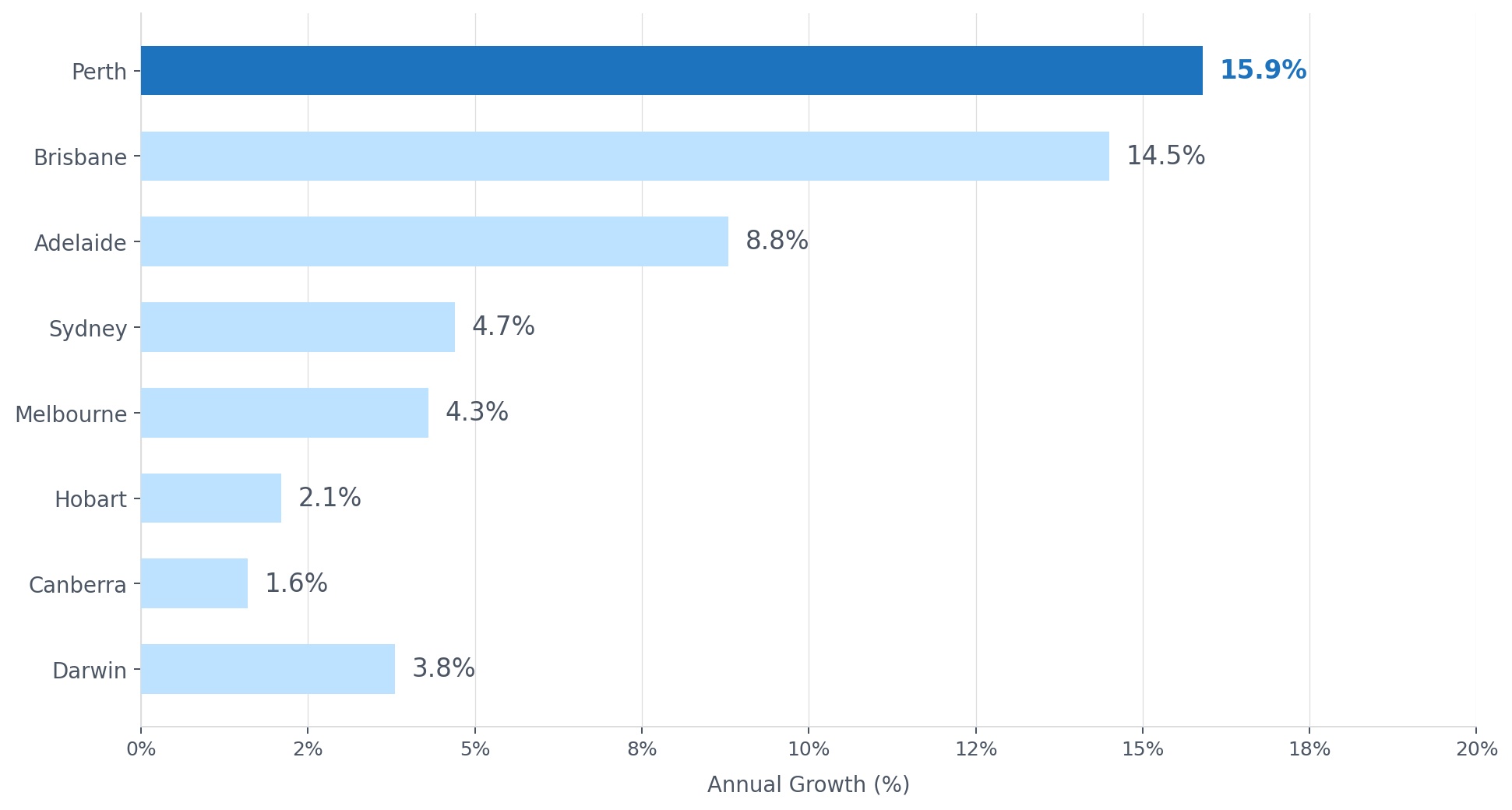
Source: Cotality (CoreLogic) Home Value Index, December 2025
The Demand Drivers That Actually Matter
Migration is the first one. WA net overseas arrivals have stayed elevated well beyond pandemic rebound norms. Combine that with a housing shortage that has been building for years, and the demand pressure isn't cyclical. It's structural.
Defence infrastructure is the second. AUKUS submarine commitments are locking in 8,000 to 10,000 skilled jobs at peak, concentrated around Henderson and the broader southwestern corridor. That employment story doesn't evaporate between election cycles.
The third is something most interstate investors underestimate: Perth hasn't had a genuine new supply response yet. Building approvals rose but labour constraints slowed delivery. The pipeline is filling. It hasn't been resolved.
Best Suburbs to Invest in Perth in 2026
The Yield vs Growth Trade-off Mapped by Suburb
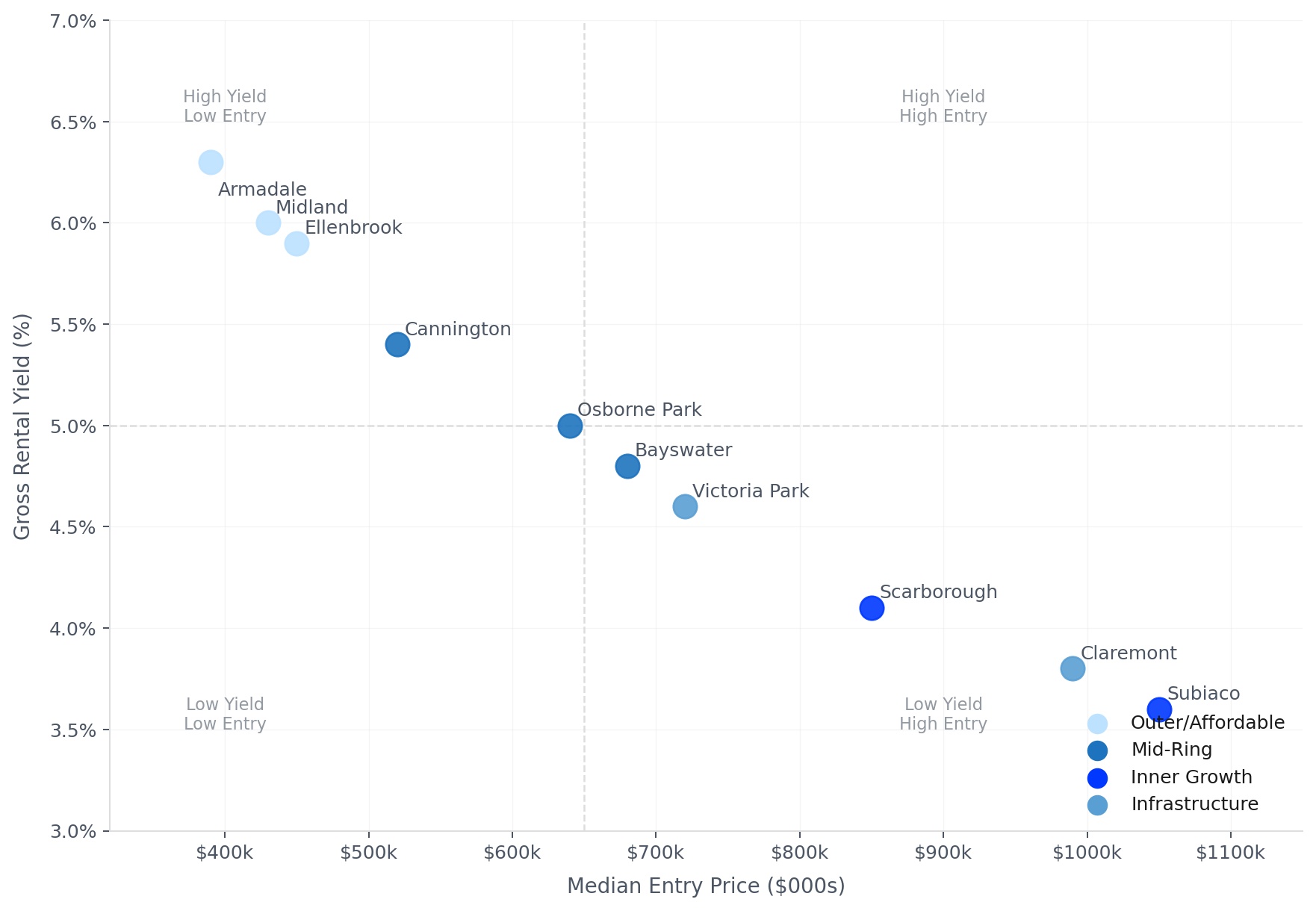
Source: REIWA suburb data, CoreLogic, June 2025
High Growth Suburbs: What's Actually Driving Them
Bayswater and Osborne Park are the clearest mid-ring examples right now. Both sit within 15 kilometres of the CBD, both benefit from the Morley-Ellenbrook rail corridor under construction, and both still have room between current prices and genuine inner-suburb comparables.
Scarborough is a different story. Strong capital growth, yes. But entry at $800,000-plus compresses yields to around 4 percent gross. The case there is capital appreciation over 7-plus years, not income.
These suburbs make sense if you have the borrowing capacity to absorb a neutral or mildly negative cash flow position for several years while growth does the work.
Affordable Entry Under $600k: Where the Structural Case Still Holds
Armadale, Midland and Ellenbrook. These three keep appearing in every affordability-focused analysis for one reason: they each have a genuine catalyst, not just low prices.
Midland has the health campus precinct, which generates sustained employment that doesn't depend on one industry. Ellenbrook got its rail connection. Armadale has the Tonkin Highway extension and active urban renewal investment from the state government.
The gross yields in these areas still hit 6 percent or above. That matters when you're balancing rent yield against capital growth in a higher rate environment.
Infrastructure-Linked Suburbs: Buying the Announcement vs Buying the Delivery
Victoria Park is worth serious attention. Proximity to Optus Stadium and Burswood, relative affordability against inner-south suburbs, and active medium-density rezoning create a specific profile that differs from both the outer ring and the premium inner belt.
The Morley-Ellenbrook corridor has already been partially bid up by investors who bought the announcement. The better entry in corridor suburbs is usually closer to when the crane arrives, not when the press release does.
FOR EXAMPLE
A $430,000 purchase in Midland with a 20% deposit means roughly $344,000 in debt. At a 6.1% gross yield, weekly rent is approximately $505. After management fees, rates, insurance and a modest vacancy allowance, the net yield lands around 4.1 to 4.3%. That's a marginally positive cash flow position at current variable rates — tight, but serviceable.
Perth Rental Yields Explained
Yield Benchmarks by Suburb Type
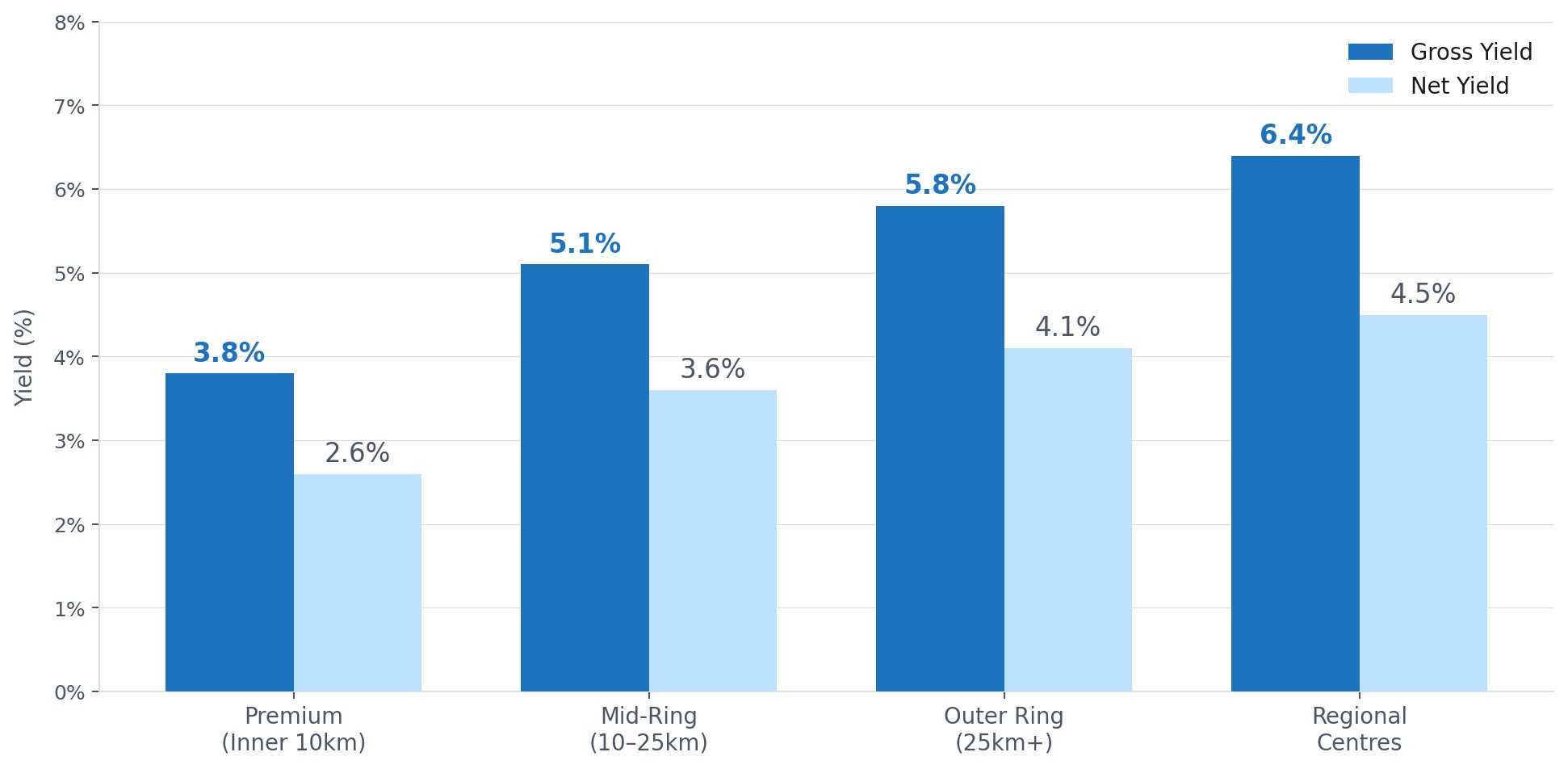
Source: REIWA Market Data, Domain Rental Report Q2 2025
What a 0.35% Vacancy Rate Actually Means
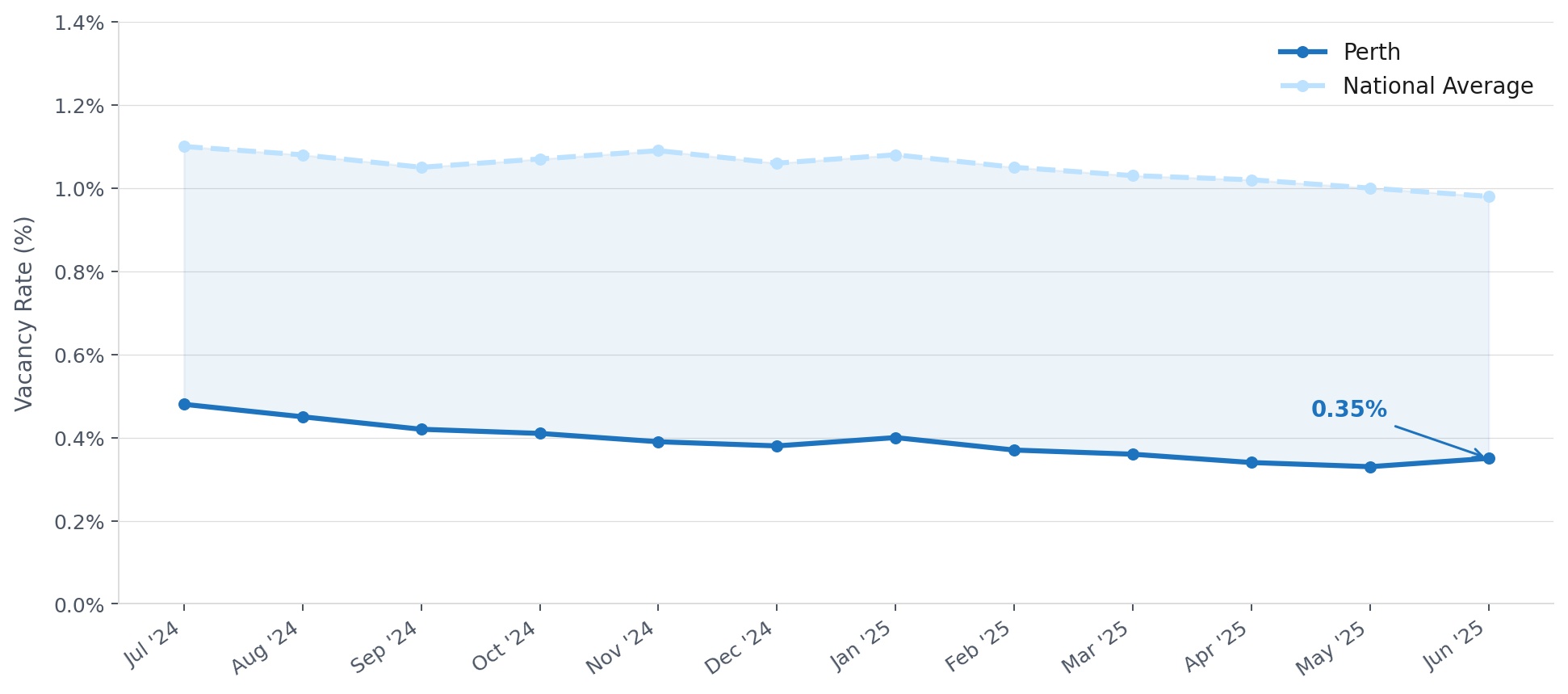
Source: SQM Research Vacancy Rate Data, June 2025
A sub-0.5% vacancy rate changes how you model an investment. Void periods between tenants become close to negligible in practical terms. Rent reviews go up, not sideways. Tenant competition means less negotiation pressure on landlords.
The investors who understand the rental crisis dynamic will see Perth's vacancy story for what it is: a structural floor under rental income that most markets can't offer right now.
The caveat: vacancy rates shift. If WA's construction pipeline accelerates through 2027 and new stock lands in outer ring corridors faster than expected, that floor can move. Model conservatively. Don't assume current vacancy holds forever.
Perth vs Brisbane vs Adelaide: Three Markets, One Decision
Growth Driver Intensity Across Three Markets
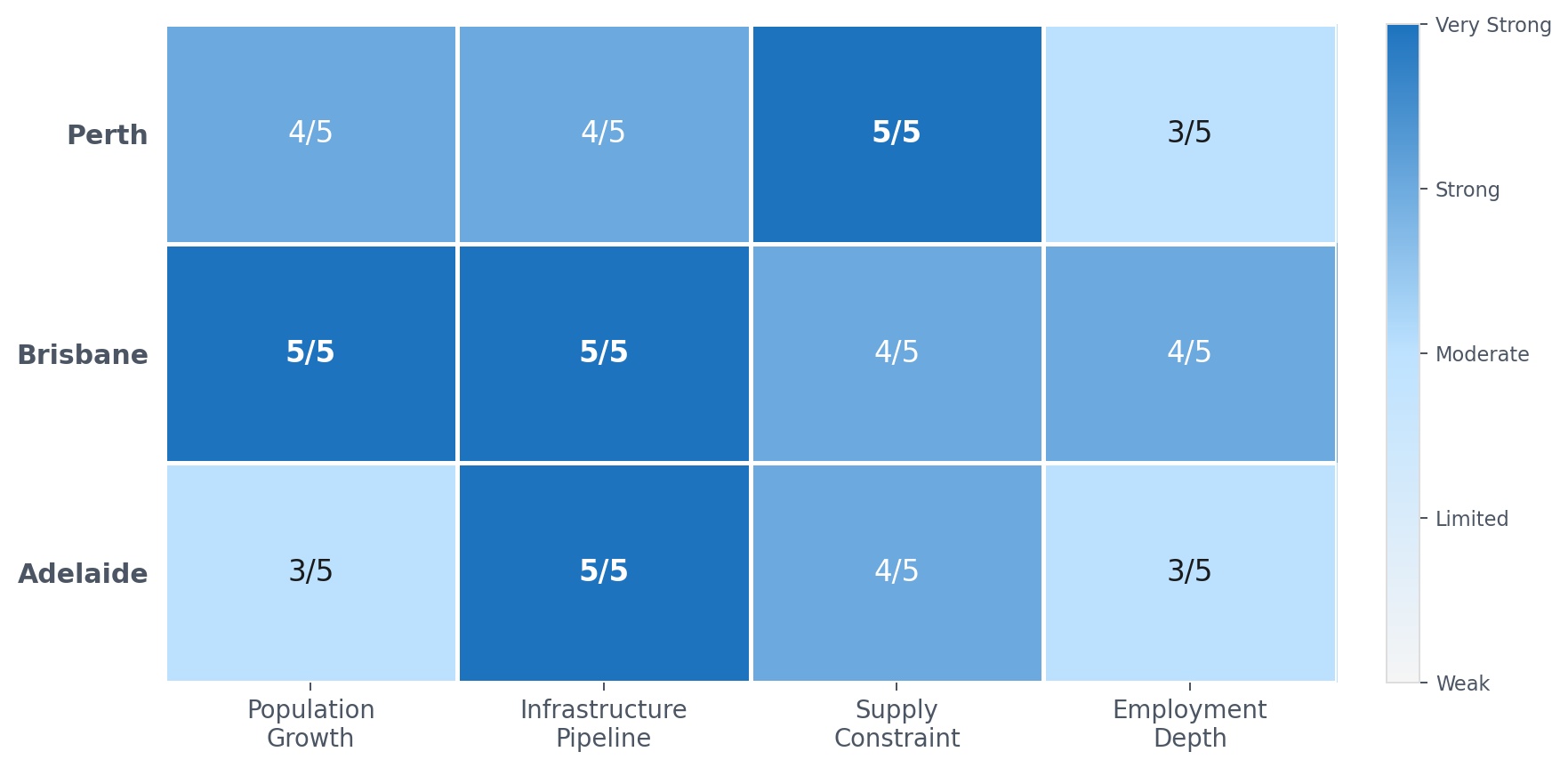
Source: ABS Population Data, Infrastructure Australia Major Project Pipeline, 2025
A full city-by-city comparison is available in the property investors guide to Brisbane, Adelaide and Perth. The short version: Brisbane suits growth buyers with a 7-plus year horizon. Perth suits investors who want the tightest rental market in the country with solid but moderating growth. Adelaide offers value positioning at a lower entry threshold.
These aren't competing arguments for the same investor. They're different investment profiles for different goals.
Understanding how to choose investment grade suburbs in any of these cities depends on having the framework before you pick the location.
Risks in Perth Property Investment 2026
Cycle Position Risk: The Market Isn't What It Was in 2022
This is the most significant risk and the one most investors are not pricing correctly. Perth in 2026 is not Perth in 2022. The easy money has been made. Buying now means entering a market that is already performing, which means paying for expected future growth rather than discounted present value.
That's not automatically a bad trade. But it requires a much cleaner entry. Overpaying by 10 to 15 percent on a suburban asset when the market was growing at 16 percent annually was forgivable. When growth moderates to 6 to 8 percent, that same overpayment takes years to recover from.
Interest Rate Sensitivity
Perth investors carry the same leverage exposure as any property holder in Australia. The RBA rate hike cycle demonstrated that even markets with strong fundamentals are not immune to borrowing cost pressure. Sentiment can cool faster than fundamentals deteriorate.
Anyone entering a $650,000 Perth purchase in 2026 should stress-test against a rate 2 percent above current settings. If the position doesn't work at that level, it's carrying how to increase your borrowing capacity before you overextend at today’s prices.
Supply Pipeline Risk: Real But Not Dominant
WA approvals have lifted. But labour constraints, materials costs and build times have slowed delivery materially. A sudden supply surge is structurally unlikely in the near term.
Where it matters most is outer ring medium-density. If apartment and townhouse completions in affordable corridors cluster in the same 18-month window, localised vacancy can move quickly. Spread that risk by being specific about the asset type, not just the suburb.
FOR EXAMPLE
$650,000 purchase, 20% deposit, 80% LVR: $520,000 in debt. At 6.3% variable, monthly repayments are approximately $3,200. Gross rent on a comparable outer-ring property runs around $550 to $580 per week. After costs, the net position is marginally positive to neutral. A 10% rent softening reduces that buffer to near zero. The investment still works — but only if you're not relying on cash flow to service your lifestyle.
Is Perth Property Still a Good Investment in 2026?
Structurally, yes. Indiscriminately, no. That's the most honest answer available.
The vacancy rate is real. The migration story is real. The infrastructure pipeline is real. The undersupply is real. None of those conditions have reversed.
But the price that those conditions command has already moved. You're not finding a hidden opportunity in 2026 Perth. You're buying into a market that has already been discovered, with known fundamentals and updated pricing. That's a different exercise.
Three Scenarios: What Actually Happens from Here
Scenario one: Growth continues at 8 to 12 percent annually. Plausible if rates ease, migration stays elevated and supply stays constrained. Investors with well-selected assets in infrastructure corridors do well.
Scenario two: Growth moderates to 3 to 6 percent. Probably the base case. The structural supports hold but the tailwind softens. Positive or neutral cash flow positions survive comfortably. Stretched ones get uncomfortable.
Scenario three: Correction of 10 to 15 percent. Low probability given current vacancy and migration, but not zero. Triggered most likely by rate sensitivity or a WA employment shock. Investors with thin buffers face real pressure.
The investors who'll look back at 2026 Perth with satisfaction are the ones who were clear on why banks calculate borrowing capacity differently before locking in a purchase at peak cycle pricing.
Final Thoughts
Perth still deserves serious attention as an investment market. The fundamentals are among the strongest of any capital city in Australia right now.
What changed is the margin for error. In 2022, Perth was forgiving. You could buy broadly and still perform. In 2026, you need a clear thesis: which suburb, which asset type, at what price, for what reason.
If you're thinking about your why borrowing capacity drops when interest rates rise is essential context before committing to a Perth purchase at 2026 prices.
That level of precision is what separates an investment from a bet.
Frequently Asked Questions
Recommended Reading
Two pages selected based on what readers of this article are most likely to need next.
Recommended Video
Most investors are still positioned in capital cities — but in 2026, that allocation gap is creating real opportunity cost. In a market where timing, positioning, and yield profiles compound into long-term outcomes, that disconnect matters more than most people realize.