

RBA Rates Hiked Again: What It Really Costs Property Investors
The RBA rate hike on 29 September 2026 lifted the cash rate to 4.60%, and for property investors it costs more than the extra 0.25% suggests. On its own it adds over $1,000 a year to a typical investment loan, but it is the fourth rise this year, and together they have widened cash flow gaps and cut how much lenders will offer.
The monthly repayment is only the first cost. Two bigger ones sit behind it: how much of the extra interest your rent can cover, and how far your next loan shrinks when a lender tests you at a higher rate.
Below we run the numbers on three loan sizes, one rental and one borrower, then look at when buying, holding or waiting makes sense after this hike.
What the Latest RBA Rate Hike Means for Property Investors
In its 29 September statement, the RBA said inflation is still too high and some of the risks it flagged in August are now happening. Higher global oil prices, strong demand for technology goods and pressure on domestic capacity were all named.
The RBA also pointed to conflict in the Middle East and energy prices that are higher than it assumed in August. It said higher fuel prices have partly flowed through to the prices of other goods and services, and that the Board is focused on making sure high inflation does not become embedded, as SBS reported.
The Board noted that its three earlier rises this year have tightened financial conditions and the economy appears to be slowing. Even so, it judged inflation is still too high and that a further tightening was needed.
This rise follows increases in February, March and May, after the RBA held in June and August. The cash rate is now 1 percentage point higher than it was in January, and it lands on top of the 2026 budget changes to negative gearing.
RBA Cash Rate Target, January 2025 to October 2026
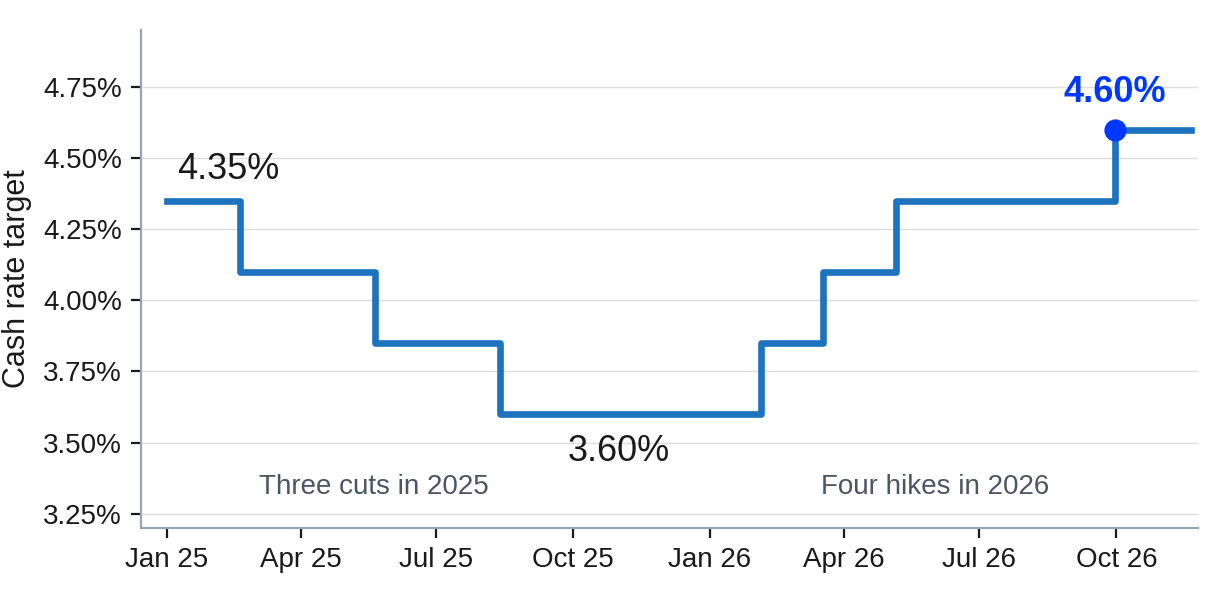
Source: Reserve Bank of Australia, Cash Rate Target, decisions to 29 September 2026.
How the cash rate flows through to investment loan rates
Most lenders pass on a hike to variable rates within a few weeks. Investment loans already sit above owner occupier rates, as our guide to property investment interest rates explains.
Will the RBA raise rates again?
This hike was no surprise. All the major banks and many economists had predicted it, and ANZ expects a fifth rise at the November meeting. The Board said it will raise the cash rate further if needed, and the next decision is on 3 November. HSBC economists told the ABC they expect another rise before the end of the year, and September quarter inflation data due on 28 October will shape that call.
How Much Does an RBA Rate Hike Cost Property Investors?
The table assumes an investor variable rate of 6.60% before this hike and 6.85% after it. Your rate will differ, but the size of the change will be close.
Repayment examples on a $500,000, $700,000 and $900,000 investment loan
FPW Group calculations. Assumes 5.85% before the first 2026 hike and a 30-year principal and interest term.
For comparison, analysis by Canstar found this rise adds roughly $107 a month to repayments on a $700,000 loan at an average variable rate. Our principal and interest figure of $116 is a little higher because investment loan rates usually sit above the average.
Interest only vs principal and interest: who feels it more?
Interest only borrowers feel each hike more. Every dollar of their repayment is interest, so on a $500,000 loan this rise lifts the payment by about 3.8%, compared with about 2.6% on principal and interest.
Extra Monthly Interest on an Interest Only Investment Loan
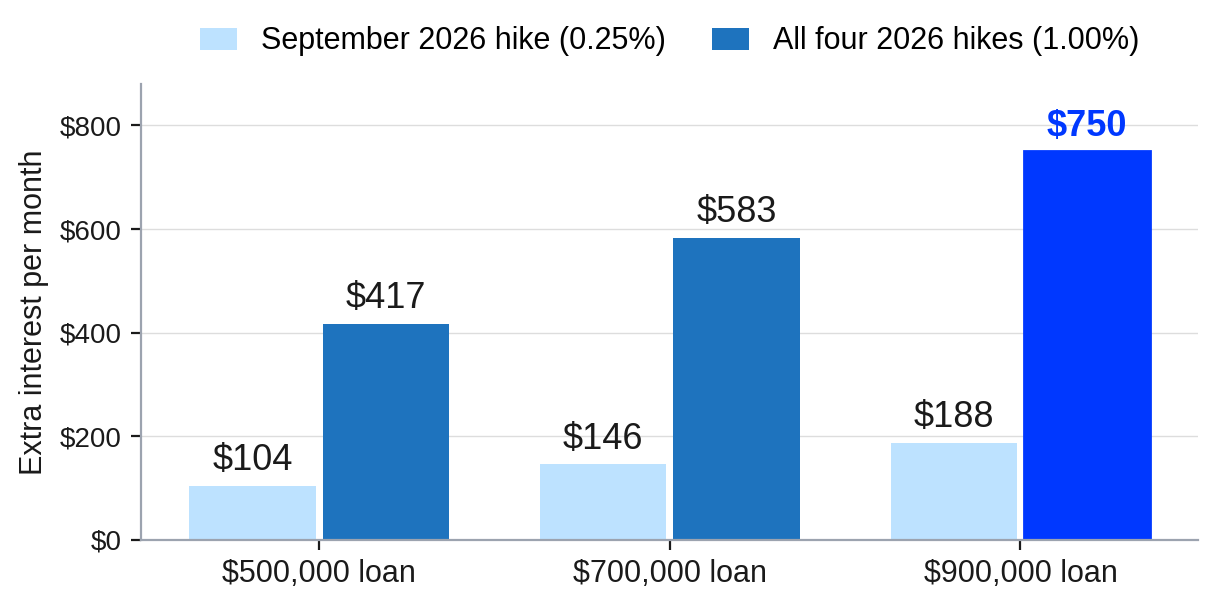
Source: FPW Group calculations based on 2026 RBA cash rate changes, fully passed on.
Variable vs fixed rate loans after a hike
Fixed rate borrowers pay nothing extra until their term ends. But new fixed rates move ahead of the RBA, so fixing now usually locks in a rate that already assumes more hikes.

How a Rate Hike Affects Your Cash Flow and Rental Yield
Rents are rising, but not fast enough to cover this year's rate rises on a geared property. Cotality reported national rents up 5.7% over the year to August 2026, and the national gross rental yield reached 3.79%, the highest since September 2019.
Gross yield is yearly rent divided by the property's value, before costs. It still sits well below most investment loan rates, so the gap between rent and repayments has widened again.
Annual Cash Flow on a $750,000 Investment Property After the 2026 Hikes
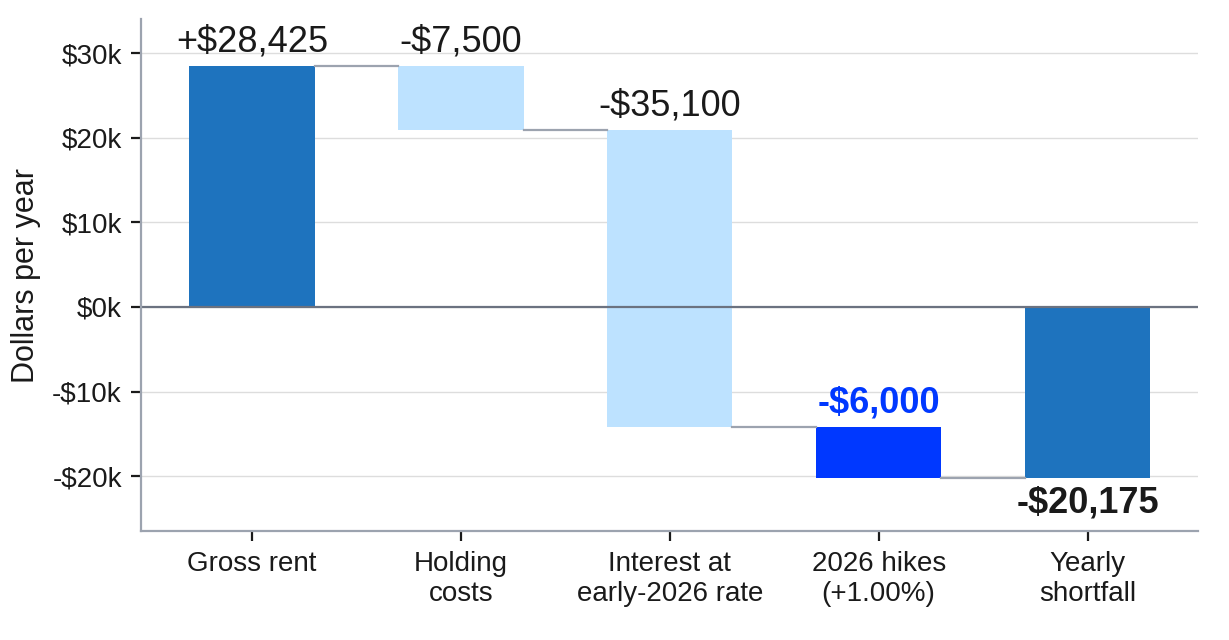
Source: FPW Group example using the national gross yield from the Cotality Home Value Index, September 2026. Costs and rates are assumptions.
What happens to negative gearing when rates rise?
Negative gearing means a rental loss can reduce tax on your other income. For properties held before 7:30pm AEST on 12 May 2026 that still applies, so at a 39% tax rate the shortfall above costs about $12,300 after tax.
For established properties bought after that time, the ATO confirms losses can no longer reduce wage income from 1 July 2027. Every rate rise then hits at its full pre-tax cost, as our guide to negative gearing rules explains.
Does an RBA Rate Hike Reduce Your Borrowing Capacity?
Yes. Your borrowing capacity is the most a lender will let you borrow, and it falls with every hike because lenders test your loan at a higher rate than you pay.
How lenders reassess you after a hike
The serviceability buffer is an extra 3 percentage points lenders add to your loan rate when they test whether you can repay. APRA has kept it at 3 points, so a 6.85% loan is now tested at 9.85%. This is why borrowing capacity drops when interest rates rise, even if your income has not changed.
A worked example of lost borrowing power
Take a borrower with $4,200 a month left for a new loan after living costs and other debts, tested on a 30 year principal and interest loan.
Maximum Loan on the Same Monthly Surplus as Rates Rise
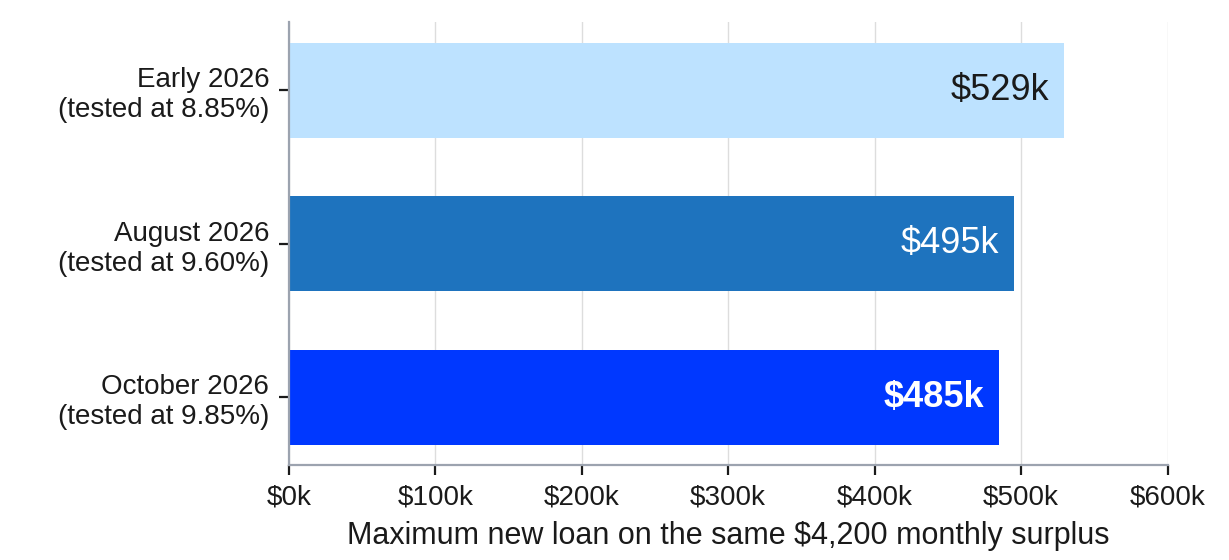
Source: FPW Group calculations using the 3 point buffer confirmed by APRA, May 2026. Loan rates assumed at 5.85%, 6.60% and 6.85%.
Canstar reached a similar result. Its analysis found borrowing power for an average wage earner drops by about $11,200 after this hike.
Ways to protect your borrowing capacity
Closing unused credit limits, lowering living costs and adding documented income all help, as our guide on how to increase borrowing capacity shows. It also helps to know how interest rate buffers reduce borrowing power.

Will Property Prices Fall After an RBA Rate Hike?
Prices were already falling before this hike. Cotality found national home values fell 0.9% in August, the fifth monthly fall in a row, and 93% of capital city suburbs lost value over winter.
Not everyone backed the decision. The Australian Council of Social Service (ACOSS) cautioned against raising rates, and CEO Cassandra Goldie said an increase "would be creating unemployment by design". For investors, a weaker job market matters because it can make it harder for some tenants to keep up with rent.
Higher rates cut what buyers can borrow, which usually slows prices, though how interest rates affect house prices varies by market. In the 2022 to 2023 cycle, values fell for several months, then recovered while rates were still rising.
Rental demand is holding up better. The Cotality chart pack shows yields rising as values fall, and markets with low rental vacancy rates tend to protect income best when rates rise.
Should Property Investors Buy, Hold or Wait After a Rate Hike?
There is no single right move. It depends on your cash buffer, your borrowing room and whether the new tax rules apply.
When buying, holding or waiting makes sense
Buying can still work if you can cover the shortfall at a rate 0.50% higher than today, in a market with strong rental demand.
Holding often suits properties bought before 12 May 2026, which keep the tax benefit, since selling in a falling market locks in lower prices.
Waiting is reasonable if buying would drop your cash buffer below six months of shortfall, or your borrowing capacity now only just reaches the price you need.
A simple checklist before you decide
These questions sit at the centre of property investment in Australia right now, and a strategy session on your investment property can test a specific deal against them.
How to Protect Your Cash Flow When Interest Rates Rise
You cannot control the cash rate, but you can control how exposed you are to it.
Compare your rate with new customer rates, and consider whether to refinance your investment property.
Build a cash buffer in an offset account, which cuts interest without locking the money into the loan.
Check your debt to income ratio, which is total debt divided by gross yearly income, using a debt to income ratio calculator.
Talk to a broker before your next move about how mortgage serviceability will be tested at today's rate.
Final Thoughts
This RBA rate hike is small on its own, but it completes a full percentage point of rises in 2026. For property investors, that means higher repayments, a wider cash flow gap and less room to borrow, all at a time when prices are softening and new tax rules apply to established purchases.
Rising rents and higher yields are helping, but they are not yet covering the extra interest on a typical geared property. The investors who come through this cycle well will be the ones who know their numbers at a higher rate, keep a real cash buffer and check their loan before the next decision.
Frequently Asked Questions

Recommended Reading
Two pages selected based on what readers of this article are most likely to need next.
Recommended Video
As rates rise, many people immediately assume it is no longer a good time to invest. But in reality, the opportunity has not disappeared—it has simply shifted. This episode explains why higher interest rates do not automatically remove your ability to invest, but they do change your borrowing power, your cash flow, and the price point that makes sense for you.