

Interest Only Home Loan: Can It Shrink Your Next Purchase?

An interest only home loan can shrink your next property purchase, even though it lowers your repayments today. Lenders judge your existing loan by the bigger repayment it will need later, not the smaller one you pay now, so the cash you save does not turn into extra borrowing power.
That gap has become harder to ignore since the Reserve Bank lifted the cash rate to 4.60% on 29 September 2026. Every rate rise changes how lenders test mortgage serviceability, and an interest only structure changes that test in a way most investors never see on their loan statement.
Below, we run the numbers on two investors with the same loan and income. By year three, one has more cash and the other can borrow more, and the gap is bigger than most expect.
What Is an Interest Only Home Loan and How Does It Work?
How interest only repayments work
With an interest only home loan, each repayment covers only the interest charged that month. None of it reduces the amount you borrowed, so the balance stays the same until the period ends.
Moneysmart uses five years as an example of an interest only period. It also warns that the interest rate can be higher than on a principal and interest loan, while noting that investors may be able to claim higher tax deductions.
What happens when the interest only period ends?
When the interest only period ends, the loan switches to principal and interest. The full balance now has to be cleared over fewer years, so the new repayment is higher than if you had paid principal from day one.
Take a $600,000 investment loan at 6.8% over 30 years. Interest only repayments are about $3,400 a month, and principal and interest from the start would be about $3,912. After five years of interest only, the repayment rises to about $4,164.
Monthly Repayments: Interest Only First vs Principal and Interest
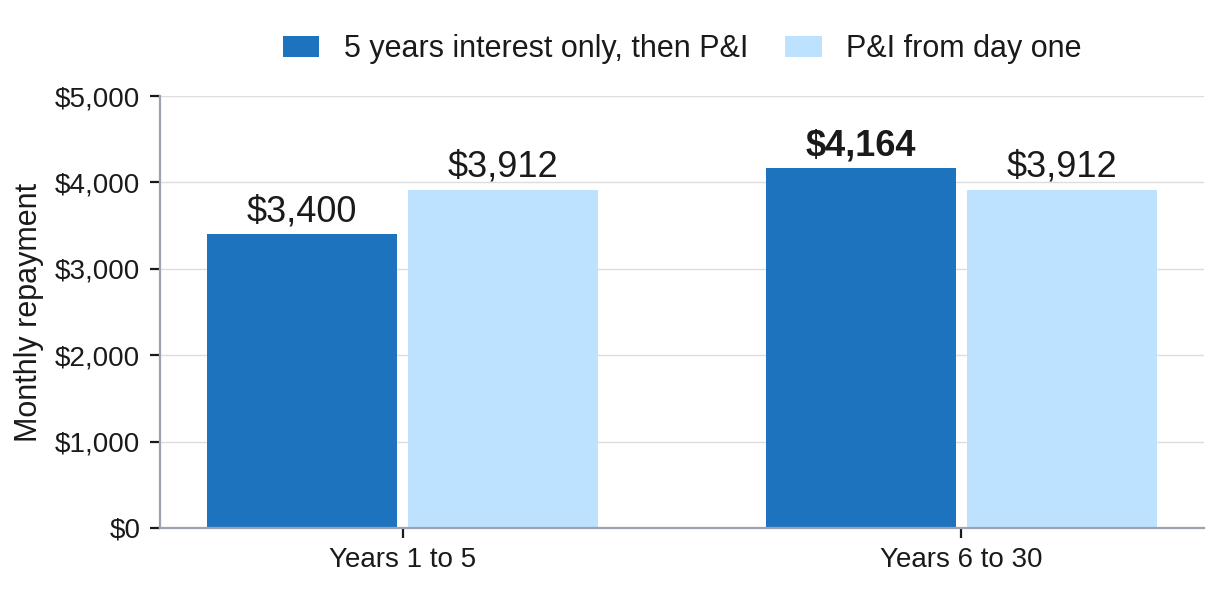
Source: FPW Group calculations, September 2026, via the Moneysmart interest-only mortgage calculator
Why Lower Repayments Do Not Always Mean More Borrowing Power
Cash flow and borrowing capacity are not the same thing
Cash flow is the money left in your account each month. Borrowing capacity is what a lender works out you could safely repay on a new loan, using its own borrowing capacity formula for your income, expenses and debts.
The two usually move together, so many investors assume a smaller repayment will help their next application. With interest only, they can move in opposite directions.
How lenders assess an interest only loan
APRA's residential mortgage lending guide (APG 223) tells banks to test interest only loans on a principal and interest basis, over only the years when those repayments apply. The interest only years are left out of the calculation.
The Reserve Bank calls this the residual-term method, and it states the result plainly: interest only borrowers get a lower maximum loan size. That comes on top of the test rate, which is how interest rate buffers reduce borrowing power for every borrower.
What You Pay vs What the Lender Assesses in Year Three
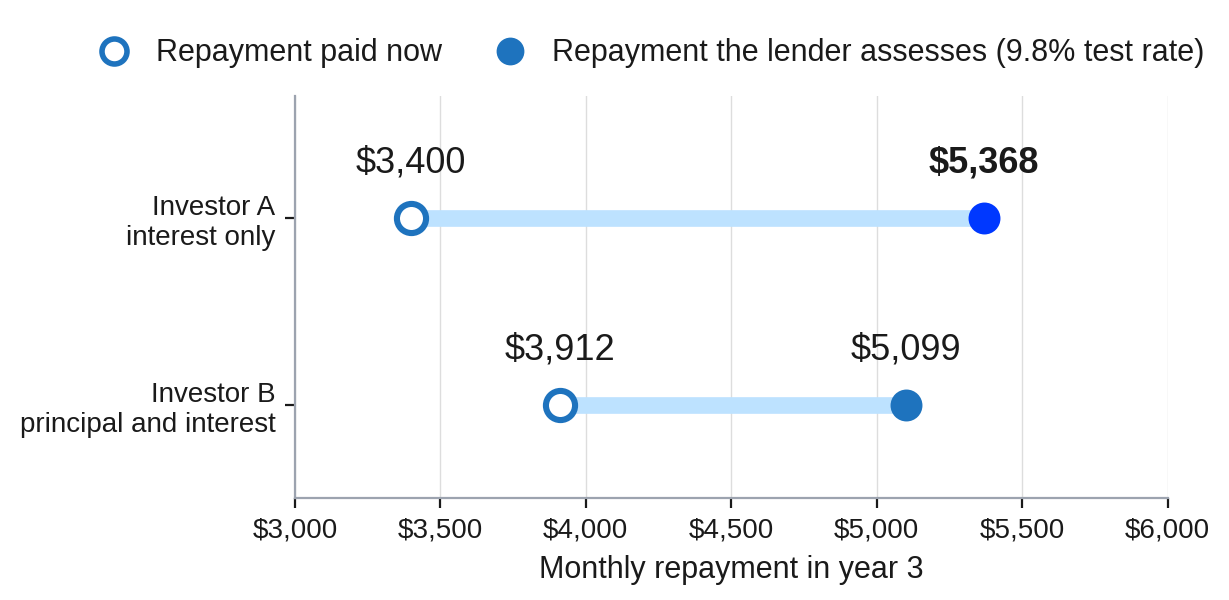
Source: FPW Group calculations, September 2026, based on APRA APG 223

How an Interest Only Loan Can Affect Your Next Property Purchase
Your existing debt does not shrink
Principal and interest repayments chip away at the balance. After three years on our $600,000 example, that borrower owes about $579,600, while an interest only borrower still owes $600,000.
That $20,400 difference also pushes up your debt-to-income ratio, a number lenders now watch closely. It is small at first, but it grows while the loan stays interest only.
Loan Balance Over 30 Years: Interest Only First vs Principal and Interest
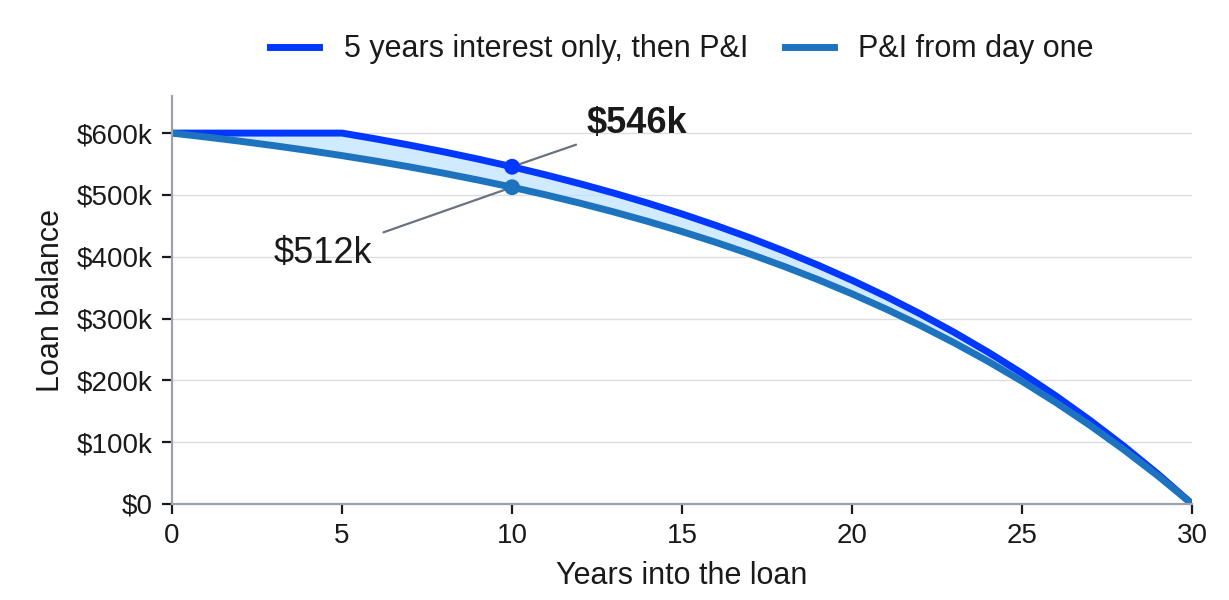
Source: FPW Group calculations, September 2026, via the Moneysmart mortgage calculator
The remaining loan term changes the math
The residual-term rule means the clock matters. A principal and interest loan that is three years old is assessed over its remaining 27 years, but an interest only loan with two years of interest only left is still assessed over just 25 years.
Fewer years plus a bigger balance means a higher assessed repayment. This is central to how lenders assess borrowing capacity, and it is one reason banks calculate borrowing capacity differently for two people who earn the same.
Rising rates make the gap wider
The cash rate has risen four times in 2026, and APRA confirmed on 28 May 2026 that its serviceability buffer stays at 3 percentage points, with its limit on high debt-to-income lending also unchanged.
At a 6.8% loan rate, your debts are tested at about 9.8%, and that test rate sits at the heart of borrowing capacity in Australia. Every rise lifts every assessed repayment, which is why borrowing capacity drops when interest rates rise, and the shorter assessment term on an interest only loan makes that rise bite harder.

Worked Example: Two Investors Trying to Buy Property Number Two
Investor A and Investor B each borrowed $600,000 for their first investment property at 6.8% over 30 years. They earn the same income and have the same expenses. Investor A chose five years of interest only, and Investor B chose principal and interest.
Three years later, both apply for a second loan. This is how a lender using the residual-term method and a 3% buffer would see them.
Investor A has about $18,400 more in savings for a deposit or buying costs. But the lender treats Investor A's loan as costing $269 more each month, which removes roughly $31,000 from the next loan.
Neither investor is simply ahead. Investor A has more cash and less borrowing power, while Investor B has less cash and a cleaner serviceability position.
Which matters more depends on whether the deposit or the loan size is holding you back. Borrowing right up to your maximum borrowing capacity carries its own risks too, so a lower limit is not always a loss.
Interest Only vs Principal and Interest for Property Investors
Neither structure wins for everyone. Here is how they compare when you plan to keep buying.
Total Cost Over 30 Years on a $600,000 Loan
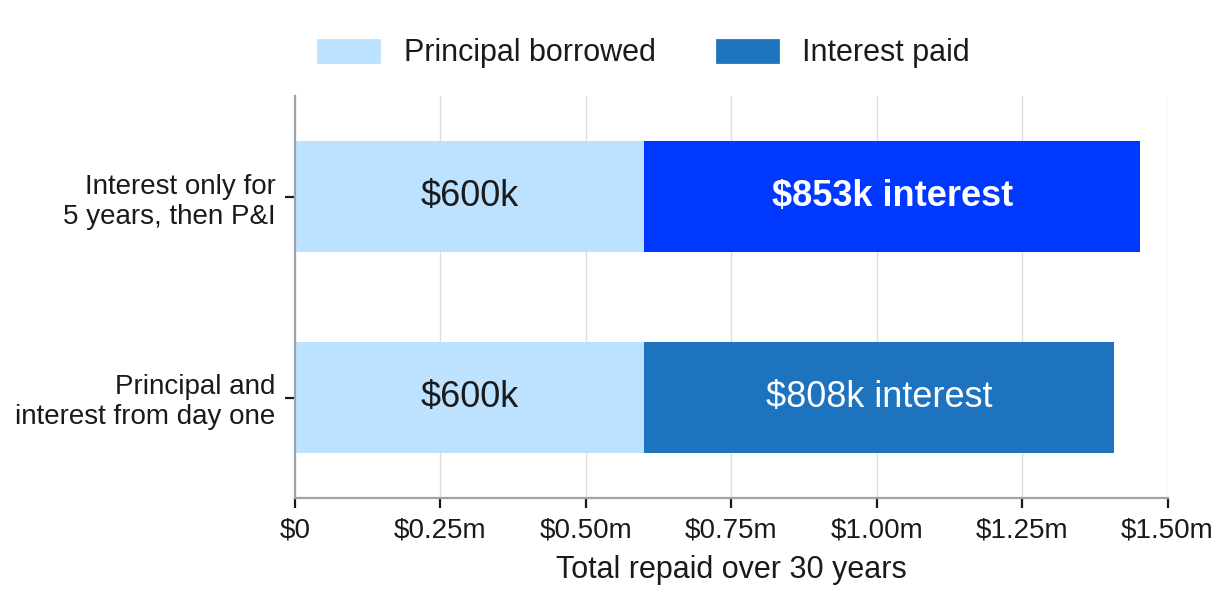
Source: FPW Group calculations, September 2026; Westpac interest only guidance
When an interest only home loan may make sense
You need extra cash flow for a set period, such as during a renovation.
You want spare cash sitting in an offset account while you save for the next deposit.
You have a clear plan for the savings, such as paying down your own home loan first.
Your next purchase is held back by the deposit, not by how much a lender will approve.
When interest only can work against your strategy
You would need to keep refinancing or extending the interest only period to afford the loan.
Your budget could not handle the higher repayment when the interest only period ends.
Your next purchase is limited by loan size, and every dollar of borrowing power counts.
You bought an established property after Budget night on 12 May 2026. The ATO confirms negative gearing will be limited to new builds from 1 July 2027 for those purchases, which weakens the tax case for interest only, and our guide to negative gearing rules explains more.

What to Check Before You Choose an Interest Only Home Loan
Run these checks before you sign, and again before your next application.
Your repayment after the switch, at today's rate and 3 percentage points higher.
Your borrowing capacity with and without interest only on each loan you hold.
Your outstanding balance and how many years of principal and interest are left.
What your next purchase needs: deposit, buying costs and loan size.
How each lender treats interest only loans, because rules and test rates differ between banks.
Our investment property loan approval checklist covers the paperwork side, and our guide on how to increase borrowing capacity shows other levers you can pull. An experienced mortgage broker can model both loan structures across several lenders before you commit.
Final Thoughts
An interest only home loan is not good or bad on its own. It is a trade: lower repayments now, in exchange for a higher balance, a bigger repayment later and, very often, less borrowing power for your next purchase.
With the cash rate at 4.60% and a 3-percentage point buffer on top, that trade is sharper than it was a few years ago. Small monthly savings can quietly become tens of thousands of dollars less at your next application.
For an investor planning a second or third property, the useful question is not how low your repayment can go. It is whether your loan structure supports the purchase you want to make next.
Frequently Asked Questions

Recommended Reading
Two pages selected based on what readers of this article are most likely to need next.
Recommended Video
While many investors spend time researching growth areas and property types, this discussion highlights a different reality—your ability to continue investing is often determined not by what you buy, but by how your loans are structured and how your borrowing power is managed over time.