

Perth Investment Property: Best Suburbs to Buy Before the Next Price Jump
Perth is still one of the most credible investment markets in Australia right now. But which suburbs you buy has never mattered more.
The city's median dwelling value reached $1,050,354 as of May 2026 (Cotality), up 25.8% over the year. That is the fastest annual growth of any Australian capital. The fundamentals behind it, WA population growth of 2.4% per year, rental vacancy pinned near 0.5%, and a METRONET rail network now largely complete, are still structurally intact.
Blanket buying worked for the last three years. From here, Perth real estate rewards investors who understand which suburbs still carry structural upside, and which have already run most of it.
For a city-level comparison, see how Brisbane, Adelaide, and Perth are tracking for investors in 2026.
Is Perth Still Worth Buying Into in 2026?
Three years of double-digit growth makes investors nervous. That is a reasonable response. But context matters a lot here.
Perth's median house price now ranges from around $845,000 to $1.05 million depending on the data source and timing. It has crossed above Melbourne on Cotality's combined dwelling data. Yet income-adjusted affordability still favours Perth because WA wages track resources sector conditions rather than the constrained employment dynamics that shape Sydney.
Median Dwelling Value by Australian Capital City — May 2026
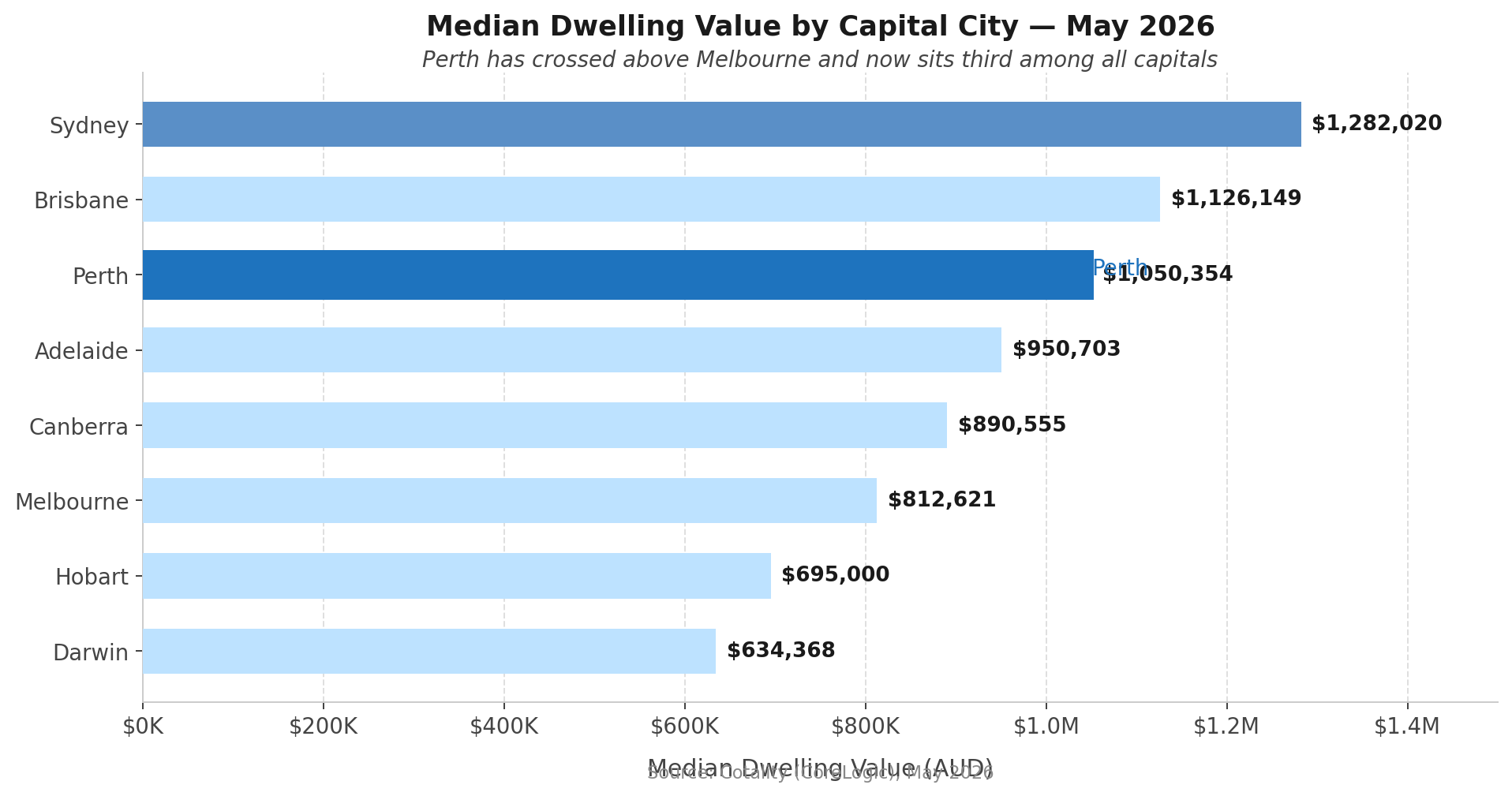
Source: Cotality (CoreLogic), May 2026.
REIWA forecasts more than 10% house price growth through 2026 and 15 to 20% unit growth. The supply deficit has not closed. Rental vacancy across the Perth metro sits at 0.5% to 0.7%, which is objectively critical.
What Has Driven Perth Prices So Far
Population growth is the first and most persistent driver. WA is growing at 2.4% per year, the fastest of any Australian state. Overseas and interstate migration continues flowing into Perth, pulled by the resources sector and by relative affordability that the east coast can no longer offer.
METRONET is the second. Perth's $5+ billion rail expansion has fundamentally reshaped accessibility across the metro. Suburbs that were poorly connected five years ago are now genuinely commutable, and that repricing is still working through the market in outer corridors. You can see this dynamic in detail in our overview of the Perth investment property market.
Annual Dwelling Price Growth by Capital City — Year to May 2026
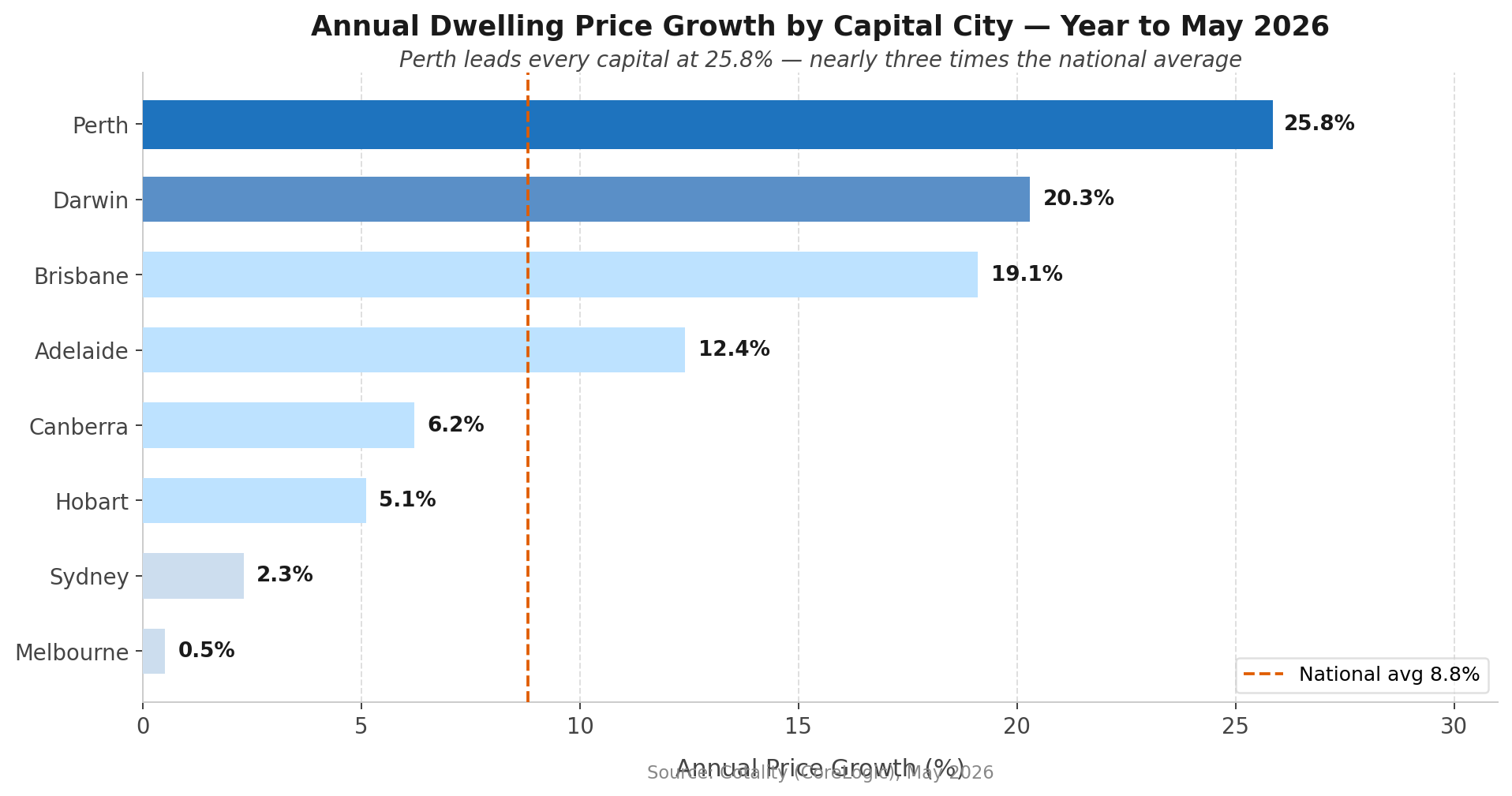
Source: Cotality (CoreLogic), May 2026.
Is It Already Too Late to Buy?
Parts of the market have run hard. Riverton at $1.23 million and Spearwood at $870,000 have already captured a significant portion of near-term upside. That doesn't mean they're bad investments. It means the risk-adjusted return from here is different to buying at those prices three years ago.
Armadale at $605,500 and Midland at $636,000 still offer structurally credible entry points relative to their current infrastructure profile. The investors who overpay in Perth in 2026 will not necessarily lose money. They will likely see slower growth and weaker cash flow than investors who buy with sharper fundamentals.
How We Assessed These Perth Suburbs
Each suburb was assessed across six metrics: median price, gross rental yield, 12-month growth, vacancy rate, infrastructure access, and employment diversity.
A suburb that delivers a strong yield but depends on one employer is a fundamentally different risk profile to one with diversified tenant demand across health, education, retail, and government jobs. We have separated capital growth picks from yield-focused picks below because they genuinely serve different investor goals.
Best Perth Suburbs for Capital Growth
Perth Investment Suburb Comparison — Key Metrics 2026
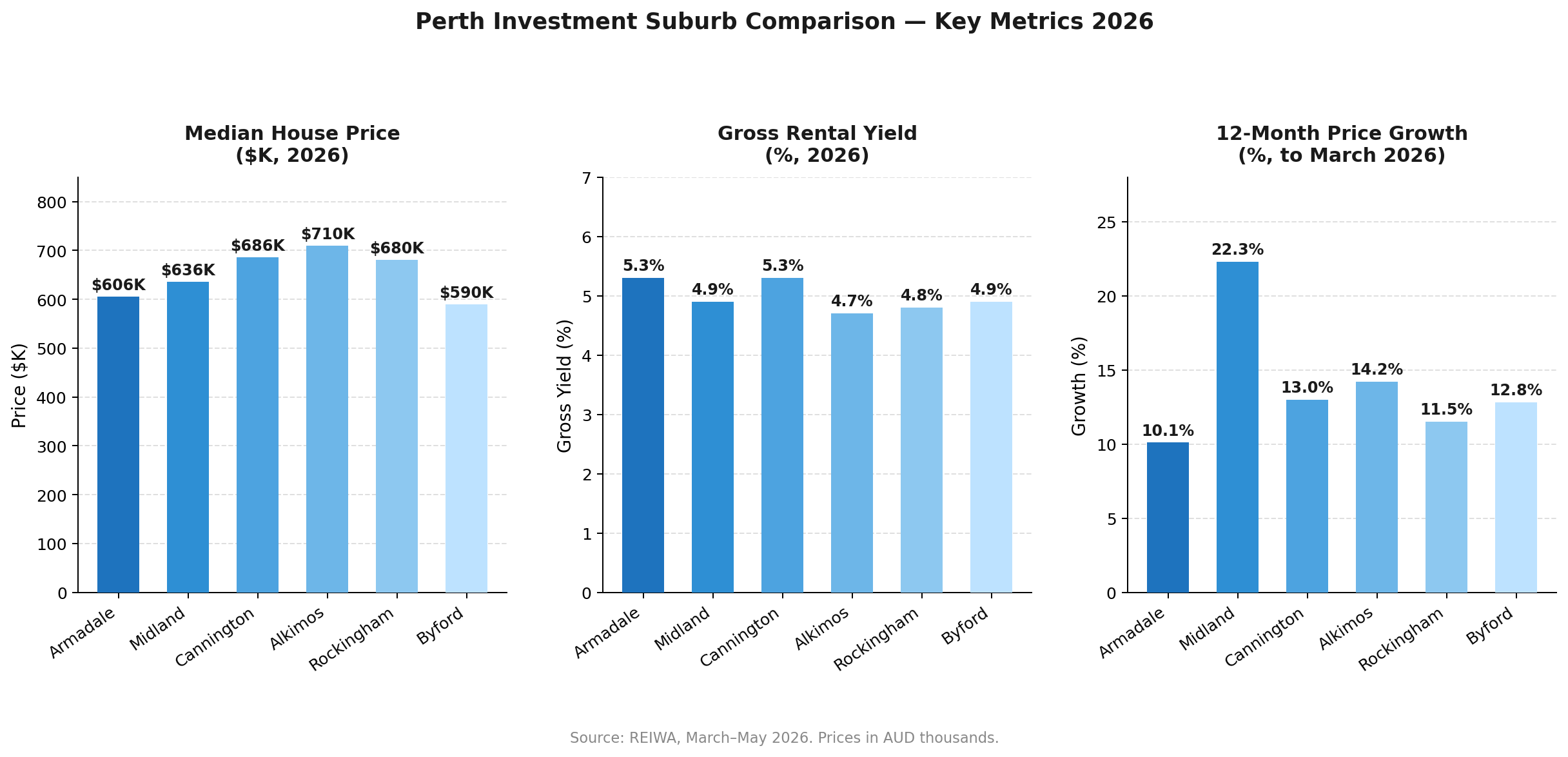
Source: REIWA, March–May 2026. Prices in AUD thousands.
Perth Investment Suburb Data — 2026
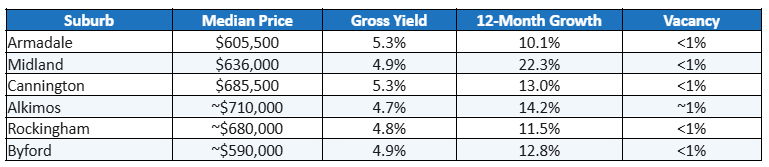
Source: REIWA, March–May 2026. All prices in AUD.
Armadale
Armadale sits at a $605,500 median with a 5.3% gross yield and 10.1% annual growth to March 2026 (REIWA). The new elevated Armadale Station, completed in October 2025 as part of the Byford Rail Extension, removed nine level crossings and extended cross-city rail access significantly.
The structural argument is straightforward: Armadale remains undervalued relative to its infrastructure profile. The risk is neighbourhood perception, which changes more slowly than infrastructure does. Investors with a 7 to 10 year horizon have historically outperformed short-term buyers in this type of suburb.
Midland
Midland recorded 22.3% annual growth to March 2026 while maintaining a $636,000 median and 4.9% gross yield (REIWA). The final METRONET station here opened in February 2026, adding an 800-bay multi-storey car park and direct pedestrian access to the Midland Health Campus.
Healthcare and government employment make Midland's rental demand less cyclical than mining-adjacent suburbs. At under $650,000, it remains one of the last sub-$650K options in Perth metro with this quality of infrastructure access.
Alkimos
Alkimos is the northern corridor play. Priced around $710,000 and yielding approximately 4.7%, it benefits from coastal lifestyle demand and the completed Yanchep rail extension. Owner-occupier demand here is consistently strong, which creates a floor under values. That's structurally different to investment suburbs that depend predominantly on renters.
For a deeper comparison of how Perth rental yields stack up against Brisbane, see our analysis of Brisbane vs Perth gross rental yields for 2026.
Best Perth Suburbs for Rental Yield
Rental Vacancy Rate — Perth vs Other Markets, 2026
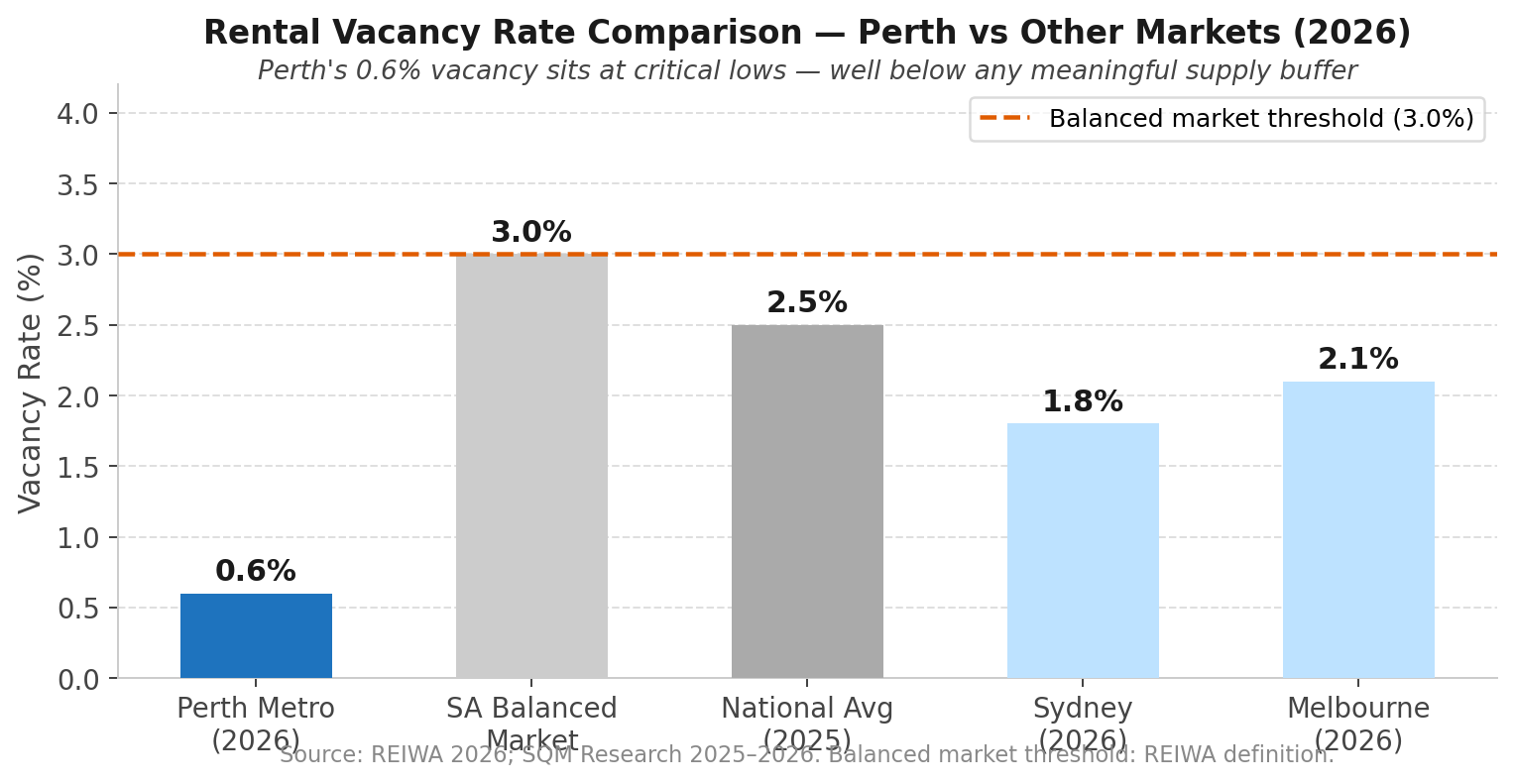
Source: REIWA 2026; SQM Research 2025–2026. Balanced market threshold: REIWA definition.
Perth's vacancy rate of 0.5% to 0.7% is not just tight. It is structurally tight, meaning it reflects a long-running supply deficit, not a short-term seasonal dip. Investors should understand what makes a good investment property in a market like this, where vacancy protection is real but yield compression is also real as prices rise faster than rents.
Cannington
Cannington topped REIWA's rental yield ranking for Perth houses in 2025 and into 2026, sitting at 5.3% gross yield on a $685,500 median with a weekly rent of approximately $700. It is 12 kilometres from the CBD, which makes tenant demand structural rather than location-dependent.
Gosnells and Maddington
The southeast corridor delivers the highest yields in the Perth metro. Gosnells and Maddington sit between 5.2% and 5.6% gross yield on entry prices still in the $500,000 to $650,000 range.
The trade-off is slower capital growth relative to METRONET-anchored suburbs further north. For investors who need portfolio cash flow to service debt or fund future purchases, understanding the interplay of yield vs growth in a balanced property portfolio is essential before committing.
Rockingham
Rockingham offers coastal lifestyle demand at yields between 4.5% and 5.1% and an entry price under $700,000. It consistently draws tenants from the Kwinana industrial corridor, which provides employment diversity that supports long-term vacancy control.
The southern coastal lifestyle premium is real. Rockingham attracts both owner-occupiers and renters in a way that insulates it from the single-employer risk you see in purely industrial suburbs.
Affordable Entry Points and Emerging Areas
Byford
Byford sits at the southern end of the Armadale rail corridor, meaning it directly benefits from the October 2025 METRONET upgrade. Priced below $600,000 with yields around 4.9%, it is a genuine emerging market rather than an already-run suburb. Growth has been driven by family demand and affordability migration from closer-in suburbs.
Yanchep
Yanchep offers some of the strongest yields in Perth's northern growth corridors at 4.5% to 5.1%, combined with coastal lifestyle appeal and the now-complete Yanchep rail connection. The northern coastal position means long-term demand from Perth's population growth pattern favours it structurally.
If you are also comparing Perth to other markets for affordability-focused buying, our guide to the best investment suburbs in Australia under $500,000 gives a national-level comparison.
House vs Unit: What Works Better in Perth?
REIWA forecasts unit prices to grow 15 to 20% in 2026, faster than houses, largely because buyers priced out of the house-and-land market are moving into the attached dwelling segment. That is a meaningful data point but it does not make units automatically better investments.
Houses in established Perth suburbs retain land value, which is what ultimately drives capital growth over 10 to 20 years. Units in high-demand inner suburbs, such as Wembley where the median sits around $420,000, can deliver yield and affordability. But you need to check body corporate fees, the supply pipeline in that precinct, and strata history before committing. Perth still carries localised apartment oversupply risks in specific corridors.
For first-time investors, a house in an outer-ring suburb with clean title, low strata exposure, and strong tenant demand frequently outperforms a unit in a more expensive inner suburb on total return over a 10-year hold. See our guide to common property investment mistakes first-time investors make before you decide.
What Could Slow Perth Down
Affordability Constraints
Perth's price-to-income ratio has risen from 5.8x in 2023 to 6.4x by late 2025. That is still well below Sydney's 11x, but the gap is closing. If incomes do not keep pace with further price growth, first-home buyer demand, which accounts for 36% of new WA loan volumes, will plateau.
Borrowing Capacity Pressure
Rising property prices interact directly with borrowing capacity. Higher purchase prices require larger deposits and larger loans, meaning more investors are hitting serviceability limits before they can transact. The speed of recent price growth has compressed the borrowing runway faster than most investors anticipated three years ago.
Understanding how your debt-to-income ratio shapes your purchase ceiling matters enormously before you commit to a price point in the current Perth market.
Commodity Cycle Risk
Perth is more exposed to commodity sector volatility than any other Australian capital. When iron ore or lithium prices turn, the impact flows through to employment, migration patterns, and rental demand faster here than in a diversified economy. The current commodity cycle looks supportive. But concentration risk should sit in every Perth investor's framework.
Supply Response
Building approvals in WA are rising in response to price signals. New housing supply typically hits the market 18 to 24 months after approval. Investors in outer-ring greenfield corridors should monitor supply pipelines closely because a surge of new stock in a localised precinct can stall rental growth and slow capital appreciation faster than inner-ring established suburbs.
How to Match Perth Suburbs to Your Strategy
If your priority is capital growth, suburbs like Midland, Alkimos, and Armadale offer infrastructure-backed upside at credible entry points. If your priority is yield and cash flow, the southeast corridor (Cannington, Gosnells) and the southern coastal suburbs (Rockingham, Byford) deliver the highest gross yields in the Perth metro, consistently above 5%. See our guide to which suburbs have the strongest capital growth across Australia to benchmark Perth against other cities.
If you are working with borrowing capacity constraints, the size of the loan, not just the suburb, shapes how much portfolio headroom you carry into your next purchase. Buying at $600,000 versus $1,000,000 has materially different implications for your ability to increase borrowing capacity and fund a second or third property.
And if you already hold a Perth property, understanding when and how to refinance your investment property can unlock the equity you need to scale further without needing fresh deposit capital.
Frequently Asked Questions
Recommended Reading
Two pages selected based on what readers of this article are most likely to need next.
Recommended Video
Most investors are still positioned in capital cities — but in 2026, that allocation gap is creating real opportunity cost. In a market where timing, positioning, and yield profiles compound into long-term outcomes, that disconnect matters more than most people realize.